
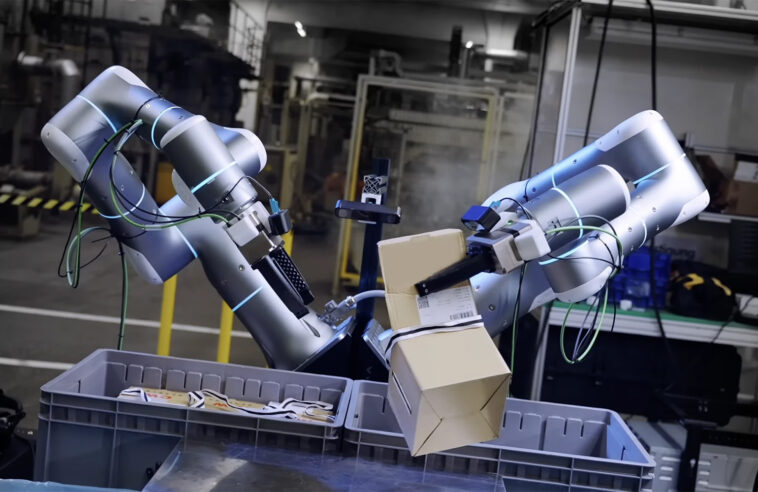
Rhoda AI offers a Direct Video-Action Model that reformulates robot policies as video generation. | Source: Rhoda AI
Rhoda AI has emerged from stealth with $450 million in Series A funding. The company also unveiled FutureVision, an approach to robotic intelligence that is based on video-predictive control.

“We believe the next era of robotics requires models that understand how the world moves — not just what it looks like or how it’s described in language,” said Jagdeep Singh, cofounder and CEO of Rhoda. “By learning from internet-scale video and operating in closed loop, our systems are designed to adapt to real-world variability in ways conventional approaches struggle to achieve. The goal is simple: robots that work in the real world, not just controlled lab settings.”
Traditional industrial robots perform well in structured environments but remain largely limited to pre-programmed trajectories. More recent AI approaches, particularly vision-language-action (VLA) models, allow robots to learn from data. These have demonstrated impressive results in laboratory settings.
However, Rhoda said many still struggle to cope with the variability of the real world, including shifting layouts, previously unseen objects, and unpredictable workflows. Rhoda aims to address this gap.
By combining internet-scale video pretraining with closed-loop video predictive control, Rhoda claims it can enable robots that can adapt and operate autonomously across real-world environments. The company said it works with leading industrial partners across manufacturing and logistics.
Extensive pre-training and continuous observation enable fast learning
Rather than relying primarily on teleoperated robot trajectories, Rhoda said it pre-trains its models on hundreds of millions of videos to build a strong prior on motion, physics, and physical interaction. The company then post-trains the models on smaller amounts of robot data to learn embodiment-specific behaviors and the mapping from video predictions to robot actions.
The resulting system continuously observes its environment, predicts future states as video, converts those predictions into actions, executes them, and re-observes the world. It then repeats this process every few hundred milliseconds in a closed loop.
Rhoda calls this proprietary architecture a Direct Video Action (TWO) model, designed to bridge perception and control. Unlike open-loop approaches that generate plans without continuous feedback, Rhoda said its DVA system updates its behavior dynamically as conditions change, enabling physics-aware control in real time.
The strong motion prior learned during Rhoda’s natively autoregressive video-based pretraining allows the model to learn new tasks efficiently, often requiring as little as ten hours of teleoperation data, Rhoda claimed.
Built on this architecture, FutureVision serves as Rhoda’s intelligence layer, a foundation model that powers Rhoda systems today and is expected over time to be licensed to partners across different robotic hardware and software platforms.
Rhoda gains real-world experience
Rhoda’s technology has demonstrated autonomous operation in production environments, where robots must handle continuously changing materials, layouts, and workflows. In a recent high-volume manufacturing evaluation, Rhoda said it completed a component-processing workflow in under two minutes per cycle without human intervention, exceeding customer KPIs.
The $450 million Series A will support continued research and engineering investment, expansion of industrial deployments and customer pilots, and growth of Rhoda’s multidisciplinary team spanning generative AI, computer vision, and robotics.
The company is backed by top technology investors, including Capricorn Investment Group, Khosla Ventures, Leitmotif, Matter Venture Partners, Mayfield, Premji Invest, Prelude Ventures, Temasek, and Xora, as well as Silicon Valley leaders such as John Doerr.

The post Rhoda AI exits stealth with $450M to train robots from video appeared first on The Robot Report.




GIPHY App Key not set. Please check settings