
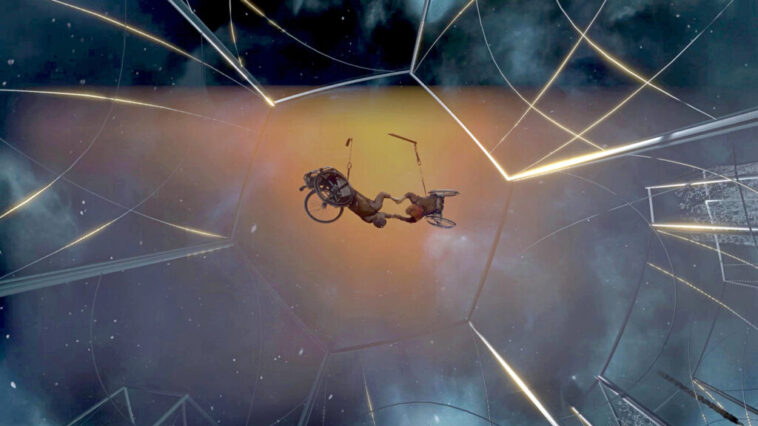
Kinetic Light’s territory, which premiered this summer, uses technology to place each audience member right in the center of the action: The 11-minute piece is designed for and created in virtual reality. Its digital environment features an otherworldly mountain range, a swirling sky, and, at times, metal and barbed-wire structures, which form the set for a cast of three dancers. At the end of the work, viewers feel as though they are ascending along with the performers, moving together towards the ever-shifting sky.
The piece began as a VR reimagining of the company’s stage work Wired, but territory quickly took on a life of its own, say Alice Sheppard and Laurel Lawson, members of the work’s creative team. “The relationship between our live performance and virtual reality is a space of deep generativity and complex creativity,” adds Sheppard, who is also Kinetic Light’s founder, artistic director, and one of the performers in territory. And as VR becomes more widespread, a growing number of dance artists and companies are exploring—and, in some cases, redefining—what this technology can do.

Here and below: still images from territory.

Expanding Artistic Possibilities
Most technology isn’t designed with artists in mind, says Lawson, who performs in territory in addition to being Kinetic Light’s access and technology lead. But this hasn’t stopped dancers and choreographers from making VR their own. In fact, Sheppard adds, dance artists now seem to be leading the way in VR innovation. That’s partly because the pandemic forced many dance artists to learn to work with technology, and some of the dancers who came of age during that time are further exploring these synergies in a formal capacity, emerging from higher education programs with dual focuses in dance and technology. “The field has just suddenly leapt and now everyone is doing their thing on tech,” Sheppard says.
Film has long intrigued dance artists—and VR technology allows for the creation of 360-degree dance films. Boston Ballet, for example, has created a series of VR films that can be viewed with either a headset or inside ÜNI, a pop-up geodesic dome that the company takes to various community events. With ÜNI, Boston Ballet offers free viewings of a montage of footage from works by artists like William Forsythe and Crystal Pite, and—a crowd favorite—the snow scene from The Nutcracker.
 Boston Ballet filming My’Kal Stromile’s On (my) line, In (my) mind. Courtesy Boston Ballet.
Other dance artists are creating new technology that is designed for their purposes, Lawson says. She adds that territory, which tailors VR to expand upon Kinetic Light’s overall mission to create disability-centered art, falls into this category. During the creation of territory, Lawson and Sheppard collaborated with the immersive entertainment company Double Eye Studios (whose founder, Kiira Benz, is a co-director of territory), which worked with a team at Meta to edit existing software, expanding its haptic (touch-based sensation) options.
 Lawson and Sheppard watch playback during the territory filming process. Photo by Cherylynn Tsushima, Courtesy Kinetic Light.
 Double Eye Studios’ Kiira Benz and Sheppard. Photo by Cherylynn Tsushima, Courtesy Kinetic Light.
San Francisco Bay Area–based dance artist Valencia James has featured VR in several projects, including her 2021 work Suga’, which used the now-defunct VR social platform Mozilla Hubs, along with additional customized hardware and software, to live-stream 3-D video to viewers. James is also the co-creator of the Volumetric Performance Toolbox, which provided guidance and low-cost hardware to dancemakers creating projects similar to Suga’. “The whole idea was to make virtual performance more accessible to any artist, especially thinking about those who are usually underrepresented in digital spaces,” James says.
 Here and below: performance stills from James’ Suga’. Photos by Simon Boas, Courtesy James.

New Options for Audiences
Virtual reality also has the potential to alter the traditional audience experience. Before experiencing territory, for example, audience members toggle through a variety of accessibility options to make their selections. Among the choices on the menu are a haptic score that interprets the choreography and sound with vibrations; written captions that describe sounds taking place; and poetic audio description by Leah Lakshmi Piepzna-Samarasinha that artfully interprets the dance work and its meaning—all of which can be seamlessly incorporated into the VR experience. Sheppard says there are more than 200 different ways to experience territory, depending on the combination of settings selected.
Boston Ballet also approached VR through the lens of audience accessibility, with a focus on reaching viewers in new ways. The seeds that grew into the company’s ÜNI pop-ups were planted in 2021, when many companies were limiting in-person offerings due to social-distancing guidelines. That year, the company premiered its Dance in VR project, which offered a selection of dance works specifically filmed to be viewed in VR. The project was somewhat limited in scope because it was only accessible to people who owned VR headsets, says the company’s chief marketing officer, Deborah Moe. In an effort to bring this experience—and ballet in general—to more people, the company began using ÜNI. Some of the dances are also now on YouTube.
 Here and below: Inside Boston Ballet’s ÜNI, featuring artwork by MASARY Studios. Photo by Aram Boghosian, Courtesy Boston Ballet.

Adapting Process
Working in virtual reality is, of course, very different from creating a work for the stage or the traditional screen. Dance artists experimenting with VR often have to adapt in ways both practical and artistic. Factors like the lack of wings when filming in 360 degrees necessitate a different way of thinking about space, for example.
“Ballet is traditionally seen from the front, not from all angles,” says Moe, adding that, ultimately, the works featured in both the Dance in VR project and the ÜNI pop-ups had to be re-choreographed to account for the 360-degree view. During the process of reimagining and filming works for VR, Moe says the company tried several different camera setups, ultimately hanging the camera from the lighting rigs above the stage to minimize interference with the dancers’ space.
Despite the increased presence of VR in society at large, the barrier to entry is still relatively high. Not only are pieces of hardware, like VR headsets, very expensive, but, often, making the software work as envisioned requires specialized technical knowledge. Kinetic Light partnered with technology company Double Eye Studios for the creation of territory, and both Boston Ballet and Valencia James also collaborated with professionals to help with tech-related questions related to their respective projects.
Still, the field of VR dance seems poised to expand. “This is just something that I think really brings people into the art form,” Moe says. “It gives them a new perspective. It helps them understand the humanity of what we do in a way that you might not experience if you just came to The Nutcracker one time and sat in the balcony.”
 A camera onstage at Boston Ballet. Photo by Rachel Ketterer, Courtesy Boston Ballet.
Considering Ethics
Virtual reality dance, with its imagined bodies and spaces, brings new ethical considerations into the choreographic process. During her work with VR, for example, Valencia James thought a lot about avatars and how she’d often seen them used to both co-opt Black culture and stereotype Black bodies online. Though avatars were common on Mozilla Hubs, the platform she used to host both her 2021 work, Suga’, and her Volumetric Performance Toolbox, she did not use an avatar for the dancing in her work, though she did use them in other roles. “When it comes to avatars, I think we need to be mindful of how bodies of color are usually erased and how they’re represented with the kind of stereotypes that tend to be judged,” she says.
 Valencia James performing in front of the Volumetric Performance Kit. Photo by Botond Bognar, Courtesy James.
 The kit’s hardware. Photo by Thomas Wester, Courtesy James.
Laurel Lawson, Kinetic Light artist and access and technology lead, says that ethical concerns were also top of mind during the creation process of territory. The Kinetic Light team spent time pondering how to use the technology to best serve both their artistic and their accessibility goals. This process, Lawson says, ultimately led to a collaboration with Meta, expanding upon the company’s existing technology to create new forms of tactile and nonvisual access.
“The things that we understand as artist engineers are really critical to creating these products in ways that work for us, not ways that are made to work for commercial entertainment because they turn a profit,” Lawson says.
The post The Intersections of Dance and Virtual Reality appeared first on Dance Magazine.



GIPHY App Key not set. Please check settings