
What matters today
1 Rev. Jesse Jackson dies at 84 — Civil rights icon, MLK protégé, and two-time presidential candidate dies Tuesday morning surrounded by family in Chicago; Trump calls him “a force of nature”; public commemorations to be held in Chicago; nation mourns amid politically charged moment

2 Geneva dual diplomacy — US-Iran nuclear talks produce “guiding principles” agreement; Russia-Ukraine Round 3 opens under shadow of 71-missile, 450-drone overnight strike; Witkoff and Kushner mediate both tracks from same city on same day
3 Carney launches $6.6B Defence Industrial Strategy — Canada’s first-ever defence procurement overhaul prioritises domestic suppliers; targets 70% domestic procurement share from 33%; 125,000 new jobs over decade; 5% GDP defence target by 2035
4 Wall Street slides on AI disruption fears — Nasdaq -1%, S&P 500 -0.7% as SaaS stocks crater; Danaher acquires Masimo for $9.9B; DHS shutdown Day 4 as Congress on recess; General Mills cuts 2026 outlook; Nvidia earnings Feb 25 looms; BTC ~$68,500
Critical
Iran — Geneva Nuclear Talks
“Guiding principles” agreed Tue; Witkoff/Kushner mediate; Iran offers 2-week return with text; 2nd carrier group + 18 F-35s deployed; IRGC Hormuz drills close lanes; zero enrichment vs curbs gap
Critical
Ukraine — Geneva Round 3
Umerov vs Medinsky; 71 missiles + 450 drones overnight; Odesa devastated; Trump: “come to the table fast”; territory deadlock; June deadline; continues Wed
Escalating
DHS Shutdown — Day 4
Congress on recess until Feb 23; 90% of 272K workers exempt but unpaid; Dems demand ICE body cameras, use-of-force reform post-Pretti shooting; no signs of compromise over Presidents’ Day weekend
Tense
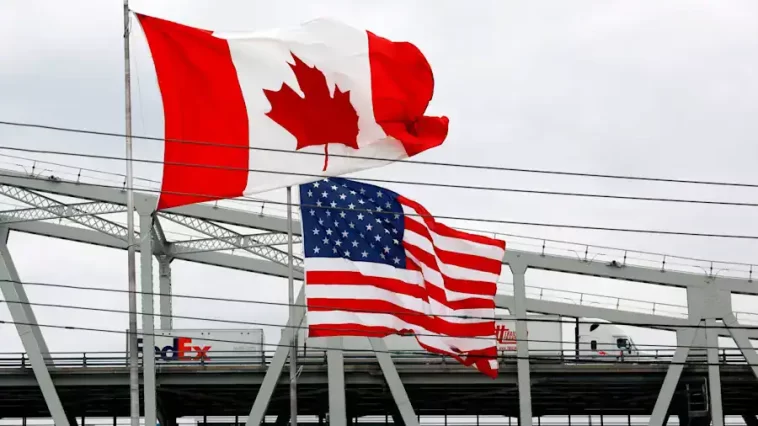
US-Canada Trade & Defence
Carney launches $6.6B “Buy Canadian” defence strategy; 5% GDP by 2035; CUSMA review pending; new Chief Trade Negotiator to US named; strategic autonomy doctrine deepens
The Man Who Made America Look, and the Market That Looked Away
Jesse Jackson died on Tuesday morning in Chicago, and the nation he spent six decades trying to change paused, briefly, to acknowledge the loss. He was Martin Luther King’s protégé, the man who stood on that Memphis balcony, the first Black candidate to turn a presidential primary into a genuine contest, the inventor of the Rainbow Coalition as both a metaphor and a political machine. Trump called him “a force of nature.” Sharpton called him “a movement unto himself.” The tributes crossed partisan lines — as they do for the dead — but arrived in a country more divided over the questions Jackson spent his life asking than at any point since the movement he helped lead. Meanwhile, the machinery of American power ground on in Geneva, where Witkoff and Kushner mediated both the Iran nuclear and Russia-Ukraine tracks from the same Swiss city — producing “guiding principles” with Tehran while presiding over a horseshoe table where Umerov and Medinsky faced each other beneath the shadow of 521 Russian munitions launched overnight. Wall Street returned from Presidents’ Day to sell technology stocks with accelerating conviction: the Nasdaq dropped over 1%, the S&P fell below its 50-day moving average, and the AI disruption thesis — once a growth engine — is now eating the companies it was supposed to empower. Oracle, Salesforce, CrowdStrike, AMD: the casualty list grows weekly. North of the border, Carney unveiled Canada’s most ambitious defence strategy in a generation — a $6.6 billion “Buy Canadian” plan to transform military procurement from 33% domestic to 70%, with a 5% GDP defence target by 2035. The message to Washington was unmistakable: Canada is building strategic autonomy, not because it wants distance from the US, but because it can no longer afford to depend on it.
CHICAGORev. Jesse Jackson, Civil Rights Giant and King Protégé, Dies at 84
The Rev. Jesse Louis Jackson, the towering civil rights leader whose moral vision and fiery oratory reshaped the Democratic Party and American political life, died Tuesday morning at the age of 84. His family confirmed he passed peacefully, surrounded by loved ones. Jackson had been living with progressive supranuclear palsy and Parkinson’s disease and had been hospitalised since November. Born in Greenville, South Carolina in 1941, Jackson was ordained in 1968 and worked alongside Martin Luther King Jr. until King’s assassination on the Memphis motel balcony where Jackson stood. He founded Operation PUSH in 1971 and later the Rainbow PUSH Coalition, which became a cornerstone of American civil rights organising. His two presidential campaigns — finishing third in 1984 and a strong second in 1988, winning 13 states and 7 million primary votes — registered more than a million new voters and proved a Black candidate could build a national coalition. President Trump praised him as “a force of nature like few others before him.” House Minority Leader Hakeem Jeffries called him “a voice for the voiceless.” The Rev. Al Sharpton described Jackson as his mentor and “a movement unto himself.” Bernice King posted a photograph of Jackson alongside her father with the words, “Both now ancestors.” Public commemorations will be held in Chicago. Jackson is survived by his wife Jacqueline and six children, including former Congressman Jesse Jackson Jr.
GENEVAWitkoff and Kushner Mediate Dual Negotiations as Geneva Becomes Diplomatic Epicentre
US envoys Steve Witkoff and Jared Kushner mediated both the Iran nuclear and Russia-Ukraine peace tracks from Geneva on Tuesday — a logistical and diplomatic feat without modern precedent. On the Iran track, the second round of indirect talks concluded with what Iranian FM Abbas Araghchi called “a general agreement on a set of guiding principles.” Iran offered to return within two weeks with detailed proposals. The US maintains its demand for zero enrichment and zero nuclear weapons; Iran insists on its right to enrich for civilian purposes, offering a temporary pause rather than a permanent ban. The Pentagon has deployed two carrier strike groups and an additional 18 F-35 fighter jets to the Middle East, while Iran’s IRGC simultaneously conducted naval exercises in the Strait of Hormuz, closing shipping lanes. On the Ukraine track, Umerov and Medinsky sat across a horseshoe table as Russia launched the largest combined aerial strike of 2026 overnight — 71 missiles and 450 drones across 12 Ukrainian regions. Odesa’s DTEK energy facilities suffered what the company described as devastation. Trump told reporters on Air Force One that Ukraine had “better come to the table fast.” The territory deadlock persists: Russia demands the remaining 20% of Donetsk; Kyiv refuses. Military chiefs are discussing ceasefire monitoring mechanisms. Talks continue Wednesday.
MONTRÉALCarney Launches Canada’s First Defence Industrial Strategy — $6.6B “Buy Canadian” Overhaul
Prime Minister Mark Carney unveiled Canada‘s first-ever Defence Industrial Strategy from a Montréal manufacturing plant on Tuesday, marking the most significant shift in Canadian military procurement since confederation. The $6.6 billion plan, built on five pillars, prioritises domestic suppliers and targets increasing Canadian-built defence procurement from the current 33% to 70% over the next decade, with a goal of creating 125,000 new jobs. The strategy positions Canadian industry to capture $180 billion in defence procurement opportunities and $290 billion in defence-related capital investment over the coming decade, with an anticipated $125 billion downstream economic benefit by 2035. Carney said the work of defending Canada was “the work of building Canada” and framed strategic autonomy as essential, not isolationist. The centrepiece is the Defence Investment Agency, a new standalone entity that will serve as a single point of contact for procurement and investment, replacing what Carney called a system that was “too complicated, too slow, and too reliant on international suppliers.” The government also announced BOREALS — a new Bureau of Research, Engineering and Advanced Leadership — to coordinate defence R&D spending, which will increase 85%. Canada is on track to hit the 2% NATO spending target this fiscal year (~$63 billion) and is committed to 5% of GDP by 2035. CAF applications are up nearly 13% since Carney took office.
WALL STREETTech Rout Deepens as AI Disruption Fears Spread; Danaher Acquires Masimo for $9.9B
US stocks fell on Tuesday as the AI disruption thesis broadened beyond chip makers to engulf SaaS companies, financial technology, and logistics. The Nasdaq 100 dropped more than 1%, the S&P 500 fell 0.7% and slipped below its 50-day moving average, while the Dow shed roughly 250 points. Oracle, Intuit, and Salesforce fell between 3% and 5% on fears that AI automation tools would displace demand for enterprise software. CrowdStrike plummeted 7% after Mizuho cut its recommendation. AMD fell more than 4%. Nvidia, reporting February 25, traded lower despite a bullish note from Citi projecting outperformance in the second half. The session’s marquee M&A announcement came from Danaher, which agreed to acquire pulse oximetry specialist Masimo for $180 per share in cash — a 38% premium — valuing the deal at approximately $9.9 billion including debt. Masimo shares surged 34%. On the consumer side, General Mills cut its 2026 sales outlook, citing “weak consumer sentiment, heightened uncertainty, and significant volatility.” Southwest Airlines rose nearly 2% after UBS upgraded to Buy. The 10-year Treasury yield fell to a fresh two-month low of 4.03%, supporting rate-sensitive sectors even as technology bled. Fed minutes Wednesday will be closely watched.
WASHINGTONDHS Shutdown Enters Day 4 — Congress on Recess, No Deal in Sight
The Department of Homeland Security’s partial shutdown entered its fourth day on Tuesday with no signs of compromise, as lawmakers remain on a scheduled recess through February 23. The shutdown — the third in recent months — was triggered when Senate Democrats blocked a DHS funding bill in the absence of reforms to federal immigration enforcement following the fatal shooting of two US citizens, Alex Pretti and Renee Nicole Good, by immigration agents in Minneapolis in January. Democrats demand body cameras for ICE agents, use-of-force standards, judicial warrants for private property entry, and agent identification requirements. Republicans have resisted most demands while pushing counterproposals on “sanctuary city” crackdowns. Over 90% of DHS’s 272,000 employees continue working under the “exempt” classification, but without pay until the shutdown ends. ICE and CBP operations are largely unaffected thanks to $70 billion in alternative funding from last year’s One Big Beautiful Bill Act. Border czar Tom Homan said the administration would not agree to “masks off” policies that could endanger agents. Senate Majority Leader Thune has said members should be ready to return if a deal materialises before the scheduled February 23 reconvening.
WASHINGTONRFK Jr. Signals FDA Will Act on Kessler GRAS Petition — Processed Food Fight Escalates
Health and Human Services Secretary Robert F. Kennedy Jr. confirmed in a CBS “60 Minutes” interview aired Sunday — and amplified by an HHS statement Monday — that the FDA will act on former Commissioner David Kessler’s petition to revoke the GRAS (Generally Recognized as Safe) status of dozens of processed refined carbohydrates including corn syrup, high fructose corn syrup, and refined flours. The petition, filed last August, argues that the safety classification of these ingredients is based on outdated data and that they contribute to metabolic disease, obesity, and hypertension. Kennedy called the GRAS self-affirmation pathway a “loophole” that had been “hijacked” by food manufacturers, allowing nearly 99% of new food chemicals since 2000 to enter the supply chain without FDA review. While Kennedy stopped short of promising to regulate ultra-processed foods directly, he said he intends to close the self-certification pathway if he gets White House approval. The Consumer Brands Association said the industry “stands ready to work with HHS and FDA.” General Mills’ Tuesday guidance cut — citing weak consumer sentiment — underscored the business sensitivity of any regulatory tightening.
GAZA / WASHINGTONTrump’s Board of Peace to Pledge $5B for Gaza at Thursday Meeting
President Trump announced Sunday that members of his Board of Peace initiative will pledge more than $5 billion for reconstruction or humanitarian efforts in Gaza at the board’s inaugural meeting on Thursday. Trump also said members have committed thousands of personnel toward a stabilisation force and local police. The announcement comes as Doctors Without Borders suspended noncritical operations at Nasser Hospital in Gaza due to what it described as security breaches, including armed men in the compound. The hospital disputed MSF’s account, attributing the armed presence to civilian police protecting patients. The pledges represent the first concrete financial commitment from an initiative that had previously operated at the rhetorical level, though details on implementation mechanisms, governance, and the role of the Palestinian Authority remain unclear. The Board of Peace met informally at the sidelines of the Munich Security Conference last week.
A Nation Mourning While Its Markets Correct and Its Neighbours Rearm
Tuesday delivered a rare convergence of the symbolic and the structural across North America. Jesse Jackson’s death at 84 is the kind of loss that transcends politics — the man who stood on the Memphis balcony with King, who proved a Black candidate could win presidential primaries, who coined the Rainbow Coalition as both aspiration and apparatus. The tributes crossing partisan lines were genuine, but they arrived in a nation whose government is partially shut down over the conduct of its immigration agents, whose markets are in the grip of an AI-driven correction that is eating the software sector from the inside, and whose diplomats are simultaneously mediating nuclear talks with Iran and peace talks over Ukraine from the same Swiss city. The Geneva outcome was characteristically asymmetric: genuine progress with Iran, where “guiding principles” represents the most substantive framework since the JCPOA, and grinding stalemate on Ukraine, where Russia launched 521 munitions overnight while its negotiator sat at the horseshoe table. Trump’s demand that Ukraine “come to the table fast” lands differently when Odesa’s energy grid is in rubble. Wall Street’s response to all of this was to sell tech. The Nasdaq’s 1% decline extended a pattern that has transformed the AI narrative from growth catalyst to existential threat: Oracle, Salesforce, CrowdStrike, AMD — the rotation out of software and into rate-sensitive value plays is accelerating. The 10-year Treasury at 4.03% suggests the bond market is pricing a Fed that will need to act before the labour market deteriorates further. North of the border, Carney’s Defence Industrial Strategy is the most consequential Canadian policy announcement of the year: $6.6 billion, 125,000 jobs, a 70% domestic procurement target, and a 5% GDP defence commitment by 2035. The strategic autonomy doctrine he articulated at Davos is now backed by concrete industrial policy and a new institutional architecture. The CUSMA review will determine whether this vision survives contact with the White House’s transactional reality. The week ahead is dense with catalysts: Fed minutes Wednesday, SCOTUS opinion dates starting Thursday, the Board of Peace’s $5 billion Gaza pledge, Walmart earnings, Core PCE on Friday, and Nvidia on the 25th. But Tuesday’s lesson is already instructive: America can mourn a civil rights giant, conduct dual-track diplomacy, and watch its tech sector correct simultaneously — and the system, for all its fractures, continues to function. The question is whether functioning is the same as working.
USA & Canada Intelligence Brief
Tuesday Edition · February 17, 2026



GIPHY App Key not set. Please check settings