
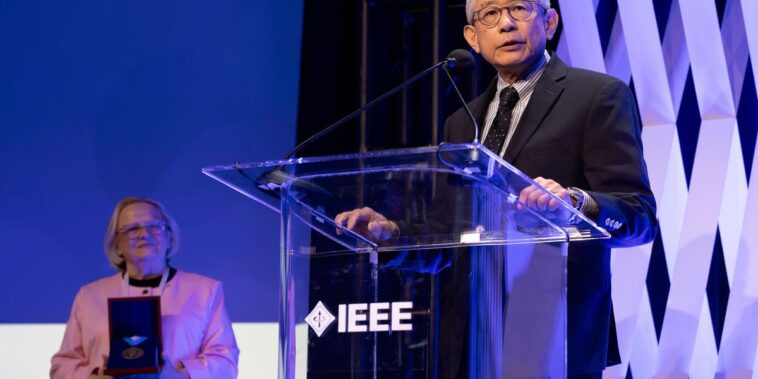
Unlike many budding engineers, K.J. Ray Liu wasn’t inspired to enter the field by tinkering with electronics or following in the footsteps of a family member. Growing up in Taichung, Taiwan, he answered his government’s call for students to become electrical engineers to help manufacture semiconductors in the 1970s, when the country’s economy was struggling.
“Students who were good in math, science, and physics all wanted to be an electrical engineer because that was the top priority of the government,” Liu says. “That’s how I got into engineering. Now Taiwan is a world leader in semiconductors.”

K.J. Ray Liu
Occupation
Retired professor of information technology and a digital signal processing researcher at the University of Maryland in College Park
Member grade
Fellow
Alma maters
National Taiwan University; University of Michigan; UCLA
But by the time he graduated from university in 1983, semiconductor facilities were still under construction, so there were no jobs available.
Instead, he went on to have a successful career as an educator and entrepreneur in the United States.
For 31 years, he was a professor of information technology and a digital signal processing researcher at the University of Maryland in College Park until he retired in 2021.
Liu was the chairman, CEO, and CTO of Origin Wirelessa startup he founded in Rockville, Md. Origin, which was acquired by ADT in February, pioneers artificial intelligence for wireless sensing and indoor tracking.
Liu, an IEEE Fellow, is an active IEEE volunteer who served as the organization’s president in 2022.
IEEE honored him with this year’s Haraden Pratt Award for “transformative and impactful leadership.”
Liu is credited with increasing the diversity of nominees for IEEE’s Fellow programwhich is the highest level of membership. He also led the effort to realign the organization’s regions geographically to ensure more equitable global representation on the IEEE Board of Directors.
He received the Pratt honor on 24 April during a ceremony in New York City. The IEEE Foundation sponsored the Board-level award.
“More than anything, I share the honor with the volunteers and staff I had the privilege to work alongside,” he says. “Our hard work is fueled by our shared devotion to this professional home we love and care for so much.”
In the 1970s, Taiwan’s policymakers decided to improve the country’s economy by pivoting from making products such as shoes and umbrellas to manufacturing electronics.
The industry got its start in 1976 when RCAa major electronics company at the time, agreed to transfer licensed semiconductor processes to Taiwan’s Industrial Technology Research Institute. ITRI spun off several semiconductor-related companies including the Taiwan Semiconductor Manufacturing Co. TSMC, launched in 1987, is the world’s largest dedicated semiconductor foundry.
Liu graduated in 1983 with a bachelor’s degree in electrical engineering from National Taiwan Universityin Taipei. At the time, there were no semiconductor companies to work for, he says.
“Nowadays, many of the country’s university graduates go right to TSMC to get a job,” he says. “But back then, there was no real job market.
“Most of my classmates—including me—came to the U.S. for graduate studies. Many of us stayed and, over the last three to four decades, contributed to the development of electronic computer communication technology in the U.S.”
Liu left Taiwan after a two-year mandatory stint in the Republic of China Armed Forces to attend the University of Michiganin Ann Arbor, where in 1987 he earned a master’s degree in electrical engineering.
“If I can help make IEEE a better professional home for future members, that is something that I can pay back to IEEE.”
He went on to earn a Ph.D. in electrical, electronics, and communications engineering in 1990 from the University of California, Los Angeles. His interest in digital signal processing and very-large-scale integration (VLSI) was sparked while at UCLA. Today VLSI powers all modern electronics.
“When I was a graduate student, there was no wireless communication. Everybody had a landline,” he explains.
VLSI was an important, active research field at the time.
“My research interest was digital signal processing,” he says. “One day I saw a book on VLSI signal processing on my professor’s bookshelf. I immediately thought to myself: That is the field I want to pursue.
“VLSI is one lane, digital signal processing is the other, and there is a bridge linking the two. I was interested in both areas, so I did my Ph.D. thesis on VLSI signal processing.”
After graduating, Liu joined the University of Maryland, where he is credited with establishing its signal processing research program.
In addition to teaching, he conducted research on a broad range of signal processing and communication aspects. The topics include bioinformatics, game theory, signal processing algorithms and architectures, and wireless sensing and communications.
He has authored more than 10 books and 900 papers, and he holds 250 patents. You can find his research papers in the IEEE Xplore Digital Library.
Ambient-sensing trailblazer
Liu is considered to be a pioneer in the field of ambient sensing. The technology gathers environmental data and is used in security systems and health-monitoring devices.
He came up with the idea, he says, while working on a project in 2009 for the U.S. Navy. He was trying to solve a problem the Navy was having with the wireless communication systems used in its submarines. Because submarines are made of metal, radio waves were unable to penetrate the vessels’ compartments and instead bounced around, creating interference, he says.
His solution was to use a relatively unknown concept in physics: time-reversal signal processing. The technique captures waves, such as sound and electromagnetic signals, and sends them back through the same medium in reverse, flipping the signal from last-in to first-out, and re-emits them.
“By using time-reversal feed, we could increase the signal-to-noise ratio by four times,” he says. “That improved performance dramatically.”
He became fascinated by the physics of time-reversal signal processing, he says, and wondered how he could apply the concept to serve society. After three years of research, he came up with the idea of using wireless sensing applications through ambient radio waves from surrounding Wi-Fi networks.
“I learned to turn Wi-Fi networks into sensing networks that decipher our activities,” he says. “We could know everything happening around us—our motions, breathing, heartbeat, even fall detection—without any wearables.”
Through the university’s incubatorwhich encourages faculty to work on projects with an impact on society, he launched Origin in 2013. The company’s Wi-FI and AI sensing technology enables accurate indoor tracking, motion detection, and health monitoring without the need for wearable devices or cameras. Its products, including its remote patient monitoringreceived three innovation awards at the 2020 and 2021 Consumer Electronics shows, including one for best innovation.
Finding his professional home
Liu joined IEEE in 1986 as a graduate student to access its research papers, he says.
“If you didn’t join an IEEE society, you didn’t get its journal—which meant that you couldn’t read the most up-to-date research papers,” he says. “So, I joined the IEEE Signal Processing Society. When I attended my first signal processing conference, I knew I had found a professional home. I met many like-minded people, and together, we built a professional home for our members worldwide.”
He became an active volunteer, holding top leadership positions including 2012–2013 president of the Signal Processing Society and 2016–2017 director of IEEE Division IXwhich covers societies focused on signal processing, data transmission, navigation, and transportation. In 2019 he was vice president of the Technical Activities Board.
In 2022 he served as IEEE president and CEO. The three accomplishments during his term he says he is most proud of are increasing the prize money for the IEEE Medal of Honor, overseeing the realignment of IEEE regions, and establishing greater financial transparency.
The reason for increasing the prize for IEEE’s highest award—from US $50,000 to $2 million—in 2025, he says, was to underscore the importance of the technologies the IEEE community develops. Those innovations include semiconductorsthe Internet, and the GPU. The money for the Medal of Honor now exceeds that of the Nobel Prizewhich carries an award of roughly $1 million.
“We need the whole world to understand the IEEE community has made the most impact on society in the last century,” Liu says. “Nevertheless, we did not receive the attention and respect we deserved, so we needed to help ourselves. We want the whole world to know what our contributions are.”
His next achievement was realigning IEEE’s regions. During the past several years, membership in Region 10which covers countries in Asia and the Pacific, has grown from 10 percent of total membership to nearly 40 percent, he says. It is the largest and most populous of IEEE’s geographic areas, but its members were not equitably represented on the Board of Directors. Each region had one representative on the Board.
“The region has 40 percent of the members but only makes up 10 percent of the Board,” Liu says. “That didn’t make sense to a lot of us.”
The IEEE Board in 2022 approved region realignment. The total number of regions remains at 10, but their organization is changing. Effective 1 January 2028, the six U.S.-based regions will be consolidated into five, and Region 10 will be split into two. IEEE will no longer use the Region 1 designation. The new Region 2 will represent the Northeastern and Eastern U.S. Region 10 will cover North Asia, and the new Region 11 will represent South Asia and the Pacific.
Liu also succeeded in leading a movement that persuaded the IEEE Board to invest in a better financial reporting system to have a clearer understanding of the organization’s finances. A more modern system now tracks banking transactions, contracts, expense reports, and other spending.
“Now we know exactly where the money comes from and where it is spent,” he says, “so that we can make more informed decisions.
“If I can help make IEEE a better professional home for future members, that is something that I can pay back to IEEE,” he adds. “I truly appreciate what IEEE offered me. From student to professor to an established leader, at every stage, it offered me different opportunities to grow. That is why I worked very hard when I was president to make sure everybody realizes it is a professional home for our entire career.”
From Your Site Articles
Related Articles Around the Web




GIPHY App Key not set. Please check settings