
As AI reshapes work, education is evolving. Explore five essential skills and shifts helping students build adaptability, judgment, and real-world readiness for an AI-powered future.
Ask a hiring manager what they’re looking for today and you’ll hear something that would have sounded unusual two years ago: not a longer list of tools, but a deeper set of human capabilities. New Microsoft research, Preparing Students for the Future of Workfinds that roughly 70% of the skills used in most jobs are expected to change by 2030, AI literacy now appears in job listings around six times more often than a year ago, and 66% of leaders say they wouldn’t hire someone without AI skills.

For educators, it’s an opportunity to further shape the future.
Success in education has always depended on the interplay of knowledge, aptitudes, and skills. Skilling is the capability that turns new technology into confident, trusted practice. The question isn’t whether to prepare students for an AI-shaped world. It’s how to do it in a way that keeps human flourishing, not just employability, at the center.
Work is changing. People are not.
This line, drawn from the report’s conclusion, is worth holding onto. Technologies will keep shifting. What endures is distinctly human: curiosity, judgment, the capacity to learn and relearn, and the wisdom to apply knowledge well. The OECD makes the same case in its 2025 framework, Education for Human Flourishing, which argues that education should help every learner live “a life they have reason to value,” moving beyond a narrow human-capital view of schooling.1
Together, the reports point to a consistent pattern: today’s labor market increasingly rewards people who can apply their intelligence and adapt to context and continue learning. Thus, education’s enduring purpose is to develop and refine those skills and dispositions.
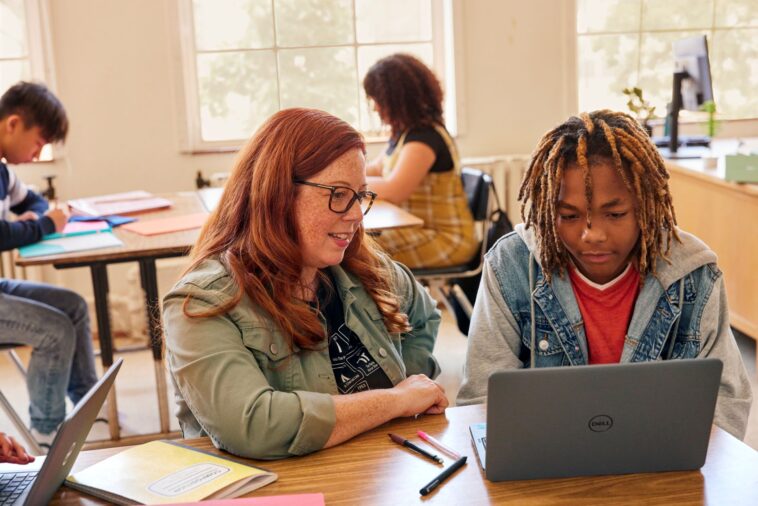
Curiosity, judgment, and the ability to learn are developed through meaningful collaboration, not technology alone.
Five new fundamentals reshaping what it means to be ready
The OECD report identifies five shifts quietly redrawing the line between “entry-level” and “experienced.” For schools and universities, the report points to building AI readiness not just through access to technology, but through human capabilities, governance, and practical experience that help AI work responsibly.
Elevated entry-level expectations
Working with AI as a partner to become an “agent boss”
Context engineering
Judgment, voice, and the human standard
From credentials to capabilities
Grounding skills in human flourishing
If those five fundamentals describe what the workplace now rewards, the OECD framework describes the human foundation underneath them. It centers on acting in the world with the agency to shape one’s life and contribute to others. This is supported by four competencies:
Adaptive problem-solving
Ethical competence
Understanding the world
Appreciating the world
The overlap is striking. “Context engineering” and the “agent boss” mindset are adaptive problem-solving in a new medium. “Judgment and the human standard” is ethical competence made practical. Building skills for the future of work and educating for a flourishing life are not competing goals; done well, they are the same work.
 Agency, problem-solving, and ethical judgment grow when learners have the space and support to apply them.
What this looks like in classrooms today
This isn’t theoretical. Schools and universities are already turning these ideas into everyday practice—and the early results are encouraging.
At Fulton County Schools, students are using AI as a thought partner to explore ideas, build confidence, and tackle real-world problems—shifting learning from using technology to creating with it across a district serving nearly 87,000 learners.
At the University of Sydney, the “Cogniti” platform lets educators design AI tools that guide students through reasoning—a working example of teaching students to direct AI, not just use it.
The University of California San Diego, redesigned an introductory computer science course around GitHub Copilot—helping students complete coding tasks faster, build more ambitious projects, and develop practical AI skills for the workplace.
Across K-12 and higher education, the pattern is the same: AI is embedded into everyday learning and teaching, building the literacy and adaptability employers describe as “skilled for life.”
Empowering educators to foster these skills is one of the goals of the Microsoft Elevate for Educators program. It is designed to provide educators and school leaders with access to a global community, credentials, and skilling opportunities to confidently integrate AI into teaching and learning.
The road to ISTELive 2026
Knowing which skills matter is the first step. Building them, at scale, is the next. Keep an eye out for our upcoming blog posts which get specific about the products and programs that help educators put this skilling intent into practice—from classroom-ready AI tools to professional learning that meets educators where they are.

Equip your students with essential AI skills
Preparing students for the future of work
1 OECD, Education for Human Flourishing: A Conceptual Framework, November 7, 2025, CC BY 4.0.




GIPHY App Key not set. Please check settings