
Many crypto enthusiasts dream of trading traditional
equities around the clock on public blockchains. They imagine a decentralized
utopia where anyone can buy fractional shares of major corporations without
traditional brokers.
This vision fundamentally misunderstands how institutional
finance operates. In my opinion, major tokenized stocks will never migrate to
public networks. The future of twenty-four-hour equity trading belongs
exclusively to private or semi-private blockchain architectures.

The United
States Securities and Exchange Commission recently proposed rescinding two
key rules under Regulation National Market System.
Related: A Token Is Only as Good as the Share Behind It – How Four Crypto Exchanges’ SpaceX Bets Came Up Empty
These rules require trades to be routed to the national best
price and prohibit locked or crossed quotes across venues. Analysts like Alex
Thorn note that automated market makers on public chains conflict with these
requirements because they execute against isolated liquidity pools without
checking off-chain quotes. Removing the rules could theoretically open the door
to compliant on-chain trading of tokenized United States equities.
However, this remains a medium-term structural adjustment
rather than an immediate green light. The proposal still faces a lengthy
comment process, and platforms would still need to register as exchanges or
alternative trading systems, satisfy clearing obligations, and ensure token
holders retain voting and dividend rights.
Traditional market groups also warn that removing the rules
could reduce price transparency and fragment markets.
Operational Constraints of Public Blockchains
Even with favorable regulations, public blockchains present
significant operational hurdles for institutional
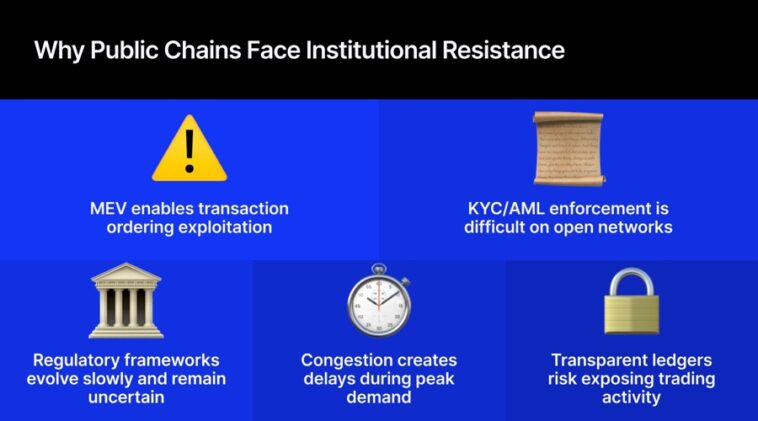
equity trading. Gas fee volatility remains a primary deterrent. A surge in
retail activity can congest public networks and sharply increase transaction
costs.
Institutions cannot risk large equity settlements being
delayed or becoming more expensive because of unrelated retail traffic.
Traditional finance
requires deterministic execution.
A bank executing a large block trade needs certainty around
cost and settlement timing. Institutional traders require millisecond precision
and reliable finality. Public networks prioritize openness and censorship
resistance over the predictable throughput global capital markets demand.
Maximal Extractable Value (MEV) presents another critical
barrier. Public blockchains broadcast pending transactions in a public mempool
before execution. Sophisticated actors deploy bots to scan this information and
front-run large orders by manipulating transaction ordering.
Billions of dollars have been extracted through these
practices in recent years. This directly conflicts with the fiduciary
obligations of traditional brokers and institutional mandates requiring best
execution. Financial
institutions are unlikely to embrace a system that permits such extraction
from client order flow.
Privacy, Compliance, and Control Requirements
Privacy and compliance requirements further strengthen the
case against public ledgers. Traditional finance operates under strict Know
Your Customer and Anti-Money Laundering regulations.
Public blockchains expose
transaction data to everyone. Institutions cannot broadcast their strategic
positioning or client holdings on a transparent ledger. Regulators also require
the ability to freeze assets or reverse transactions under specific legal
circumstances. Public blockchains generally resist these interventions,
creating challenges when compliance frameworks require administrative control.
Wall Street is warming to tokenized stocks. The dream of eliminating middlemen? That’s another story https://t.co/jHO9RtW9fy
— Businessweek (@BW) June 17, 2026
Private networks provide the logical solution. A private
blockchain functions as a shared, cryptographically secure ledger maintained by
a trusted group of regulated institutions.
This architecture delivers many of the benefits of
distributed ledger technology without the unpredictability of public networks.
Competitors cannot observe order flows, trade sizes, or account balances.
Transactions remain confidential between authorized participants and regulators.
These networks can also streamline clearing and settlement
by enabling institutions to transact directly with one another. This lowers
costs, reduces counterparty risk, and supports continuous settlement.
Enterprise networks further offer dedicated support and contractual service
guarantees that public protocols do not provide.
Institutional Adoption Is Already Underway
Major financial institutions already recognize this reality.
J.P. Morgan operates its Onyx platform for tokenized intraday repurchase
agreement trades and payments. Goldman Sachs uses its Digital Asset Platform to
issue and trade digital bonds and other institutional instruments.
HSBC’s Orion platform supports tokenized gold and digital
bond issuance. These examples demonstrate that financial institutions view
blockchain primarily as infrastructure for automation, synchronization, and
efficiency within controlled environments.
The Direction of Tokenized Equities
Market participants continue to pursue the vision of trading
major corporate shares on public decentralized exchanges. Yet the structural,
regulatory, and operational realities of global finance point elsewhere.
The Securities and Exchange Commission may eventually adapt
market rules for digital
assets, but the infrastructure itself will remain largely in private hands.
Tokenized equities are far more likely to thrive on secure,
permissioned networks designed for institutional performance and compliance
than on fully public chains. The future of financial innovation is not public
exposure. It is private, efficient infrastructure built to meet the demands of
modern capital markets.
Many crypto enthusiasts dream of trading traditional
equities around the clock on public blockchains. They imagine a decentralized
utopia where anyone can buy fractional shares of major corporations without
traditional brokers.
This vision fundamentally misunderstands how institutional
finance operates. In my opinion, major tokenized stocks will never migrate to
public networks. The future of twenty-four-hour equity trading belongs
exclusively to private or semi-private blockchain architectures.
The United
States Securities and Exchange Commission recently proposed rescinding two
key rules under Regulation National Market System.
Related: A Token Is Only as Good as the Share Behind It – How Four Crypto Exchanges’ SpaceX Bets Came Up Empty
These rules require trades to be routed to the national best
price and prohibit locked or crossed quotes across venues. Analysts like Alex
Thorn note that automated market makers on public chains conflict with these
requirements because they execute against isolated liquidity pools without
checking off-chain quotes. Removing the rules could theoretically open the door
to compliant on-chain trading of tokenized United States equities.
However, this remains a medium-term structural adjustment
rather than an immediate green light. The proposal still faces a lengthy
comment process, and platforms would still need to register as exchanges or
alternative trading systems, satisfy clearing obligations, and ensure token
holders retain voting and dividend rights.
Traditional market groups also warn that removing the rules
could reduce price transparency and fragment markets.
Operational Constraints of Public Blockchains
Even with favorable regulations, public blockchains present
significant operational hurdles for institutional
equity trading. Gas fee volatility remains a primary deterrent. A surge in
retail activity can congest public networks and sharply increase transaction
costs.
Institutions cannot risk large equity settlements being
delayed or becoming more expensive because of unrelated retail traffic.
Traditional finance
requires deterministic execution.
A bank executing a large block trade needs certainty around
cost and settlement timing. Institutional traders require millisecond precision
and reliable finality. Public networks prioritize openness and censorship
resistance over the predictable throughput global capital markets demand.
Maximal Extractable Value (MEV) presents another critical
barrier. Public blockchains broadcast pending transactions in a public mempool
before execution. Sophisticated actors deploy bots to scan this information and
front-run large orders by manipulating transaction ordering.
Billions of dollars have been extracted through these
practices in recent years. This directly conflicts with the fiduciary
obligations of traditional brokers and institutional mandates requiring best
execution. Financial
institutions are unlikely to embrace a system that permits such extraction
from client order flow.
Privacy, Compliance, and Control Requirements
Privacy and compliance requirements further strengthen the
case against public ledgers. Traditional finance operates under strict Know
Your Customer and Anti-Money Laundering regulations.
Public blockchains expose
transaction data to everyone. Institutions cannot broadcast their strategic
positioning or client holdings on a transparent ledger. Regulators also require
the ability to freeze assets or reverse transactions under specific legal
circumstances. Public blockchains generally resist these interventions,
creating challenges when compliance frameworks require administrative control.
Wall Street is warming to tokenized stocks. The dream of eliminating middlemen? That’s another story https://t.co/jHO9RtW9fy
— Businessweek (@BW) June 17, 2026
Private networks provide the logical solution. A private
blockchain functions as a shared, cryptographically secure ledger maintained by
a trusted group of regulated institutions.
This architecture delivers many of the benefits of
distributed ledger technology without the unpredictability of public networks.
Competitors cannot observe order flows, trade sizes, or account balances.
Transactions remain confidential between authorized participants and regulators.
These networks can also streamline clearing and settlement
by enabling institutions to transact directly with one another. This lowers
costs, reduces counterparty risk, and supports continuous settlement.
Enterprise networks further offer dedicated support and contractual service
guarantees that public protocols do not provide.
Institutional Adoption Is Already Underway
Major financial institutions already recognize this reality.
J.P. Morgan operates its Onyx platform for tokenized intraday repurchase
agreement trades and payments. Goldman Sachs uses its Digital Asset Platform to
issue and trade digital bonds and other institutional instruments.
HSBC’s Orion platform supports tokenized gold and digital
bond issuance. These examples demonstrate that financial institutions view
blockchain primarily as infrastructure for automation, synchronization, and
efficiency within controlled environments.
The Direction of Tokenized Equities
Market participants continue to pursue the vision of trading
major corporate shares on public decentralized exchanges. Yet the structural,
regulatory, and operational realities of global finance point elsewhere.
The Securities and Exchange Commission may eventually adapt
market rules for digital
assets, but the infrastructure itself will remain largely in private hands.
Tokenized equities are far more likely to thrive on secure,
permissioned networks designed for institutional performance and compliance
than on fully public chains. The future of financial innovation is not public
exposure. It is private, efficient infrastructure built to meet the demands of
modern capital markets.




GIPHY App Key not set. Please check settings