
Widely regarded as the work that heralded the start of the postmodern dance movement, Yvonne Rainer’s solo Trio A is celebrating its 60th anniversary this year. To mark the milestone, London’s Tate Modern gallery is hosting free, durational performances and discussions from July 10–11. “Of course I’m surprised and very appreciative of all the attention,” Rainer, 91, says on a recent call from her home in New York City.
By eschewing music and narrative in favor of seemingly pedestrian motions—toe taps, limbs folding and unrolling—that don’t repeat, Trio A challenged dance tradition when it premiered in 1966. It requires performers to maintain what Rainer describes as an “uninflected continuity,” never making eye contact with the audience. By giving all movements the same emphasis, they achieve a look of “weighted ease,” according to Pat Catterson, a certified transmitter of Trio A who is based in Boston and New York City.

“It’s not that she was erasing something, just proposing something we hadn’t seen before,” says Sara Wookey, who, as a certified transmitter of Trio A, will be helping to stage the performances at the Tate. “There’s a built-in, democratic value system that I’m very drawn to,” she adds, noting Rainer has always been a socially and politically engaged artist.
When Catterson first saw Trio A at New York City’s Billy Rose Theatre in 1969, three audience members climbed onto the stage and attempted to perform it themselves. “The Vietnam War draft had been such a leveler, and there was an egalitarian impulse in the culture,” she says. “It was of our time. You wanted to do (Trio A), because you felt it was yours.”
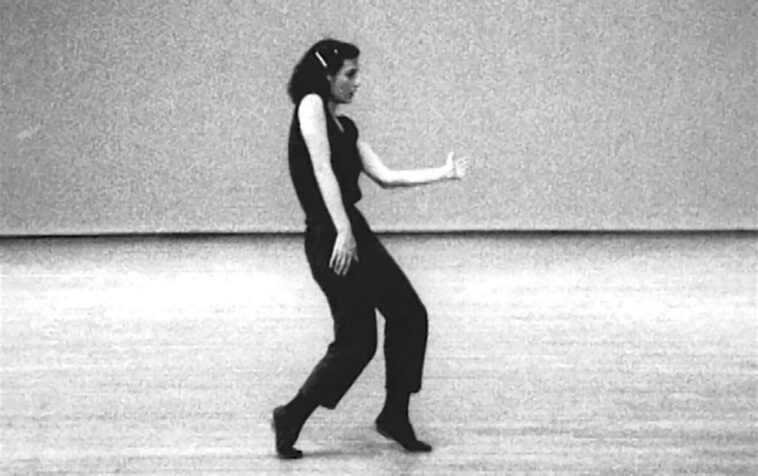
A still from the 1978 video of Rainer performing Trio A. Image © Yvonne Rainer, courtesy Rainer.
Pedestrian or Persnickety?
Dancing Trio A is more complicated than it looks. “Even those I’ve authorized to teach it come back every now and then for a tune-up from me,” Rainer says.
“The first hard thing is remembering it, because it’s one distinct, odd movement after another,” says Catterson. The lack of dynamic changes also means “you’re controlling your weight against gravity,” Wookey adds. “You can’t speed up while going down to the floor or leaping in the air. That takes a lot of muscular effort.”
Despite its difficulty, and Rainer’s self-described “persnicketiness” for its details, over the years Trio A has been performed by dancers and nondancers alike. Rainer has also given permission to various people to adapt the work, creating their own versions. “There are all these variations, including me doing it at an older age in tap shoes,” says Rainer. “It’s been done for people in wheelchairs, for plants in a scientific experiment in Chicago…”
Catterson even taught herself to perform Trio A backwards for a 1970 performance at New York City’s Judson Church. Dancing alongside Rainer, Barbara Lloyd, Steve Paxton, Douglas Dunn, and David Gordon, she wore nothing but the American flag to protest the Vietnam War. Concentrating on the choreography in reverse helped distract Catterson from the fact she was performing nude, she says.
“I’ve never seen a dance like that,” says Rainer. “The reverse is even more extraordinary than my original.”
The Trick to Transmission
For the celebration at the Tate, Wookey is teaching Trio A to 15 professionals, ages 30 to 67, from a variety of backgrounds. The event will also feature the first ever audio description of the solo.
When teaching Trio A, Wookey shares anecdotes about Rainer with the dancers, so they can learn about the person behind the piece, and offers context about the solo’s social and historical relevance. She also adopts Rainer’s idiosyncratic language to explain movements: The way Rainer describes the first movement of the entire piece, for example, is your arms swinging like rocks on the end of a string.
“I think she’s trying to get at the actual weight of the arms, the physics and mechanics of it,” says Wookey. It’s one example of a detail you can’t learn from the 1978 video of Rainer performing Trio A herself. “I try to prevent people from learning it from that video because I was no longer at my apex in terms of dancing,” Rainer says.
 Pat Catterson performing Trio A at the Museum of Modern Art in 2009, with the 1978 video of Rainer projected in the background. Photo by Yi-Chun Wu, courtesy Catterson.
“It goes on…”
What will the next 60 years of Trio A look like? “Well, I’ll be gone,” Rainer says frankly, recognizing that “things do not stay pure forever.” According to Wookey, Rainer has often said that the work’s defining feature of uninflected continuity will “probably disintegrate in the future at some point.”
Yet Catterson has faith in Trio A’s enduring appeal. “Dancing Trio A is kind of addictive,” she says. “You keep trying to do the tasks and you never can do it perfectly. It keeps nagging at you to try again.” And so, to use a phrase Rainer says repeatedly in our interview, “It goes on.”
The post 60 Years of Yvonne Rainer’s Groundbreaking Solo Trio A appeared first on Dance Magazine.




GIPHY App Key not set. Please check settings