
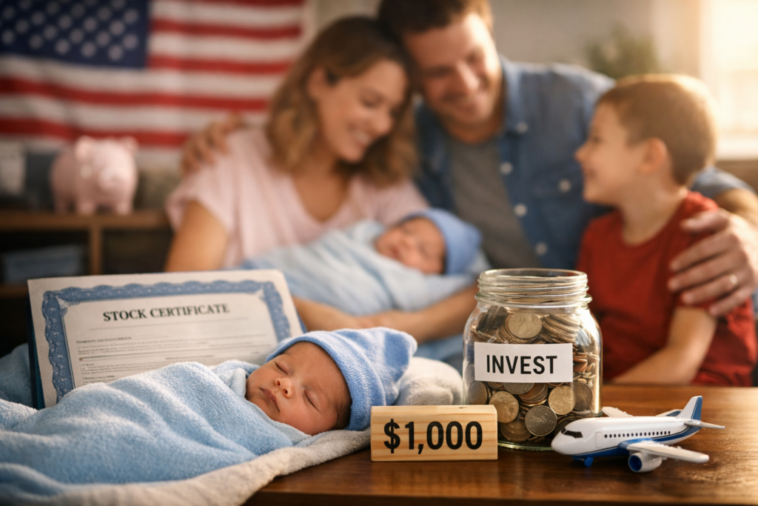
Key Points
* The plan puts a $1,000 invested stake into eligible newborns’ names, making ownership automatic, not aspirational.
* It uses real markets, real compounding, and real family and employer top-ups to teach financial habits by lived experience.

* If participation spreads beyond affluent households, it could become a rare policy that builds wealth without building bureaucracy.
The most radical part of “Trump Accounts” is not the money. It is the timing. The program tries to make capitalism feel personal from day one, by giving many children a small, invested claim on the U.S. economy before they can read, vote, or work.
Under the design presented by Treasury, eligible children born between January 1, 2025 and December 31, 2028 can receive a one-time $1,000 federal seed, invested in a broad index fund.
Families establish the account through an IRS election on Form 4547, with an online enrollment path expected in mid-2026. Contributions generally cannot begin before July 4, 2026.
After launch, parents, relatives, friends, and employers can add up to $5,000 per year. The account is in the child’s name, run by a custodian, and is generally locked until 18.
 A $1,000 Start At Birth: Inside The Plan To Make Every American Child An Investor
A $1,000 Start At Birth: Inside The Plan To Make Every American Child An Investor
That architecture is the hidden strategy. It does not ask families to “start investing someday.”
It forces the first step, then invites everyone around the child to reinforce it. A grandparent can make a birthday gift that compounds.
An employer can match deposits the way it matches retirement plans. A state can add money and link it to a financial-literacy course. The policy is trying to turn a household into a small investing committee, without calling it one.
The second strategy is cultural. When a teenager watches an account rise and fall, the lesson is not theoretical. It is emotional.
It teaches risk, patience, and the difference between spending and building. In a country where a large minority of adults own no stocks, that shift matters.
The third strategy is scale through private capital. Michael and Susan Dell pledged $6.25 billion to add $250 for 25 million children.
Ray and Barbara Dalio pledged $75 million to add $250 for roughly 300,000 children in Connecticut, targeted by ZIP-code income thresholds.
Major employers have signaled matching-style contributions. Around 20 states are exploring top-ups.
This is why supporters call it transformational. It tries to upgrade the American dream from a slogan into an account statement.
The main test will be whether the extra money reaches children whose families cannot easily add it, and whether policymakers keep the rules simple enough for mass adoption.




GIPHY App Key not set. Please check settings