
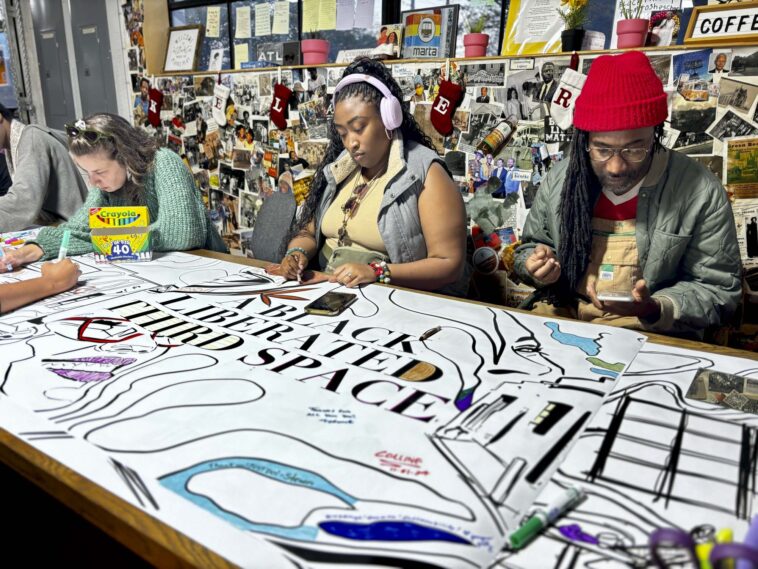
The Atlanta Regional Commission’s Community Centered Design program enables artists and community members to collaborate in meaningful ways, such as this banner designed for Ke’nekt Cooperative in 2024. (Photos courtesy of ARC)
Thoughtful, experiential and radical are all words that could be used to describe the Atlanta Regional Commission’s Community-Centered Design (CCD) program. Now in its third year, the four-month program is attended by artists, culture workers, planners and government officials to explore “ways that culture workers and community-builders can collaborate” through workshops, exchanges and real-world engagements with neighborhood partners. By initiating and developing ideas collaboratively, participants learn how to expand their work both equitably and imaginatively.

Social justice artist Roshani Thakore designed and now leads the program. Thakore grew up in Stone Mountain and Decatur as the daughter of Indian immigrants. Even as a young child, she knew she wanted to be an artist, but at that time the DeKalb County school system had few resources to support her passion, and she witnessed how her parents faced other barriers such as transportation.
Roshani Thakore, head of community engagement and culture at ARC.
Later, when Thakore moved to New York City to attend the Pratt Institute School of Art, these lived experiences informed her burgeoning social justice art practice. She became involved with community-based art projects at the Queens Museum as led by the legendary Tom Finkelpearl — an advocate for putting the “public back into public art” — which further strengthened her commitment to elevate voices through actions that are inherently transformational and often political.
After 20 years in New York City, Thakore moved to Portland, Oregon, to attend Portland State University’s Art and Social Practice MFA program. While in Portland, she was artist-in-residence at the Asian Pacific Network of Oregon (APANO) and later joined the staff. APANO believes in the power of culture and the voices of artists as social justice tools, and her involvement with the organization presented a major opportunity for Thakore to put into practice her commitment to community equity and the amplification of underserved voices. In 2022, Thakore returned to Atlanta and found a job at the Atlanta Regional Commission (ARC) in the community engagement office, which offered yet another opportunity to integrate her art practice with real-world actions.
The Community-Centered Design initiative is under the umbrella of ARC’s regional community development programs. The Atlanta Metropolitan Commission was originally founded by Fulton and DeKalb counties and the city of Atlanta in 1947. In 1960,the effort was established as the Atlanta Regional Metropolitan Planning Commission and later became known as the Atlanta Regional Commission through consolidation efforts by the Georgia General Assembly. In the years since, the ARC’s jurisdiction has grown to 11 counties and 75 municipalities, and today ARC is responsible for approving transportation projects, including highway expansions, as well as new transit and bus lines across the region.
Community development practice grew out of these mandates and expanded definitions of what constitutes transportation, such as community walkability. Much of this work is supported by the U.S. Department of Transportation, which requires community engagement as a condition for any Metropolitan Planning Organization (MPO) to receive federal dollars.
ARC’s Community-Centered Design program is pushing the envelope among traditional planning agencies, which are heavily data-focused. It has caught the attention of other MPOs and national advocacy organizations such as Smart Growth America, which has highlighted the CCD program to its constituents.
Over the past decades, community and urban planners have factored public art into their work, such as Main Street America, where best practices have emerged. The CCD initiative is certainly built upon this history and methodologies but goes much further. Inspired by the Center for Artistic Activism, the program is designed to advance the participants’ community engagement skills, which then can be deployed to their individual practices. Ultimately, CCD’s mission is to establish deeper understanding between planners and artists and to elevate public involvement with historically excluded groups.
A look at the 2024 CCD program offers insights into its processes. Committing to meet weekly over a four-month period, a cohort of 33 artists, designers, planners and architects was recruited from across the metropolitan Atlanta area. The first month focused on understanding each other’s practices and thinking deeply about how artists can be deeply engaged in community planning and development in radical and significant ways.
After this in-depth orientation, the program shifted to field work, which in 2024 included working with two community-based organizations: the Village Skatepark, a nonprofit indoor skatepark located in Vine City, and The Ke’nekt Cooperative, a mutual aid community of African American entrepreneurs and neighbors centered around a coffee shop in the Westview neighborhood. The collaboration involved rapid research, prototyping, learning by making and a public process where ideas are taken into the community.


Wayfinding efforts for the Village Skatepark were designed by the 2024 CCD cohort.
The skatepark engagement centered around the theme of mobility justice and focused on community participation and wayfinding, culminating in the CCD cohort collectively designing and building a new wayfinding system. Ke’nekt offered a different experience that strived for further understanding of how collective ownership can be a means of anti-displacement. The engagement culminated in the creation of a 15-foot banner that CCD participants and community members collectively colored.
Artist Charity Hamidullah was a 2024 participant and one of the designers of the Ke’nekt banner. Overall, she found the program to be “very uplifting” and a “profound experience.” According to Hamidullah, “the planners realized that they had creative sides, and the artists realized that they had planning skills.” Her insights into how much the work of artists intersects with the work of planners and government leaders will “resonate for years.”
Marissa Jackson, a senior planner for the city of Fayetteville, was another CCD participant. She noted that the government tends to be very structured with review criteria in order to make decisions. From the artists, she learned “to be more open-minded and flexible in thought processes.” Jackson also noted that the class emphasized “place-keeping,” a dynamic process that respects communities’ existing stories and culture, alongside “place-making” strategies.

Community members and artists collaborated on a banner for The Ke’nekt Cooperative in 2024.
CCD’s 2025 program is currently underway, supported not only by ARC but also by the Fulton County Arts Council and the Georgia Council for the Arts. The cohort is working with Atlanta Harvest, an urban farm and wellness center in Ellenwood that serves the Atlanta region. Through the collaboration with Atlanta Harvest, the cohort will focus on food sovereignty, land stewardship and climate resilience.
Through this experiential arts and culture program, Community-Centered Design is planting seeds for future community engagements that ensure that all stakeholders, including residents, artists and local organizations, are part of the dialogue around sustainable development. The investment ARC has made in supporting this cutting-edge program will ultimately lead to more equitable communities — neighborhood by neighborhood.
::

Louise E. Shaw, former curator of the CDC Museum and executive director of Nexus Contemporary Art Center (now Atlanta Contemporary), considered urban planning as an alternative career.




GIPHY App Key not set. Please check settings