
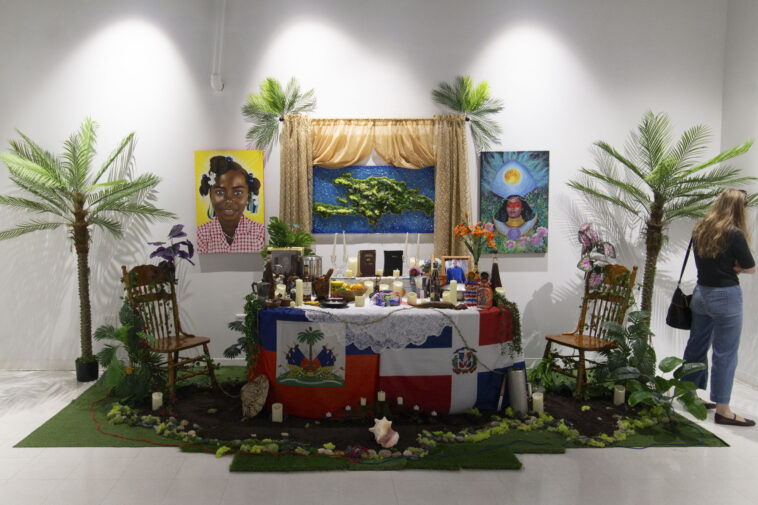
‘Ayiti-Quisqueya: Nexus of the Taíno’ showcased the works of Reinilda Blair and Darnelle Louis-Jacques. (Photos by Leia Genis)
Haiti and the Dominican Republic have a contentious history. Once the home of the native Taíno people, the island of Hispaniola has — since the onset of Spanish and French colonizers in the late 15th century — been cleaved in two. The previously unified island was subject to a period of bipolar colonization which lasted until the early 19th century.

Each colonizer implemented different methods of colonizing, although all were brutal in their own right. The French turned the western side of the island into plantations, bringing in as many as 860,000 slaves during their rule. The Spanish, contrarily, tried to transform the eastern side into a destination for more white settlers, with whites accounting for as much as one-third of the population at one point.
These different settlement patterns, extrapolated over hundreds of years, resulted in two vastly different ethnic groups; Haitians (previously under French colonization) and Dominicans (previously under Spanish colonization). This parity between the two halves of the island has been the subject of constant contention, even up to the present day. This history of a common ancestry violently split in two is the background against which Reinilda Blair and Darnelle Louis-Jacques presented their exhibition Ayiti-Quisqueya: Nexus of the Taíno at ArtsXChange’s Jack Sinclair Gallery.
This exhibition, one which featured painting and installation, is, per the exhibition text, intended to “pave the way for a future characterized by unity, empathy and mutual respect.” This has manifested as seemingly two separate bodies of work — historical re-enactments and contemporary cultural exchanges.

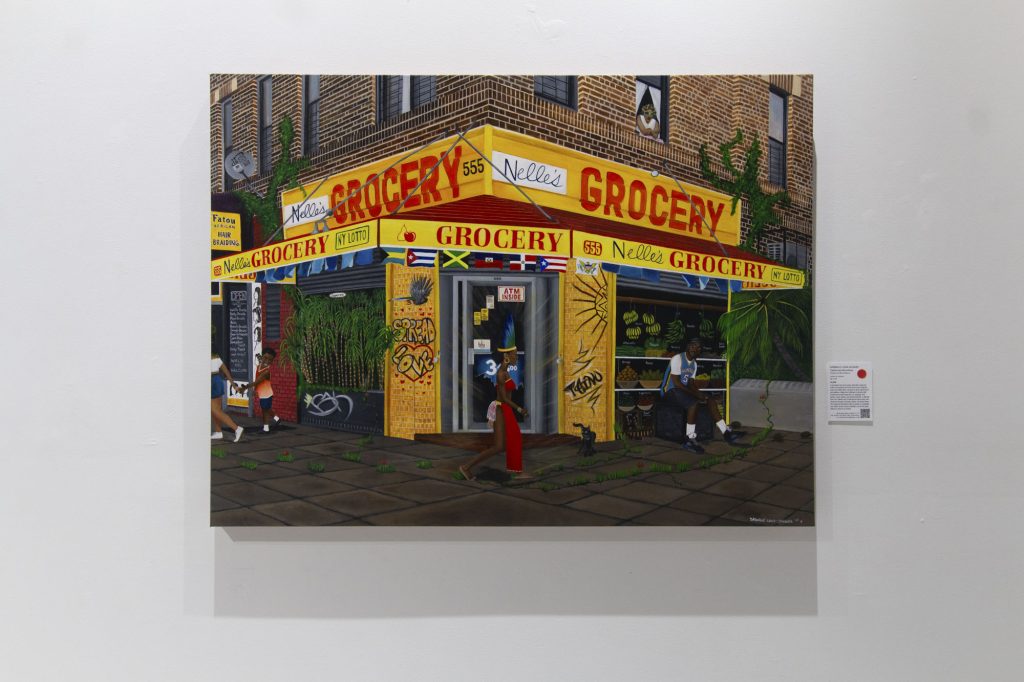


Install photos of Ayiti-Quisqueya: Nexus of the Taíno at ArtsXChange’s Jack Sinclair Gallery.
In the first vein, we find artworks like Ain’t Gold (2025) by Blair. A long horizontal canvas is visually split in two by a tree that runs the height of the canvas. On the left side, the tree is barren, behind it stands a monument to Christopher Columbus, a group of unidentifiable people gathered at its base. On the right side, the tree is lush with green leaves. Behind it, a small village stands before a vast mountain range, a group of gold-leaf figures holding hands in a circle.
As per the text accompanying the artwork, “This piece contrasts two sides of Dominican history,” with the left capturing relics of colonization and the right a Taíno village, untouched by colonizers. While the artwork certainly shows Blair’s skill with paint, I found it, and others like it, to be too didactic, as if they were illustrations made for a history textbook rather than artworks about bridging cultural parity. This bluntness made me feel like I was in a history museum rather than an art gallery. While I think the artists are correct to assume that there are visitors who will be unaware of the contentious history of the island of Hispaniola, perhaps the education would be better served if written in the exhibition text.
This obtuseness, I am happy to say, is not carried through the entirety of the exhibition. In the second vein, the one dedicated to cultural exchange, we find artworks like Soup LIbète (2025) by Louis-Jacques. Again, a long horizontal canvas is visually split in two, the left half painted a solid black, the right a solid crimson. Before these blocks of color two pairs of arms reach toward the middle of the canvas, a bowl of soup conjoining the four hands. The dish — soup joumou — is traditionally a Haitian meal, but Dominicans have their own variant of the soup. In this painting, the soup unites both hands and cultures. The arms reach toward each other, bridging the gaps this exhibition aims to fill. Within this artwork, the symbolism is more subverted, its composition still starkly divided but not in a way which feels trite.
The most impactful artwork in the exhibition was a sculptural installation positioned in the middle of the gallery. Composed of two stools,one chair and a table, this installation presents a game board for dominoes, seemingly taken right out of a Caribbean corner store. Here, cultural exchange isn’t a static symbol but an active exchange. I like to think of this board in use, with people of disparate backgrounds and nationalities convening to take part in the pleasantries of a simple game. Perhaps now that this exhibition is over, the table will be placed in a public area — something I wish for dearly as there is no greater way to bridge cultural divides than getting different people equal seats at the same table.
::

Leia Genis is a trans artist and writer currently based in Atlanta. Her writing has been published in Hyperallergic, Frieze, Burnaway, Art Papers and Number: Inc. magazine. Genis is a graduate of the Savannah College of Art and Design and is also an avid cyclist with a competition history at the national level.




GIPHY App Key not set. Please check settings