
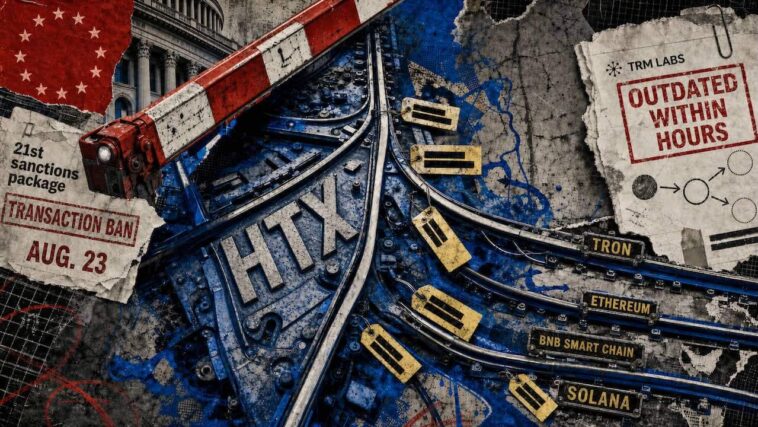
The European Union has sanctioned HTX, widening a Russia crackdown that has already affected counterparties beyond the exchange.
The bloc placed Huobi Global S.A., the entity behind HTX, under a transaction ban in its 21st sanctions package adopted July 23. From Aug. 23, EU operators will be prohibited from transacting with the exchange, though the restrictions stop short of freezing its assets.

The move follows Britain’s May action against Huobi Global, which triggered tighter scrutiny of HTX-related transfers at other major crypto exchanges.
The EU is now taking that pressure further, introducing a mechanism that could eventually restrict crypto services across entire countries that host platforms used to evade Russia sanctions.
UK sanctions pushed scrutiny onto counterparties
Britain’s May designation showed how restrictions on HTX could quickly spread to businesses and customers outside the exchange.
After the UK targeted Huobi Global on May 26, OKX warned customers who had previously conducted arbitrage between its platform and HTX that continuing to transfer funds between the two exchanges could trigger additional scrutiny of their accounts.
“Please avoid this behavior,” OKX told users.
The warning came after British authorities designated Huobi Global alongside a group of crypto platforms and entities accused of supporting Russian sanctions evasion.
UK authorities said they had reasonable grounds to suspect Huobi Global provided financial services to entities linked to Russia’s financial system, including the A7 cross-border payments network.
Britain also said a major global crypto exchange had channeled more than $1.5 billion toward Kremlin-linked entities. Blockchain intelligence firm TRM Labs identified that exchange as HTX.
The UK action subjected Huobi Global to an asset freeze and restrictions on making funds or economic resources available to the company.
HTX sought to distance the exchange from the entity named by Britain by saying:
“The listed entity Huobi Global S.A. is distinct from the online HTX exchange.”
However, the British authorities subsequently made clear that they considered HTX covered by the designation. The UK sanctions notice lists HTX and HTX Exchange among the names associated with Huobi Global.
In response, Justin Sun, an adviser to HTX, said the exchange “believes in full compliance with all applicable laws and cooperation with law-enforcement agencies worldwide.”
HTX shifts on-chain infrastructure after UK designation
HTX remained operational after the British sanctions while rapidly rotating the wallets supporting its exchange activity.
Blockchain analysis company TRM Labs said in a July 21 report that HTX had changed hot wallets and funding addresses across Tron, Ethereum, BNB Smart Chain and Solana in the weeks following the designation.
Some addresses remained active for only hours before being replaced.
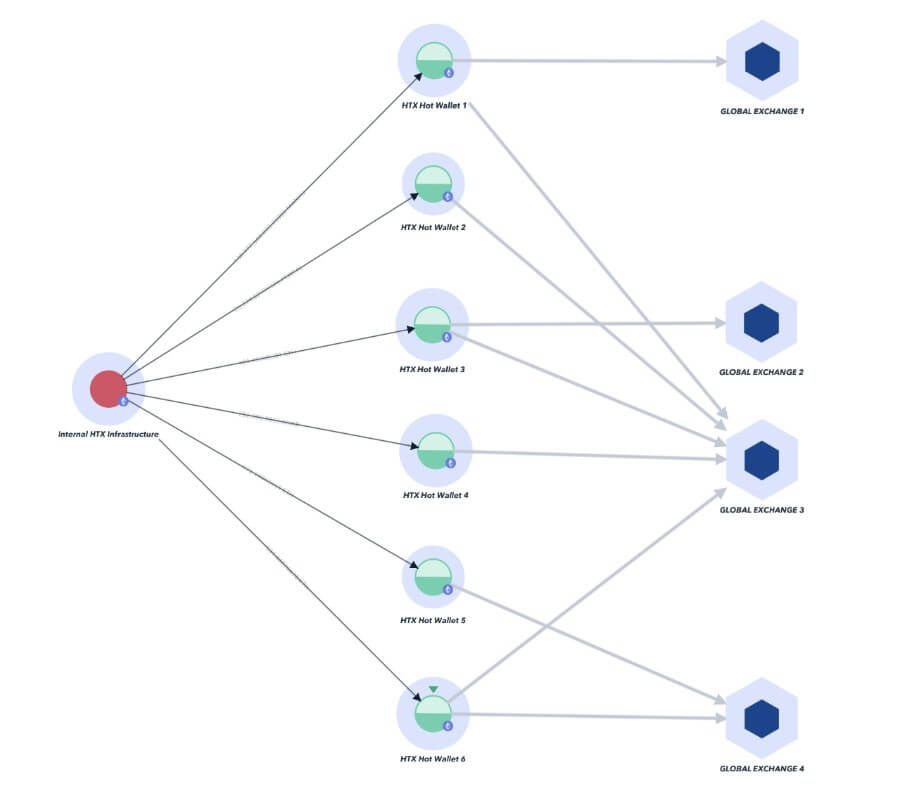 HTX Wallet Rotation (Source: TRM Labs)
That turnover left screening systems built around fixed address lists struggling to keep pace with the exchange’s changing infrastructure.
A wallet attributed to HTX could be retired while another began processing deposits and withdrawals before compliance providers had identified its connection to the exchange, TRM said.
The firm found that static blocklists could therefore become outdated within hours.
TRM said firms screening for sanctions exposure increasingly need to track transaction patterns, funding relationships and other on-chain behavior that can connect newly activated wallets to an already identified platform.
Its latest assessment of the EU package also warned that exposure can extend beyond direct transactions with a designated address. Funds moving one or two transaction hops from sanctioned platforms can still trigger compliance concerns as firms investigate their origin and destination.
Blockchain investigator ZachXBT said the UK action had already made those signals less useful in some investigations because of the volume of addresses carrying exposure to HTX.
He described the resulting on-chain “tainting” as catastrophic, arguing that HTX differs from previously sanctioned crypto businesses such as Huione, Blender and Hydra because the exchange also serves a substantial retail user base in Asia.
He stated:
CryptoSlate Daily Brief
Daily signals, zero noise.
5-minute digest 100k+ readers
Whoops, looks like there was a problem. Please try again.
You’re subscribed. Welcome aboard.
“Basically now I’ve had to ignore the sanctions category when tracing cases by exposure since ‘risk’ itself has become meaningless.”
He also criticized compliance tools for failing to adequately distinguish activity that occurred before a sanctions designation from transactions that followed it.
The criticism highlights another difficulty created by wider screening. Connections to HTX can trigger additional review without establishing that the underlying transaction was illicit or occurred after sanctions took effect.
EU takes crackdown one step further with third-country power
The EU’s latest package is nevertheless extending the regulatory perimeter beyond individual exchanges and their changing wallets.
For the first time, the bloc has created a mechanism allowing it to prohibit transactions involving crypto providers across an entire third country when services there are used to help Russia evade sanctions.
The EU described the measure as a deterrent to countries hosting platforms that facilitate circumvention. It could allow Brussels to prohibit transactions between EU operators and crypto providers used by Russia within the affected jurisdiction.
The new authority comes as Russia-linked payment infrastructure increasingly operates outside the country.
The package extends transaction restrictions to 14 crypto-related service platforms based in Georgia, Panama, the United Arab Emirates, the Marshall Islands, Kyrgyzstan and Belarus.
Several have already faced action from other Western governments, including EXMO, BitPapa and Rapira.
The EU also added four designations tied to the A7 cross-border payments network, citing its new connections to Africa. TRM identified A7 Nigeria and A7 Africa among entities covered by the latest measures.
CryptoSlate previously reported that A7 had expanded into Lagos and Harare after claiming to have processed more than $90 billion during 2025. The network is linked to sanctioned Moldovan politician Ilan Shor and Promsvyazbank, the Russian state-owned lender tied to the country’s defense sector.
A7 also operates A7A5, a ruble-backed stablecoin that has become a major settlement vehicle within the network.
The expansion follows a broader pattern in which crypto activity has moved after individual platforms were targeted.
Following the multinational crackdown on Garantex in 2025, TRM said transaction flows shifted toward successor infrastructure and the A7 network absorbed part of that activity.
The EU’s latest approach gives it the option of following those flows beyond the next individual exchange.
A country hosting platforms used to bypass Russia sanctions could now expose crypto providers across the jurisdiction to restrictions on transactions with EU operators, even as regulators continue targeting individual firms.



GIPHY App Key not set. Please check settings