
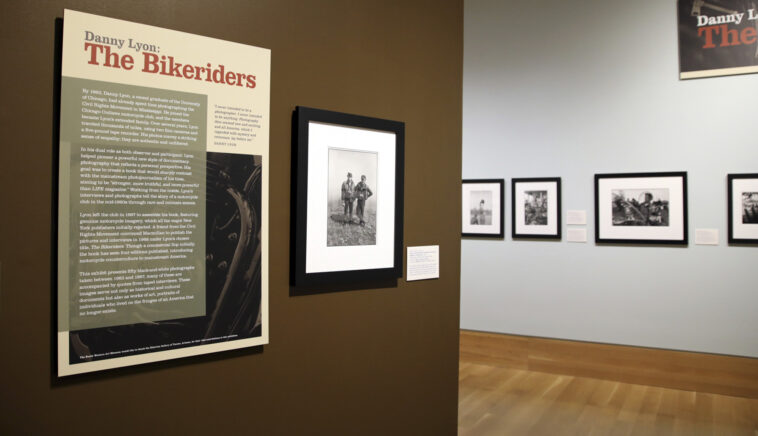
Gallery view of Danny Lyon: The Bikeriders. (Photos courtesy of Booth Western Art Museum)
Leather, chrome, smoke and a Leica camera: Danny Lyon mixed them into an image of America few had seen. When the young photographer embedded with the Chicago Outlaws motorcycle gang in the late 1960s, he didn’t just capture a subculture — he helped invent one. The resulting work shocked and fascinated audiences when his book The Bikeriders was first published in 1968.

Lyon’s unvarnished portrait of a Midwestern motorcycle club revealed a singular world from the inside, and the images — mingling intimacy and menace, camaraderie and middle-finger anarchy — helped redefine documentary photography as something lived and felt, not observed anonymously from behind a lens.
The series proved monumentally influential. Echoes ripple through the work of artists such as Nan Goldin and Larry Clark, as well as today’s street artists and documentarians. The book also helped popularize the notion of “the biker” as an archetype in the American mythos. It sparked the creation of the pivotal 1969 film Easy Rider, and the series itself became the subject of a Hollywood movie featuring Austin Butler in 2024.
The Booth Museum, located about 45 minutes from Atlanta in Cartersville, has mounted an exhibition of Lyon’s Bikeriders through January 18, giving this body of work a revealing new frame. At first glance, leather-clad motorcyclists and the cowboys of the American West may seem worlds apart. But, when placed here, Lyon’s riders feel like a continuation of the imagined and idealized Western archetype: nomadic, untethered, pushing against the boundaries of convention and geography. Horses give way to motorcycles, frontier-town saloons to clubhouses, as the legend of the West shifts gears. The exhibition’s placement at the Booth also brings a latent, tragic context to the fore: the cyclists, like cowboys, ride through landscapes that were once Native land, both myths mask histories of dispossession.
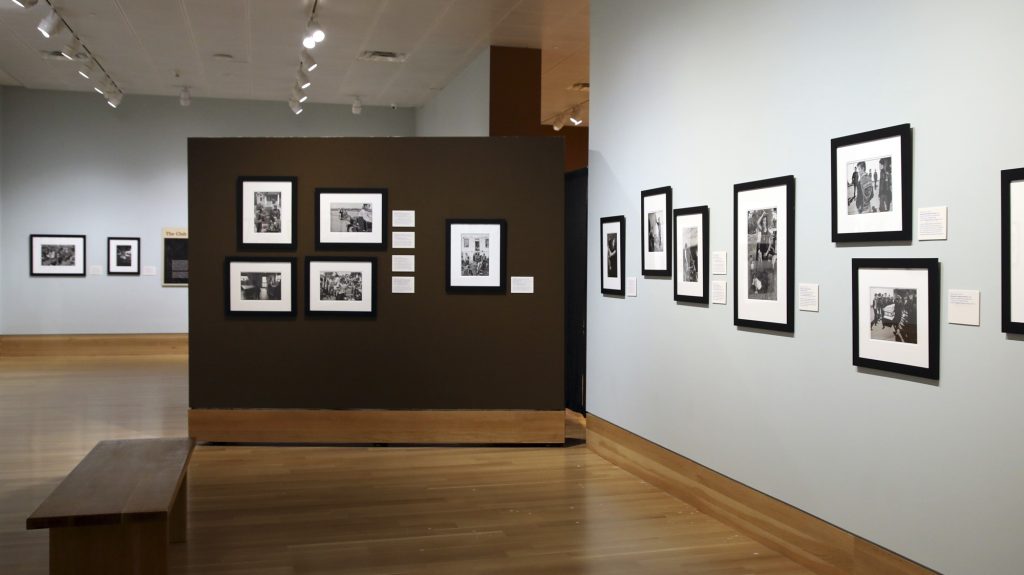
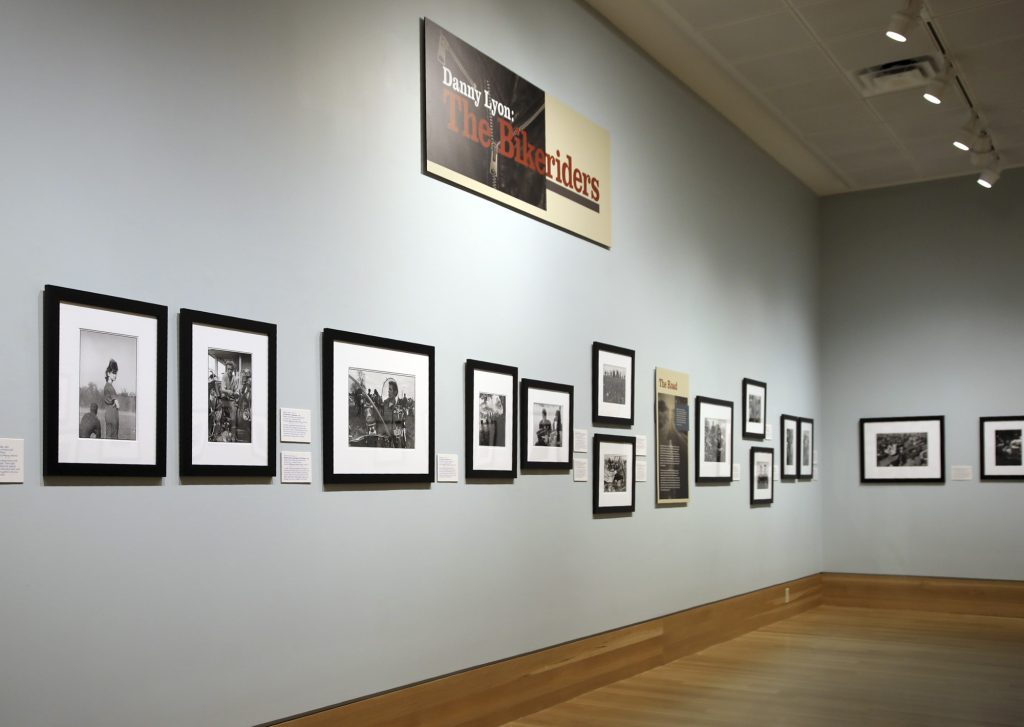
Gallery view of Danny Lyon: The Bikeriders. (Photos courtesy of Booth Western Art Museum)
Whatever the setting, Lyon’s prints thrum with life. The riders and their families are never caricatures, but remain people — friends, lovers, kin — captured within the rituals, style and codes of their singular world.
Traditionally, critics (and Lyon’s own captions) cast the women as appendages — wives, girlfriends, “mamas.” But I was surprised to find them registering differently when seen in person. Their stance, dress and gaze radiate agency, a swagger straddling a motorcycle or the elegance of eyeliner and a strangely formal dress. Lyon’s camera seems to linger on women not as decorative but rather as vital participants. They emerge as icons of rebellion, independence and glamour, foreshadowing cultural movements that were only just beginning in the late ’60s.
When the book appeared, it stood alongside Robert Frank’s The Americans as a radical act of the new documentary style, collapsing the line between artist and subject. Seen in 2025, in an age when biker culture has been commodified through fashion, film and branded lifestyle products, Lyon’s photographs return us to the source. They remind us of subculture before spectacle, social media and suburban dads on Harleys. At the same time, they feel strikingly contemporary — the staging of personae, the negotiation of belonging and exclusion, all resonate with today’s conversations about performative identities.
For Atlanta-area audiences, this exhibit is a rare chance to road-trip out to see one of the most influential photo projects of the 20th century in person and to consider how the mythology of freedom and rebellion — America’s most persistent export — still circulates.
::

Andrew Alexander is an Atlanta-based writer.




GIPHY App Key not set. Please check settings