
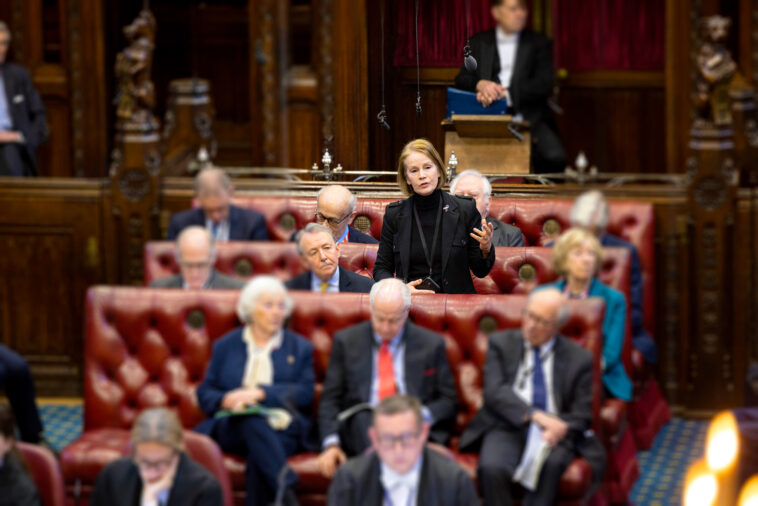
Historically, more male than female dancers have moved into leadership roles after their performance careers. Yet for Deborah Bull, CBE (a principal with The Royal Ballet from 1992 to 2001 after initially joining the company in 1981), her atypical “second act,” spanning senior roles in higher education and politics, has been less defined by her gender than by the striking differences between her professions.
“I used to say that the oddest thing about me in any scenario was not that I was a woman, but that I was an ex-dancer,” Bull says on a call from the House of Lords in London. The Lords, which is the upper chamber of the UK Parliament, scrutinizes legislation and holds the government to account. Bull has been a member since 2018, taking the title Baroness Bull, and has served as a deputy speaker since 2024.

In January, Bull also ran for Lord Speaker—the role overseeing proceedings in the House and acting as its ambassador at home and abroad. “I never thought I’d stand for election, but I really enjoyed it,” she says. While Bull did not win, she received an impressive 44 percent of the vote. “The opportunity only comes up every five years,” she says. “I think if you’re interested in something, you have to do it. You don’t know where you’ll be in five years’ time.”
Seizing the Moment
The impulse to dive into opportunities, even when they are intimidating, has been a defining feature of Bull’s offstage career. In 2001, the Royal Opera House invited her to become the creative director of ROH2, overseeing the venue’s alternative performance spaces and nurturing new talent, such as choreographers, composers, and designers, and experimental forms. “That was where I learned to think about strategy, policy, people management, budgeting, and programming,” she says. Bull could have lived out her entire career in this familiar environment, but she purposefully chose to take a leap into the unknown, joining King’s College London as director of cultural partnerships in 2012. “I knew I could drive change, inspire people, and implement great ideas, but I’d only ever done it in an institution that had known me since I was 11. Could I really do that in an environment where people’s credentials are based on a set of learning and life experiences I didn’t have?”
It turned out she could—and in many other environments as well. Through the years, Bull has worked with institutions ranging from the BBC to Arts Council England (the national public funding body for the arts), and even been a judge for the famed literary award the Booker Prize. Over time, she’s discovered that many of these settings aren’t so different from an opera house, as they’re all steeped in history and convention. “As a dancer in the classical heritage, you’re always seeking to retain the best of the past, build on it, but be willing to let things go if they are not productive toward what needs to happen for long-term sustainability,” she says.
Performance, Reimagined
The similarities between Bull’s first and second careers don’t stop there. When describing her current daily routine in the House of Lords, she compares its structure to that of a performance. “What happens on the floor of the House is really the tip of the iceberg,” Bull says. “If you’re speaking in a debate or to an amendment, you will have done lots of research, talked to charities, think tanks, and people with lived experience. You have to do all that rehearsal beforehand.”
In addition to her involvement in the wide range of legislation the House of Lords is debating and scrutinizing at any given time, Bull is also currently working on issues ranging from arts education to improved mobility for young people and touring artists post-Brexit to dyscalculia (difficulty with learning or understanding mathematics). Does Bull’s background as a principal dancer give her authority when speaking on arts and culture? “It piques people’s interests, but (what’s) going to persuade the treasury and government (is) demonstrating that supporting this will deliver better outcomes for health, employability, regional development, and economic growth,” she says. “We’re all frustrated because there is a body of evidence about the benefits of arts education for young people. But when the chips are down, it always seems that the arguments aren’t quite strong enough.”
Bull’s trajectory is a prime example of how the arts cultivate transferable skills and enhance employability. She highlights the ability to learn through observation as something that she honed through dance, and that has proven valuable in navigating new professional contexts. “Pretty much anyone can learn to use a spreadsheet, but the skills we get through dancing—to learn from failure, to test things in the marketplace, to recalibrate when things don’t work, to subsume your individual preferences to the greater need of the whole…Those are the life skills that people really value in employees.”
Despite dancers’ broad range of skills, Bull has noticed that they often avoid discussing post-performance careers. For individuals, she advises “spotting gaps” in the industry that fit their interests and could provide future opportunities. She also believes that the companies have a role to play. They could, for example, be having “day one” conversations with incoming dancers about practicalities like pension plans and opening up discussions about life beyond the stage. “It would get rid of the Peter Pan mentality that ‘I’m going to do this forever. I’m never giving up.’ Actually, we’re all giving up,” she says. “The business of running a company has most professions within it. Dancers can learn about everything from management to finance, costume design, and PR.”
By planning ahead and taking advantage of the opportunities around them, dancers can use their performing careers as “the flight path for the exit,” as Bull describes it. Considering the boundless path she continues to fly 25 years after retiring from performance, it seems like Bull is exactly the person to listen to.




GIPHY App Key not set. Please check settings