
Manual palletizing is one of the most common, and most overlooked, inefficiencies in food manufacturing. It happens at the end of every packaging line, shift after shift, and because it has always been done by hand, it rarely gets flagged as a problem worth solving.
But the costs are real. Operators performing repetitive lifting throughout an entire shift develop chronic back pain. Throughput is capped by how fast a person can physically move. And as production volumes grow, the only solution available without automation is to find more people willing to do a physically demanding job in a labor market that is becoming increasingly difficult to hire from.

That was exactly the situation at Mill Meranoa flour producer based in Merano, in the Trentino Alto Adige region of Northern Italy. With up to 80 employees and a broad range of premium flour and grain-based products for both industrial and retail markets, Molino Merano had built a strong reputation for quality. But as one of its key packaging lines grew in volume, the manual palletizing process at the end of that line was becoming harder to sustain.
There was no room in the existing team for a dedicated palletizing operator. Hiring was difficult. And the physical toll on the people doing the work was noticeable. Something had to change.
.png?width=767&height=432&name=molino-merano%20(2).png)
Finding the right solution
The path to automation started the way many industrial automation projects do at a trade show. Sebastian Obrist, Technical Manager at Molino Merano, was evaluating options when the team discovered Robotiq.
What stood out wasn’t just the technology. It was the deployment model.
Many automation projects take months sometimes longer from first conversation to a running solution. Integration complexity, custom engineering, safety infrastructure, and training requirements all add time and cost that make the investment feel uncertain, especially for a manufacturer that cannot afford to disrupt production for an extended period.
The Robotiq Palletizing Workcell (PE20) offered something different: a collaborative robot-based Workcell designed for fast deployment, easy operator adoption, and real-world flexibility without fencing, without scanners, and without a lengthy integration project.
From discovery to a running Workcell in 5 days
After selecting the PE20Molino Merano moved quickly. Parts were delivered within a week, and from that point, the clock started.
Assembly, wiring, and commissioning were completed in three to four days. Final testing happened on day five. By the end of the first week with equipment on-site, the palletizing cell was operational and running product.
“After installation, assembly, and commissioning, it was all done in four days. On the fifth day, we did the testing and it worked.”
Sebastian Obrist, Technical Manager, Molino Merano
That speed was not accidental. A key factor in fast deployments like this is having the project properly validated before anything ships. Robotiq’s IQ platform which includes a Fit Check, Workcell Simulator, 3D scanning capability, and ROI calculator allows manufacturers to confirm if the Workcell will work in their specific environment before installation begins. Cycle times, reach, pallet configurations, conveyor layouts, and site constraints are all verified through simulation, so there are no surprises when the equipment arrives.
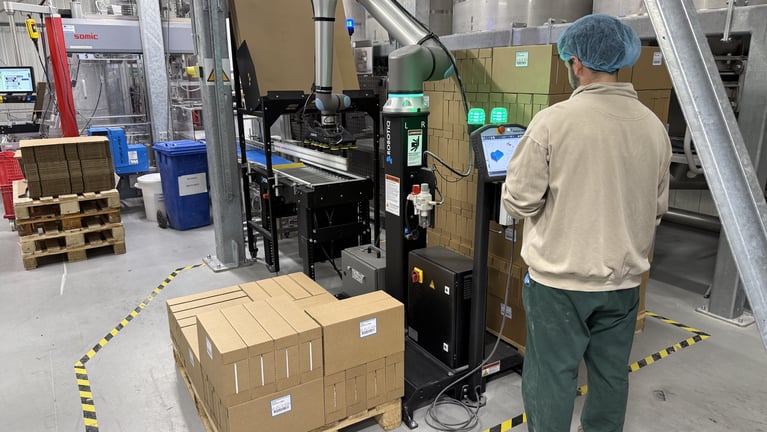
What the PE20 actually does at Molino Merano
The solution installed at Molino Merano is more than a robot arm stacking boxes. It is a complete Palletizing Workcell designed around the realities of the production floor.
The PE20 at Molino Merano includes a vertical interlayer and an integrated smart infeed, which together allow the Workcell to handle multiple SKUs across Molino Merano’s broad product range of different flour types, different package sizes, different pallet configurations without requiring significant changeover time between runs.
The collaborative aspect means the solution operates safely alongside operators without fencing or safety scanners, keeping the footprint compact even on a production floor with limited space. And because operators can change pallets while the solution continues palletizing, the line never has to stop for a pallet swap.
For a facility that had been doing all of this by hand, the difference was immediate.
What changed after palletizing automation
Three months after commissioning, the results at Molino Merano are concrete and measurable.
The back pain is gone: Operators who spent their shifts manually lifting and stacking boxes no longer do that work. The physical toll that accumulated over years of repetitive manual handling has been removed from the job entirely.
The line can scale without hiring: Production volumes on the line have increased, and Molino Merano has not needed to add a single person to the palletizing operation. The PE20 absorbed the increased workload which is particularly significant in a labor market where qualified workers for repetitive manual tasks are increasingly hard to find and retain.
Operators are doing more valuable work: Staff who were previously tied to pallet stacking now have time to contribute elsewhere on the production floor. The automation did not eliminate jobs it redirected people toward work that is less physically demanding and more meaningful.
The investment paid back for itself quickly: The combination of labor savings, throughput improvements, and operator reallocation produced a quick return on investment. A strong result for any equipment purchase, and a compelling case for other food manufacturers evaluating automation for the first time.
.png?width=767&height=432&name=molino-merano%20(3).png)
Read the full case study
This post covers the highlights, but the full Mill Merano case study goes deeper including a detailed breakdown of the challenge, the solution components, the results, and answers to the most common questions manufacturers ask before investing in palletizing automation.

Not sure if palletizing automation is right for you? Start with IQ.
One of the biggest barriers manufacturers face before investing in automation is uncertainty. Will it fit in my plant? Will it handle my products? Will the numbers actually work for my operation? These are fair questions, and they deserve real answers before any commitment is made.
That is exactly what Robotiq IQ is built for.
IQ is Robotiq’s AI-enabled platform designed to take manufacturers from first question to deployment-ready Workcell faster and with greater confidence. It is not a sales tool. It is an engineering and business validation platform that gives you the information you need to make an informed decision.





GIPHY App Key not set. Please check settings