
If you ask a U.S. immigration expert what’s changed over the past year for performing artists, you’ll get 14 bullet points linked to text-heavy web pages. And that’s just the tip of the iceberg. “With the new regime in the U.S., new challenges have arisen,” says Matthew Covey, executive director of Tamizdat, a Brooklyn-based nonprofit that facilitates and advocates for international mobility and cultural exchange.
For artists entering or exiting the country for professional purposes, some of these challenges stem from clearly stated updates to fees, forms, and policies. But there are also greater degrees of uncertainty embedded within application and approval processes, making it harder to predict—and to budget time and money for—the widening range of potential outcomes. Even after an individual or group receives the approval it needs to work in the U.S., “it is clear that changes in rules and enforcement significantly impact them in new ways,” Covey says. “Right now, it’s anybody’s guess what the current administration will do.”

More Extra Than Ordinary
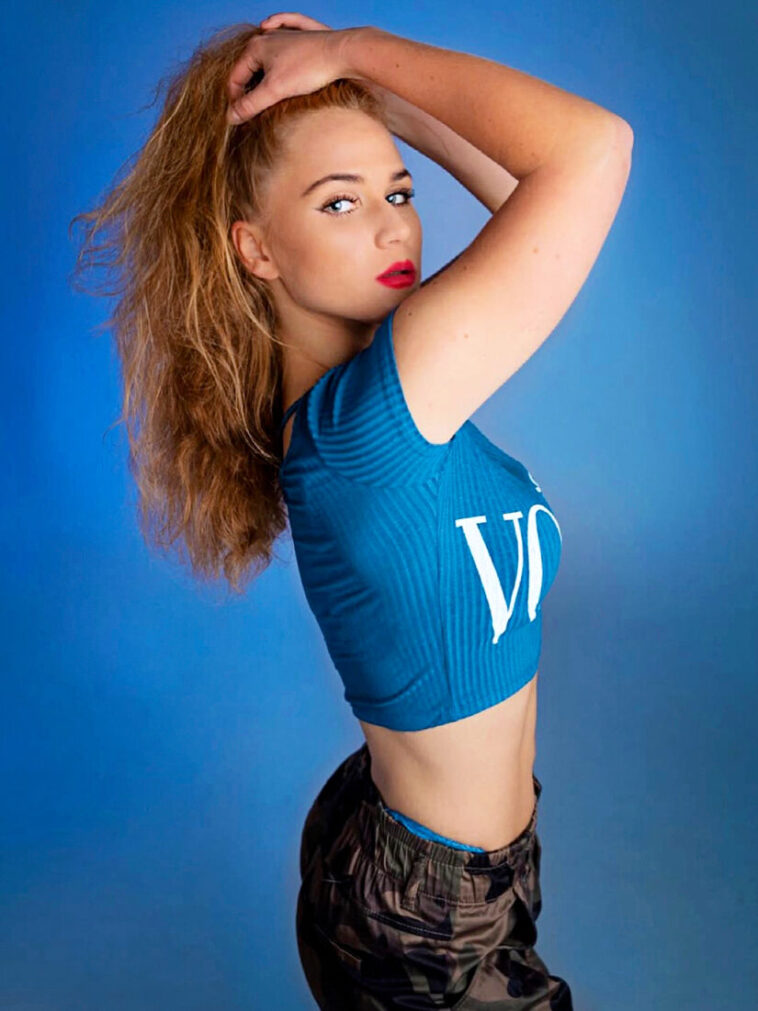
Foreign nationals who want to work in the U.S. face a gauntlet of visa-related hurdles, and these applications seem to be facing a higher level of scrutiny than they have in the past. Commercial dancer and dance teacher Isabella Starrowsky, 28 and based in Zurich, Switzerland, has been working since May 2024 on her petition for an O-1 visa, granted by the U.S. government to certain noncitizens of extraordinary ability in an art form. Despite her lawyers’ efforts, she has yet to secure it as of press time.
Isabella Starrowsky, based in Zurich, has been working since May 2024 on her petition for an O-1 visa.
 From left: Photo by Andrin Maeder, Courtesy Starrowsky; Photo by Hakki Sozen, Courtesy Starrowsky.
Hayden Rivas, 23 and from British Columbia, Canada, moved to Los Angeles in 2021 on an F-1 visa, granted to noncitizen students enrolled in U.S. colleges and universities. Following his graduation from the University of Southern California Glorya Kaufman School of Dance and Gould School of Law in May 2024, he and his lawyer began to prepare for his O-1 visa petition. While “flipping” from an F-1 to an O-1 can be difficult—holders of F-1 visas are generally expected to leave the U.S. shortly after they graduate—Rivas had been approved for an Optional Practical Training period and made the most of this “extra” 12 months offered to F-1 holders to gain professional experience in their fields of study. He lined up roles in Frozen and Miracle on 34th Street, and auditioned for a Norwegian Cruise Line production of the Beetlejuice musical, all of which bolstered his case.
 Hayden Rivas, who recently secured his O-1 visa. Photo by Lee Gumbs, Courtesy Rivas.
“I actually worked as a Canadian citizen on (the cruise) contract,” Rivas says, “because the performances weren’t in the U.S. I tried to be smart and strategic about finding a job until September, because my work authorization was ending in May.” His O-1 came through in August, and Rivas now lives in Brooklyn.
 Hayden Rivas had to make strategic moves to “flip” from a student F-1 visa to an O-1 visa after graduating from USC Glorya Kaufman School of Dance in May 2024.
 From left: Photo by Francisco Gella, Courtesy Rivas; Photo by Hannah Doerr, Courtesy Rivas.
Premium Is the New Normal
The various “P” visas available to groups of artists traveling to the U.S. for a short period are also becoming increasingly expensive to obtain. Until 2024, there was no limit to the number of artists who could be covered by a single petition for a P-1 visa; tango duos, tap quintets, and hundred-member ballet companies all paid about the same amounts for permission to appear on U.S. stages. Now, however, each P-type petition is limited to 25 people. That one recent policy change “has tripled or quadrupled the cost of (that aspect of) touring for larger companies,” says Brian Taylor Goldstein, partner at GG Arts Law, a New York City firm that specializes in paperwork necessary to cultural exchange. And any P-1 petition can be held up due to complications for just one of the artists involved.
International dance companies, and their presenters in the U.S., increasingly get trapped inside a frustrating—and expensive—four-month margin. While companies cannot initiate a petition more than a year in advance of the need for a visa, regular processing now routinely takes eight full months or more. The only way to ensure the clock doesn’t run out on a touring engagement, potentially years in the making, is to pay for premium processing—which guarantees a response within 15 days but now costs $2,805 per petition, up from the previous premium processing fee of $2,500. (And remember, large touring parties now require multiple visa petitions.)
“We’ve got a system that is already backed up,” Goldstein observes. “So now, they’re forcing everyone to pay them more to do it quickly. At what point have you created so much premium processing that now that becomes backed up, and now premium processing takes a full month? I don’t have a crystal ball, but that wouldn’t surprise me.”
In and Out Privileges
Many groups that tour internationally include dancers from multiple countries. Not only has there been an apparent increase in the likelihood of complications for those mixed-nationality ensembles, but, in some cases, individuals may need to travel back to their home countries for in-person processing at a U.S. consulate, before reuniting with their colleagues for the U.S. tour. And even dancers with European passports can be turned away at the border. Reporting for American Theatre magazine last summer, Miriam Felton-Dansky noted that, when Danish choreographer Mette Ingvartsen’s company visited New York University in spring 2024, one Iranian-born dancer was denied entry to the U.S.—despite holding an E.U. passport.
In most cases, the general terms for dance artists working in the U.S. under visas granted prior to January 2025 haven’t changed. “However, it would be no surprise if it doesn’t feel that way,” says Bertrand Evans-Taylor, director of government affairs at national service organization Dance/USA. “Folks with O-1 visas are supposed to be able to travel internationally and be able to reenter the country, but I’ve heard reports that folks have been required to have the original paper copies of documents that they aren’t supposed to need, and that people have had to literally dance for a border agent,” he says. “With the tense political environment around border crossing, there is a lot of pressure on agents and travelers that can lead to mistakes on both ends.”
Watch Your Digital Footprint
Sources say that at the moment, those who are in the process of obtaining U.S. residency permits and work authorizations should expect heightened surveillance of their social media and other online activity. Agents may not just be screening applicants for criticism of the federal government, but also for evidence that suggests an artist has intentions beyond what a visa permits. If you’re applying for a shorter-term visa, “be sure to establish clear reasons as to why you will return to your home country after your time here,” says Evans-Taylor. “It is important to be clear that you are traveling for work, not to immigrate to the U.S.”
Goldstein strongly encourages any noncitizen artist to independently verify what they are told by their professional contacts in the U.S. It is too frequently the case, he says, that competition organizers, dance schools, university departments, and other employers will suggest or even declare to foreign nationals that they are allowed to accept certain offers, when in fact they are not, which primarily puts the artist—far more than the U.S. organization—at risk. And that can be true even if the opportunity is unpaid.
Dancing the Immigration Experience
Originally from South Korea, hip-hop choreographer Sun Kim was granted her first of three O-1 visas in 2014, and earned her U.S. green card in 2023. Two years ago, she began working on Alien of Extraordinary, inspired by “the labyrinth of the U.S. artist-visa system—a process that flattens human stories,” she says. Rooted in popping and featuring eight dancers, many of whom are immigrants themselves, Alien premiered last November and will be performed this month as part of the Works & Process Underground Uptown Dance Festival in New York City.
 Sun Kim Dance Theatre in Alien of Extraordinary. Photo by Jordan Kaya, Courtesy Sun Kim Dance Theatre.
What was it like for you to navigate moving to the U.S. as a dance artist?
The entire immigration system feels chaotic. It reduces our lives to nothing but paperwork, leaving us feeling small and powerless at times. But, every so often, there’s a glimmer of hope, a faint light at the end of the tunnel that makes us believe that, just maybe, we’ll get there. I’m one of many who will tell you that all the mental, financial, and emotional struggles were worth it.
Were any of the surprises pleasant?
One of the most unexpected things during this process was discovering just how many people were willing to help and support me. When my first O-1 visa petition was declined, I was ready to give up. I had no money and no energy left. But when you’re a genuinely good person and a committed artist, people are always there to support you. That was a big part of why I appealed the denial and, ultimately, my visa got approved.
Do you have any concerns about Alien of Extraordinary complicating your residency status?
No. Despite the current administration’s efforts to censor what people believe, art remains our form of protest, and we will always find ways to express ourselves. I felt a deep need to honor our stories and share the untold narrative of what we go through.
What do you want audiences to take away from Alien of Extraordinary?
A sense of hope. The process is messy, often illogical, and overwhelming, but, at the end of the day, we’re all just trying to do our best. And our best takes other people. My hope is that people will reach out to one another, because that’s what we “O-1” another.
Learn More Online
For artists working internationally, guidance and best practices are changing more frequently than they have in decades. A few websites to bookmark for future reference are:
artistsfromabroad.org and tamizdat.org: Artists from Abroad and Tamizdat, which publish updates relevant to artists and groups exploring opportunities in the U.S.
on-the-move.org: On the Move, a collection of
resources for artists exploring opportunities in Europe
uscis.gov: United States Citizenship and Immigration Services (USCIS), the government agency that processes visa petitions
Dancing Out the Door
A growing number of U.S. citizens are curious about living and working abroad as dance artists, either temporarily or permanently, prompting some international organizations to refresh the guidance they offer online. For those exploring opportunities in European countries, for example, On the Move, established in Belgium in 2002, helpfully gathers information about many of them in one place.
Understandably, you might assume that the rules are basically the same across member nations of the European Union. Unfortunately, it isn’t so simple. “Each country has its own labor laws and regulations,” explains Anaïs Lukacs, director of MobiCulture, a resource for international artists who are en route to France. “One of the points to be clarified is the status under which dancers or choreographers can work in the country in question.” As an example, an individual planning to work in France must have an employer, whereas international artists can work for themselves while in Germany.
The post How U.S. Immigration Policies and Uncertainties Are Affecting Dance Artists appeared first on Dance Magazine.




GIPHY App Key not set. Please check settings