
Real-time insights
Crash analysis is just one part of a broader digital transformation. Porsche Cup Brasil is also using real-time telemetry to gain deeper visibility into vehicle behavior during races. Data from onboard sensors is streamed into Microsoft Fabric every few seconds, allowing engineers to detect anomalies and intervene quickly. Insights are visualized through live dashboards in Microsoft Power BI.
Engineers can now detect when a car moves outside expected parameters and respond immediately. If critical systems show abnormal readings, the team can call the driver into the pits or, in more serious cases, stop the car altogether to prevent further damage or safety risks. Real-time monitoring is already helping prevent failures by enabling interventions before issues escalate, all while cars are still on track.

“The availability of real-time data has completely transformed race dynamics,” says Luis Baldini, engineering coordinator at Porsche Cup Brasil.
We quickly realized we needed to create specialized agents for each piece of the car
Thiago Iacopini
Cumulus CEO
The crash analysis system, developed with Microsoft partner Cumulusintegrates a network of three AI multi-agents managing several specialized agents designed to cover specific tasks. Multiple components are used instead of a single model to improve accuracy, particularly because race cars frequently change their external appearance with new liveries.
“We quickly realized we needed to create specialized agents for each piece of the car,” explains Thiago Iacopini, Kumulus CEO.
The main multi-agent is the image analyzer. Engineers upload crash images through a web interface running on Azure Kubernetes Service where they can first create a digital crash record with contextual information such as the car model, driver, race day, and crash details.
 Teams use cell phones to capture images from different angles, focusing on the areas that have been impacted. Photo by Microsoft.
The web app connects to a Python-based backend, which calls the image analyzer workflow, hosted in Microsoft Foundry. It analyzes the images and identifies damaged components from a catalog of approximately 2,000 parts. Series of agents, built with Microsoft Visual Studio Code with the help of GitHub Copilot, were trained to recognize different car components and perspectives.
 Porsche Cup Brasil’s AI powered crash analysis system analyzes images of damaged cars and generates a preliminary list of affected parts. Photo by Microsoft.
Microsoft Azure AI Search holds vectorized instructions and structured knowledge that helps the agents understand how to analyze each photo and what constitutes damage in different parts of the car.
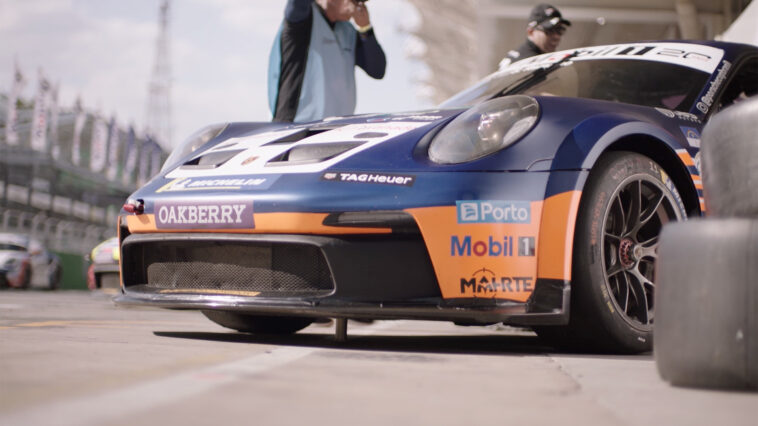
 The crash analysis process begins the moment a damaged car arrives in the pit boxes. Engineers carry out a physical inspection and take photographs of the car’s damaged exterior. Photo by Microsoft.
In the end, human expertise remains central to the process. Analysts review and validate the AI’s output and make final repair decisions, feeding corrections back into the system to improve performance over time. Crash images and related data are stored in Microsoft Fabric, with historical records stored separately in Azure Data Lake Storage.
Porsche Cup Brasil is preparing to introduce a second multi-agent into the workflow, the garage scheduler, which will automate parts ordering and work in tandem with the analyzer. Additional advanced visual models are planned to help identify components that may not be visible in photos.
A third planned element is a data agent that would connect crash analysis with real-time telemetry data. This agent would bring more contextual insights — such as speed, force and other car parameters — into the crash analysis process.
“The goal is to further expand the use of AI agents within the Microsoft Fabric ecosystem,” Baldini says, pointing to strong potential in predictive failure prevention and maintenance support. Even so, he stresses that AI remains a decision-support tool with engineers and analysts retaining full control and making the final call on every recommendation.



GIPHY App Key not set. Please check settings