
Meta Platforms: Scaling Its Revenue Base
Meta Platforms (META +1.50%) primarily generates revenue by offering digital advertising across its social applications, including Facebook and Instagram, and developing virtual reality hardware.
While launching its Muse Spark artificial intelligence model and expanding its optical cable manufacturing capacity, it reported a 48% net income margin for the quarter ended March 31, 2026.

Snap: Navigating Seasonal Revenue Patterns
Snap (SNAP +1.61%) generates revenue mainly by selling digital advertising space and augmented reality features on its Snapchat camera application.
It opened pre-orders for its new wearable augmented reality glasses and secured a credit rating upgrade, while reporting a -6% net income margin for the quarter ended March 31, 2026.
Why Revenue Matters for Retail Investors
Revenue gives investors a clear, top-level view of how much money a business brings in from its core operations over a specific period. This metric helps investors measure a company’s overall size, market footprint, and long-term trajectory.
Quarterly Revenue for Meta Platforms and Snap
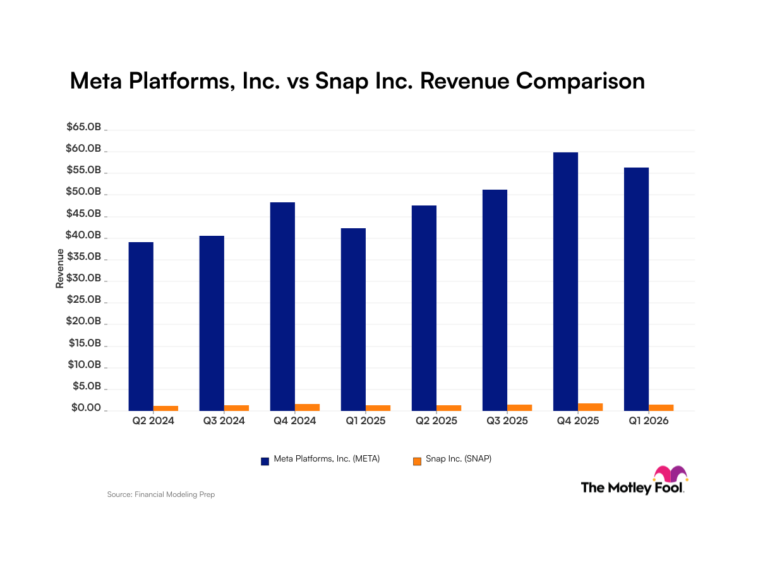
Quarter (Period End)Meta Platforms RevenueSnap RevenueQ2 2024 (June 2024)$39.1 billion$1.2 billionQ3 2024 (Sept. 2024)$40.6 billion$1.4 billionQ4 2024 (Dec. 2024)$48.4 billion$1.6 billionQ1 2025 (March 2025)$42.3 billion$1.4 billionQ2 2025 (June 2025)$47.5 billion$1.3 billionQ3 2025 (Sept. 2025)$51.2 billion$1.5 billionQ4 2025 (Dec. 2025)$59.9 billion$1.7 billionQ1 2026 (March 2026)$56.3 billion$1.5 billion
Data source: Company filings. Data as of June 23, 2026..
Foolish Take
Meta and Snap both operate in the social media space and generate the bulk of revenue from advertising, but outside of that, the two companies are on vastly different trajectories. This is not only evident in their outsized sales difference, but also in their net income margins.
Snap went public in 2017, and in nearly ten years, has yet to reach profitability. Not only that, while sales are rising year over year, they are not seeing the degree of growth experienced by Meta. For example, Snap reported a 12% year-over-year revenue increase to $1.5 billion in the first quarter. Yet that pales in comparison to Meta’s 33% year-over-year jump to $56.3 billion.
Snap’s struggles with profitability contributed to its stock dropping to a 52-week low of $3.81 this year. Meanwhile, Meta’s share price also fell in 2026 due to its lavish spending on artificial intelligence. In its Q1 report, the Facebook parent announced an increase in this year’s capital expenditures to as high as $145 billion. The company spent $72 billion in 2025.
Even so, Meta attributes revenue growth to its AI investments. That’s why it’s doubling down in this arena to fund ongoing AI development. Snap does not have the same capacity to spend on AI, and that could end up hurting its sales growth in the future.




GIPHY App Key not set. Please check settings