
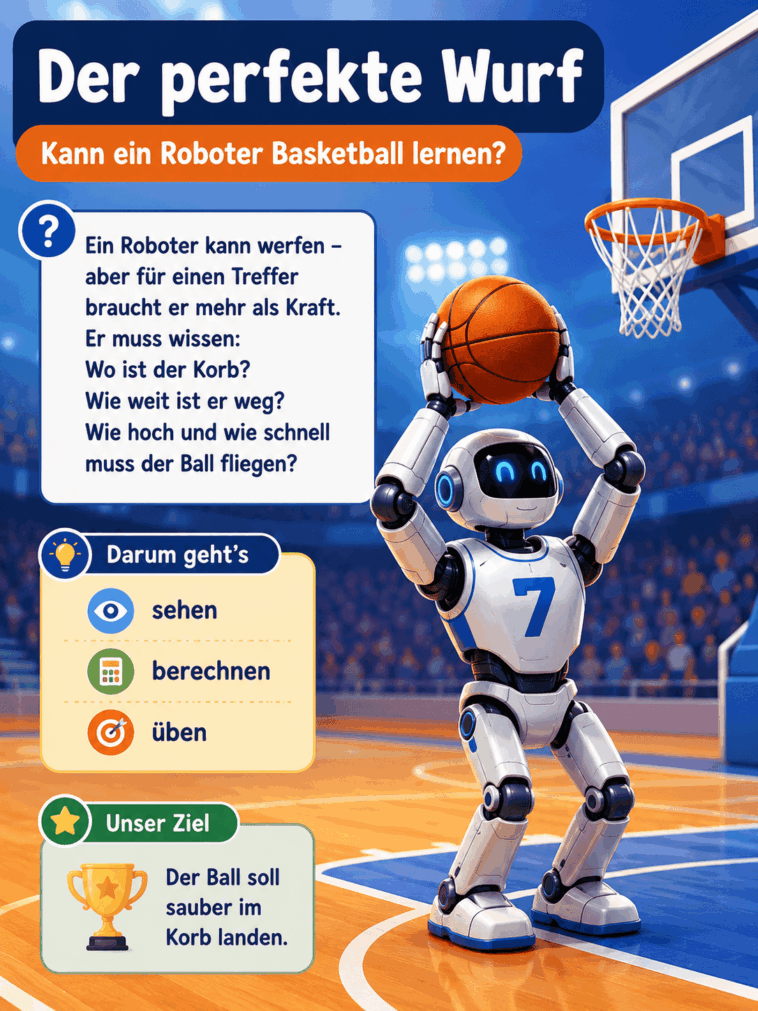
A robot lifts the ball, aligns its body, calculates the angle and force — and throws it. The ball flies in a high arc towards the basket. What sounded like science fiction a few years ago is now real robotics: humanoid robots learn basketball.
The basketball robot CUE from Toyota is particularly well known. The project began in 2017 as a voluntary idea from Toyota employees. Back in 2019, CUE achieved a Guinness World Record with 2,020 free throws in a row. In 2024, CUE6 hit from 24.55 meters away — the longest basketball throw by a humanoid robot.

From rigid thrower to basketball robot
In the beginning, such robots could do one thing above all: stand, aim and throw. That was hard enough, because shooting a basketball is a complex mix of perception, calculation and movement.
Today the development continues. With CUE7, Toyota showed a new generation of the robot in 2026 that can not only throw, but also dribble and move across the field. This means the robot is slowly approaching what human basketball players do: seeing, reacting, running, passing and throwing.
Why basketball is so hard for robots
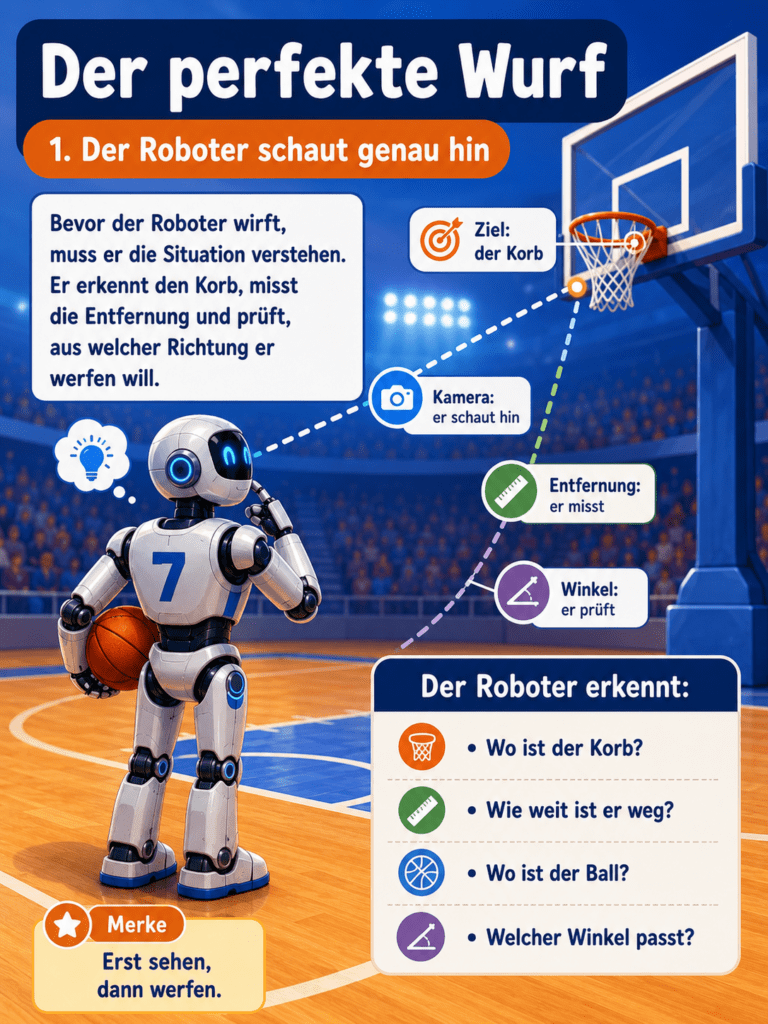
For people, a litter seems almost natural. You look at the basket, bend your knees, stretch your arm and let go of the ball. For a robot, this is a chain of many individual steps.
He has to recognize where the basket is. He has to calculate distance and altitude. Then he has to decide with what force, what angle and what rotation the ball should be thrown. At the same time, the shoulders, elbows, wrists and fingers must work together precisely.
To do this, modern robots use cameras, sensors, motors and artificial intelligence. The AI helps to learn from every throw: Was the ball too short? Was the angle too shallow? Was the force too great? The robot can adjust its movement on the next try.
The theory of the perfect throw
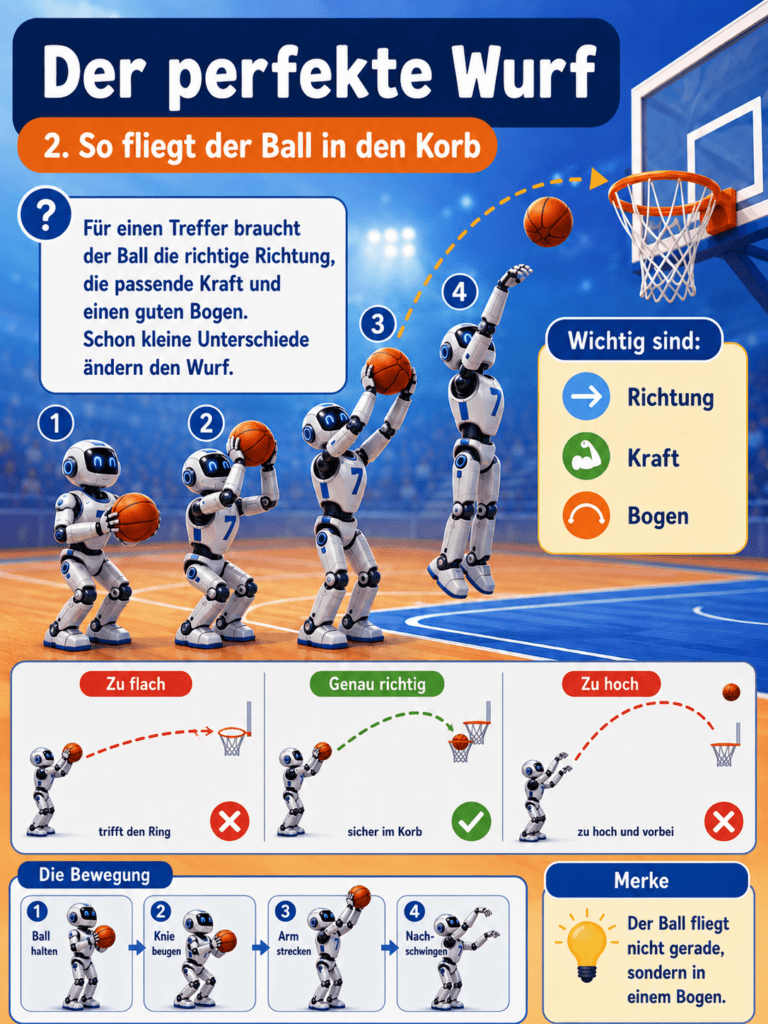
This is where things get particularly exciting, because basketball is not just a sport, but also physics. The ball flies on a parabola, i.e. an arc-shaped path. The most important factors are the release angle, the release speed, the release height, the rotation of the ball and the entry angle into the basket.
The German basketball coach Holger Geschwindner worked intensively on this idea. Not only was he a basketball player, but he was also into mathematics and physics. Together with Dirk Nowitzki, he worked on a throw that was as stable and repeatable as possible.
What’s important is that there isn’t exactly the same perfect angle for every player. A good guideline is often around 47 degrees. Depending on body size, release height and distance, the optimal release angle can be higher – studies often mention values of around 50 to 52 degrees for free throws.
Why size and release height are important
A tall player like Dirk Nowitzki releases the ball higher up than a smaller player. This changes the optimal trajectory. The ball doesn’t have to rise quite as steeply to still fall cleanly into the basket.
That’s why the perfect throw isn’t a single magic number. What is crucial is a movement that forgives small mistakes. If the ball is thrown a little too hard, too weakly or slightly sideways, it should still have a good chance of falling into the basket.
That is exactly the core idea: the perfect throw is not simply the most beautiful throw, but a fault-tolerant throw.
Holger Geschwindner and Dirk Nowitzki
Holger Geschwindner developed a special way of training with Dirk Nowitzki. It wasn’t just about repetition, but also about understanding: How does the ball move? How does the body work? How is a stable, soft throw created?
Dirk Nowitzki’s famous throw was a combination of technique, physics, rhythm and years of training. The SWR article “Dirk Nowitzki – The Perfect Throw in Basketball” shows exactly this connection between Nowitzki, Geschwindner and the idea of a physically well-thought-out throw.
NBA shooting rates compared with Dirk Nowitzki
SeasonNBA field throw rateNBA three-point rateNBA eFG%Dirk Nowitzki comparison2005/0645.4%35.8%49.0%Dirk: 48.0% FG, 40.6% 3P, 90.1% FT — one of his strongest throwing seasons.2009/10approx. 46.1% approx. 35.5% approx. 50.1%Dirk was also clearly above the league average here: 48.1% FG and a very strong free throw rate.2014/1544.9%35.0%approx. 49.6%Dirk was already 36 years old, but remained a dangerous thrower as a stretch big.2019/2046.0%35.8%52.9%Dirk had already retired. 2024/2546.7%36.0%54.5%Modern NBA: higher eFG% because many more threes are shot. Dirk was an early pioneer of this trend.
Dirk Nowitzki’s career values are 47.1% field shooting rate, 38.0% three-point shooting rate, 87.9% free throw rate and 51.2% effective field shooting rate. This made him exceptionally efficient for a 2.13 meter player – especially because many of his throws came from mid-range, from the fadeaway or from the three-point line. https://www.basketball-reference.com/players/n/nowitdi01.html
What robots can learn from Nowitzki
Robots are strong at computing. You can determine angle, force and trajectory in a split second. But basketball is more than a formula. A true throw comes from movement, timing and adjustment.
A robot like CUE can be extremely precise under controlled conditions. But a basketball game is chaotic: players move, the ball bounces, opponents interfere, the body is not always perfectly aligned. This is exactly where the next big challenge lies.
The robots of the future will not only have to be able to throw. They have to understand game situations, make decisions and use their bodies flexibly.
Conclusion
Humanoid basketball robots impressively show how far robotics and AI have already come. They can score baskets, set records and perform increasingly human movements.
Nevertheless, the perfect basketball shot remains something special. In people it combines physics, training, body awareness and creativity. With robots, he shows how machines learn to control complex movements.
Maybe one day a humanoid robot will play in a real basketball game. Until then, technology will show us one thing above all: the perfect throw is not just sport – it is applied physics.
FuxFun
Did you know that Toyota’s basketball robot CUE did not start as a large company project, but as a voluntary idea from employees in 2017? An experiment became a Guinness World Record-winning robot.
For professionals
The difference between the launch angle and the entry angle is exciting. The release angle describes the angle at which the ball leaves the hand. The entry angle describes how steeply the ball arrives at the basket. For successful throws, not only the start is important, but also how the ball arrives at the ring. Studies also emphasize that the optimal throw is individual and depends on body size, release height, distance and consistency.
Sources
Toyota Global: Development and Guinness Record of CUE.
Guinness World Records: Farthest basketball shot by a humanoid robot.
Toyota Times: Introducing CUE7.
SWR Sport: “Dirk Nowitzki – The perfect throw in basketball”.
Studies on the physics and biomechanics of basketball throwing.
Book recommendation
Humanoid basketball robots show how fascinating the combination of technology, movement and artificial intelligence is. You can find out more about these topics in my book “Robots & AI” from the SchlauFUX series from Kosmos Verlag.
It’s about how robots see, learn, decide and act – and how AI is changing our future. Clearly explained, excitingly told and with lots of ideas for participation.
About the book:
https://amzn.to/4gYZXT7
I like it:
Similar posts




GIPHY App Key not set. Please check settings