
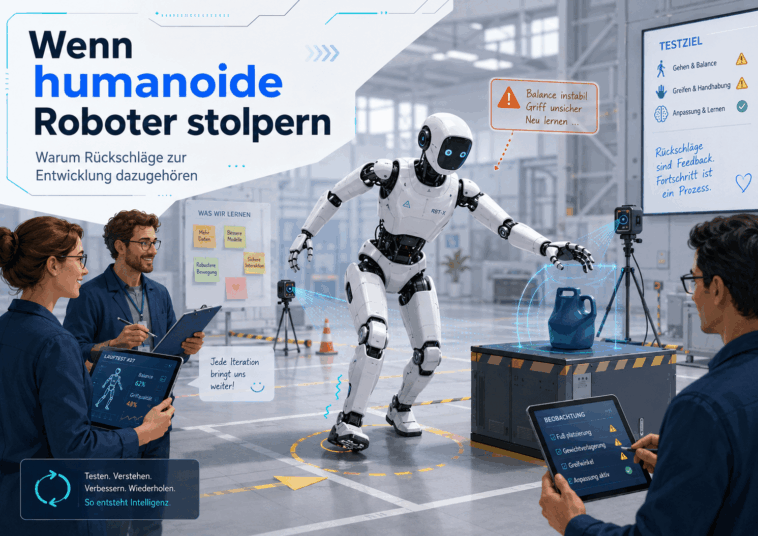
Humanoid robots often look like the future you can touch: two arms, two legs, cameras as “eyes” and sometimes even a voice that talks to you. In videos they carry boxes, open doors or wave politely at the camera.

But what happens when the camera is off?
Then it gets particularly exciting. Because setbacks are just as much a part of robotics as successes. It’s just that they’re talked about much less often. Developers, researchers and companies learn the most from these difficult moments.
1. Performances are not the same as everyday life
Many people know humanoid robots from short videos. Everything runs smoothly: the robot grips, runs, balances and acts almost like an artificial colleague.
However, practical reports show that actually trying things out is much more complicated. A robot must be prepared, monitored and often adapted to the environment. What works in a test laboratory does not automatically work in a factory hall, a nursing home or an office. It’s like a magic trick: everything looks easy from the front. Behind the stage there is a lot of practice, technique and sometimes a failed attempt.
2. Walking is extremely difficult for robots
Walking usually comes naturally to you. Your body automatically notices whether the floor is crooked, whether you stumble or whether you need to shift your weight. A humanoid robot has to calculate this. It needs sensors, motors, control software and quick decisions. It becomes particularly difficult when the floor is uneven, people walk past or the robot has to carry something.
When a little toy robot falls over, it’s funny. When a large humanoid robot tips over, things can become dangerous. That’s why many companies first test such robots in strictly controlled areas.
3. Grabbing is not just “hand-holding”
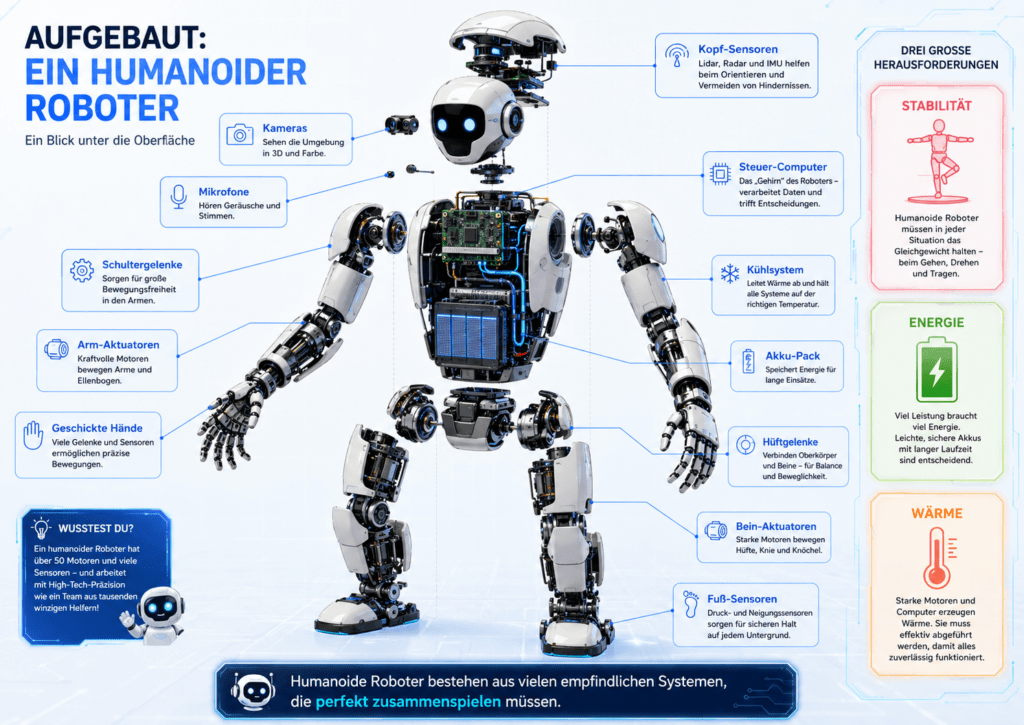
Grabbing a box sounds easy. But what about a soft bag, a cable, a tool or a crumpled package? Such things are difficult for robot hands. They have to recognize how hard they can press, where they should touch and whether the object will slip. People feel this with their skin, muscles and experience. Robots need sensors and good programs for this.
That’s why fine motor skills are one of the major construction areas. A humanoid robot can sometimes look impressive and still fail at a seemingly simple, everyday task.
4. Safety means more than an emergency stop button
Humanoid robots are often intended to work where people are. That makes it exciting, but also complicated. You have to recognize people reliably, keep your distance, not react too quickly and stop when you are unsure. The question also arises: What do cameras and microphones record? Is data stored? Who can view them?
Such questions are particularly important in companies or care facilities. A robot is not just a machine with arms and legs. It is also a device with sensors, data and responsibility.
5. Care and everyday life need acceptance
Humanoid robots have already been tested in pilot projects in the nursing sector. They can motivate people to move, think or participate. That is valuable. But there are limits here too. Robots do not replace caregivers. They need people to prepare them, accompany them and use them sensibly. In addition, residents must accept the robot. Some people find it exciting, others perhaps strange or disturbing.
This shows that technology alone is not enough. A robot also has to fit into people’s everyday lives.
6. Companies test cautiously
Companies are also trying out humanoid robots, for example in industry, logistics or development. This often involves tasks such as carrying, sorting or simple handling.
But before a humanoid robot is really useful, a lot of things have to be right: it has to work reliably, be safe, last long enough and be economically worthwhile. If a classic robot arm or conveyor belt does the same task more cheaply and reliably, the humanoid robot is not automatically the best choice. That sounds sobering, but it is important. Good technology is not measured by how cool it looks, but by whether it solves a real problem.
7. Battery, heat and technology stress
Humanoid robots need a lot of energy. Many motors move arms, legs, hands and heads. Computers, cameras and sensors work at the same time. This costs electricity and generates heat.
Heat is a serious issue for robots. Electronics and motors need to be cooled so that they function reliably. Research examples such as sweating heat mannequins also show how complex temperature and body technology can be in human-like machines. So a robot doesn’t have sore muscles. But it can have technical problems: dead battery, warm motors, faulty sensors or software that still needs to learn.
Conclusion
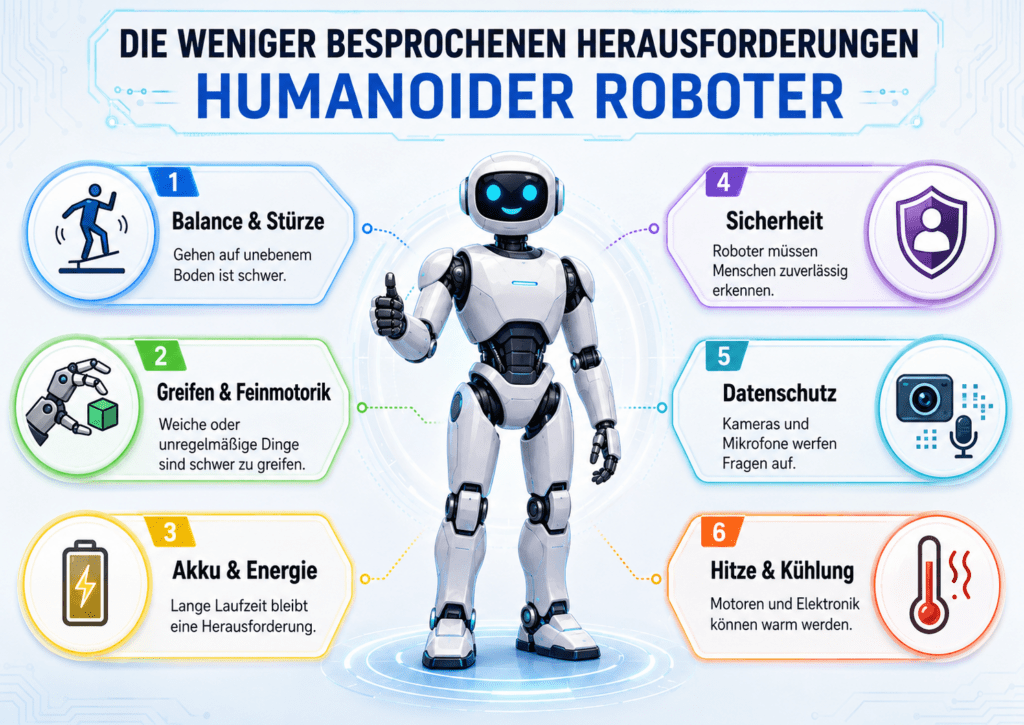
Humanoid robots are fascinating. But they are not yet perfect everyday helpers. They struggle with balance, grip, security, privacy, energy, warmth and where they can really be put to good use.
That’s not failure. It’s development.
Every setback shows the engineers and researchers that we have to do better here. That’s exactly how progress happens – not just through shiny success videos, but also through tests, mistakes and honest learning.
FuxFun
Did you know that a crumpled bag of chips can be more difficult for a robot to handle than a heavy metal box? The box is stable and predictable. The bag crackles, slips, deforms and looks a little different every time.
For professionals
If you want to go deeper, you can look for practical reports and classifications from c’t 3003/Heise, Exxeta, Fraunhofer IPA, ROBUST/vdek NRW as well as industry assessments from Springer Professional, Elektronikpraxis and Industriemagazin.
Source reference
Selection of sources used: Heise/c’t 3003 “Humanoid robots tried out”, Exxeta “Why humanoid robots are no longer a vision of the future”, ROBUST/vdek NRW on the use of humanoid robots in the care context, Fraunhofer IPA on the status quo, potential and research fields of humanoid robots, Springer Professional and Elektronikpraxis on industrial classification and Welt/scinexx on sweating robots and heat management.
Book recommendation
You can find even more robotics and AI for curious minds in the book “Robots & AI” from the SchlauFUX series from Kosmos Verlag:
https://www.kosmos.de/de/kosmos-schlaufux-roboter-und-ki_1182437_9783440182437
I like it:
Similar posts




GIPHY App Key not set. Please check settings