
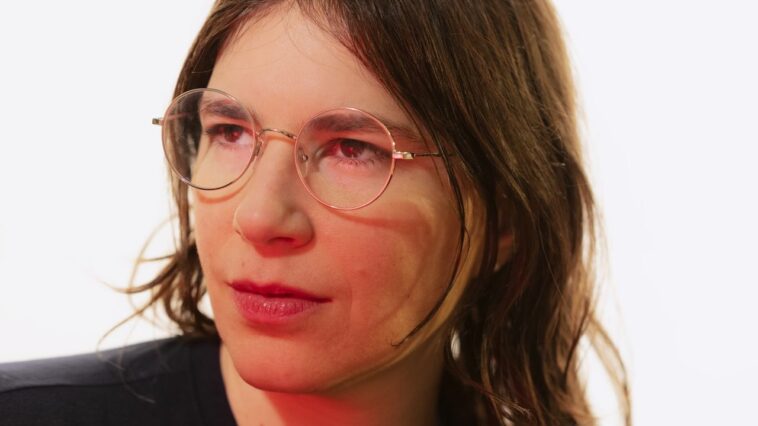
Ruth Garbus can come across like the jazz singer at an elegant party who took peyote right before her set and just started freestyling. Her voice, her arrangements, and her performances are sophisticated and beautiful, even austere. But then, she’ll step to the mic and open a song like this: “When I penetrated that man I felt just like a dog.” Or maybe you’ll catch her in a more wholesome mood and she’ll tell you about the time she went to the fair and won a Moana doll. “I was so ecstatic I thought I might cry…. and I did… then I gave it to a kid,” she beams. “And it felt really goooooood,” she belts, swooping into the heights of her falsetto and holding the note for dear life.
While Garbus has titled her latest album Profound, she’s never seemed less interested in the weighty topics and serious insights that concern a lot of singer-songwriters who release quiet, meaningful music under their birth names. Even compared to 2023’s excellent Alive People, the mood is light, the pace is slow, and her reflections are lucid to the point of being haikuesque. The clearest songwriting analog I can think of would be the Phil Elverum of Sauna, who discovered universes forming in the scattered trash on the sidewalk. But even compared to him, Garbus is pleased to present things as they are. Has there ever been a more succinct summation of the banalities of life than this five-word list poem from a song called “Nothing and Everything”? “Standing still, running around, emotions.”

No score yet, be the first to add.
On the road to making this album, Garbus started taking medication for depression and anxiety, a course called “Piano for Songwriters,” and vocal coaching. Two songs on the record, “Clair de Lune” and “Nocturne,” arrived by studying pieces by the French Romantic composer Gabriel Fauré, featuring lyrics that Garbus translated into English herself. Both tracks are traditionally beautiful—the former shares a resplendent melodic turn with “O Holy Night,” the latter dribbles across the scale like watercolor on a canvas. All the time, musicians talk about their new work representing a leap forward in their artistry, but from a technical standpoint, it is hard to imagine Garbus pulling off these performances at any other stage in her career.
Occasionally, Profound plays like the soundtrack for a humdrum indie-comedy set in a beautiful, remote location. It is more surreal than her previous work, and more delightful. “The Lost Soul,” where she layers her voice in a Roches-like unison and gazes lovestruck and isolated upon humanity, peaks with a whimsical MIDI guitar solo from Nick Bisceglia. In the sing-song twee of “Tall Face,” she follows a folksy train of thought that wouldn’t be out of place in a Shel Silverstein book, in service of embracing the “luxurious wrinkles that wind like a vine” across her narrator’s skin. Throughout, Garbus seems more consumed than usual by visions of aging and decay. In a particularly languid song called “All E-Lone,” she envisions “soup lines ’round the block in my head” and offers this insight on the inevitability of death: “If this illness weren’t killing/I wouldn’t have this time.”




GIPHY App Key not set. Please check settings