
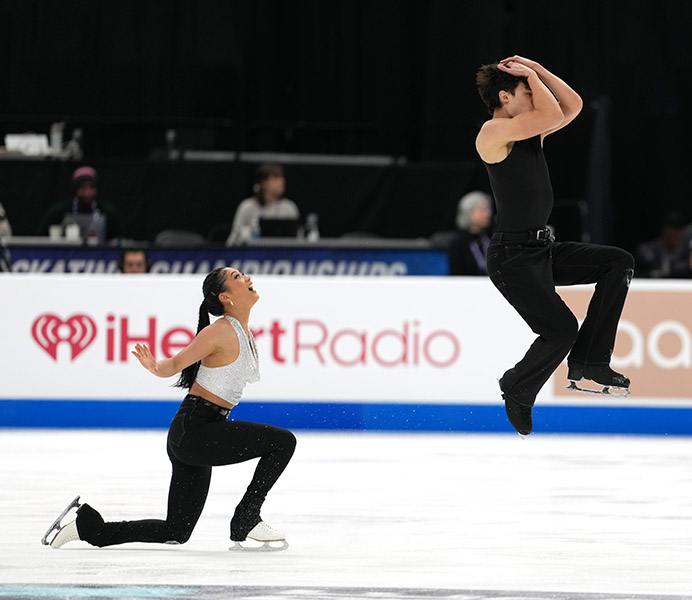
Photos by Daphne Backman
Two years into their partnership, Amy Cui and Jonathan Rogers are beginning to see just how much is possible together. From overcoming injuries and financial challenges to earning their first Challenger Series assignment, the American ice dancers have continued to grow both on and off the ice. In this interview, they discuss their evolving partnership, creative process, and the goals driving them into the new season.

In the first IDC interview in 2024, you were still a relatively new partnership. Now that you’ve had two full seasons together, how would you describe how your team dynamic has evolved?
Amy Cui (AC): Wow, it really has been two full seasons together! I remember when we first began skating together, I came in with no expectations. I was just stepping into a partnership with someone I felt genuinely excited and hopeful to skate with. Looking back over the past two years, I think I have realized just how infinite ice dance can be. I only had a glimpse of this world while competing as a junior for one season. Now with more experience, I feel like there is so much more to do, so much more to create. I feel like Jonathan and I have only scratched the surface of what we can create together, so in a way, the naive initial excitement has evolved into a stronger conviction in the good that is yet to come.
Looking back at the last two seasons, what were some of the key moments or competitions that really helped shape your partnership so far?
Jonathan Rogers (JR): Both our first Nationals and this past Nationals stand out to me because they were such different experiences. We were dealing with injuries and other challenges, so each one carried its own significance.
Our first Nationals was especially memorable because we had a pretty good season leading up to it, and the free dance was one of our strengths. We definitely fall into the category of being free dance skaters—we love performing, entertaining, and telling stories. Swan Lake was a program we really believed in, much like White Crow, which also played to our strengths and felt very personal to us.
This past Nationals was special for a different reason. I felt like we connected more and were able to lean on each other in a way we hadn’t before. Deep down, we knew we wanted to skate our best, but there was also a sense that we had something to prove to ourselves. We wanted to face the challenge that had affected us the year before and show that we could overcome it.
And we did. We pulled ourselves together, supported one another, and relied on our partnership. It felt like an important moment in solidifying that partnership and, in some ways, healing from what happened with Swan Lake.
Every team goes through learning curves in the early years. What were some challenges you faced together, and how did working through them strengthen your partnership?
AC: Figure skating is expensive, and in the beginning, not every team has access to the same level of support and resources. After our first season together, I had the honor of receiving the 2025-2026 Mabel Fairbanks Scholarship fund. It was tremendous in providing us with the support to fund competitive opportunities abroad and cover training expenses at home last season.
Heading into this next season, the financial pressure remains, but we try to put our heads down and focus on what we can control. I think it’s strengthened our resolve to make things work. And when there are challenges, there is a mutual understanding that we are in it together—I got you, and you got me.
JR: One of the biggest challenges we’ve faced is understanding how to show up for each other. We each need different things from one another as partners, and during the creation of this season’s programs, we’ve gotten much better at identifying more of what each person needs to feel supported and help them do their job. It’s helped reinforce that we’re on the same team and working toward the same goals. Amy and I are very different people. We approach skating differently, and our personalities are very different as well. That’s actually a great thing because those differences bring unique ideas and strengths to the partnership.
Your programs over the past two seasons have had very different styles—from the disco- inspired rhythm dance to the dramatic Black Swan free dance and your 2025-26 free dance to “The White Crow”. How do you approach choosing music that suits both of you?
AC: I think the best results come from going into music selection with an open mind. We never really came in with a set plan or idea; it was simply about exploring what made us feel something. The final music choice never turns out to be what I first expected. It’s so unpredictable, so I kind of look for whatever inspires me. I learned not to grow attached to any one piece and leave just space to let the music grow on me.
JR: We spend some time feeling music out. I love scrolling through Spotify and YouTube, but I usually don’t find something that really sticks with me or inspires an entire free dance. For our past free dances, though, it has almost always come from someone else suggesting an idea. Someone will say, ‘What if you skated to this?’ and it just ends up being the perfect fit. For example, Igor had already picked out White Crow for us and said, ‘What if you skated to White Crow?’ We listened and immediately thought, ‘Yeah, that sounds great.’
The same thing happened with this year’s free dance. We went to work with Kaitlin Weaver, and she said, ‘I watched this movie the other day—what if you did this as a program?’ We looked at each other and thought, ‘Yeah, that sounds great.’

Which parts of your programs are the most fun for you to perform, and which are the most challenging?
AC: I absolutely ADORE our free dance choreographic step sequence! I think it really shows our versatility as a team and as performers. We had such a wonderful time collaborating with Kaitlyn Weaver, who initially proposed our Sinners program concept. She helped us weave our own touches into the choreography, and the rest all came very naturally. With our free dance this year, we get to play characters that are somewhat unsettling and unnatural. The program is outside anything I have gotten to do before, so I am very excited to put on that character and step into that world.
JR: In our free dance, I am playing a creep and it’s so different from the characters I’ve portrayed in past seasons. I think the beginning, especially, it’s so weird and so uncomfortable. The choreographic step sequence is so multi-dimensional has so many fun little shapes and nuances. It’s reminiscent of a southern jig or barn dance. It’s rough, a little edgy and so fast paced. It’s an absolute blast.
As for the most challenging, I think it’s definitely going to be the Golden Waltz. It’s not something we’re used to. That’s an area we’ll really have to drill this season. The other challenge may be our twizzles, simply because of where they’re placed in the free dance. They come near the end, with very fast-paced music and some difficult shapes.
What are your thoughts on the Golden Waltz and the pattern returning to the Rhythm Dance next season?
AC: I had my one experience competing in the Rocker Foxtrot in Junior…and that is the extent of my compulsory dance experience. The Golden Waltz is an entirely different beast, but I like to think that without prior years of compulsory habits to unlearn, I can approach it with a blank slate.
JR: I like the idea. I love waltzes. I think they’re so beautiful, and they’re so fun to skate, especially some of the more difficult international pattern dances. Specifically, competing the Golden Waltz, it’s been a hard dance to learn so far. It’ll definitely show who has had more pattern dance experience. Some skaters have had many years of doing pattern dances in competition, then there are people like myself who only had a few years of competing pattern dances.
Hopefully the audience will be equally, if not more, entertained. At the very least, they may have a better understanding of what’s going on out on the ice.
You competed at your first ISU Challenger Series event last Fall, what was this experience like and what will you take from it to fuel you for next season?
AC: I am so grateful to have had the opportunity at the Tallinn Trophy. I think Jonathan and I were both so excited to skate that we kind of let that get ahead of us in the rhythm dance. Obviously, I am not happy about the mistake. We came in without any expectations, no nerves—just to put out our best. This year, I want to continue focusing on us, with perhaps more control over some of the excitement.
JR: I felt like I was making it to the big leagues. It was one of those milestones you always talk about, and then suddenly you’re there thinking, ‘Oh my gosh, we finally did it.’ It was such an amazing experience, and I really hope to go back. It wasn’t as intimidating as I expected a Challenger Series competition to be. I think we felt really prepared going in, which was a great thing.
What I’d like to take from that experience into next season is lowering the nerves a little bit. Even though I was having the time of my life and was so excited, that excitement also made me anxious because it suddenly felt very real.
At the start of this new Olympic quad, Jonathan, you launched a GoFundMe to help support your skating. Can you tell us more about why you started it and what some of your financial challenges have been for the past few years?
Releasing the GoFundMe was incredibly difficult for me because asking for financial help feels so personal and vulnerable. You start questioning why anyone would want to invest in your dream, especially when you don’t feel like you’ve ‘made it’ yet. But I’ve reached a point in my career where I can’t let fear of judgment stand in the way of continuing to chase this. Skating is my world, and while asking for help is uncomfortable, sometimes it’s necessary.
Financial hardship has shaped nearly every part of my skating journey. When I switched to ice dance in 2019, my biggest goal was simply to make it to Nationals—and I did. But around that same time, my parents sat me down and told me we could no longer afford for me to skate at all. At 16, hearing that felt like watching my entire world shatter in real time. My family worked tirelessly to keep me on the ice. We went into debt, my parents took on extra jobs and worked at the rink for ice credits, and as soon as I was legally able, I started working too.
We eventually found a way to make it work for a while, but life kept throwing challenges at my family—unexpected setbacks, health struggles, and financial burdens that made an already difficult situation even harder. Through all of it, my parents have continued to do everything they can just to stay afloat while still helping me pursue both skating and school.
This journey has also shaped the way I view money and adulthood. I’m 23, and there have been times I’ve lived on the bare minimum just to keep training. It can feel like I’m trying to balance adulthood while chasing a dream that demands everything from you—financially, emotionally, and physically.
At the same time, I’m incredibly grateful for the people who have shown up for me along the way. Whether through advice, emotional encouragement, or financial support, their belief in me means more than I can put into words. My parents taught me the importance of giving back to the community that supports you, and I hope one day I can do the same. I don’t take any of this lightly. Every bit of support is a big part of why I’m still here, still skating, and still fighting for this dream.
What is something fans might not realize about your partnership or your training together?
AC: We laugh a LOT. I feel like I have said this before, but Jonathan is genuinely hilarious. It is so refreshing to be in a partnership where we can turn on a switch and lock in, but also still have our moments of lightness.
What do you hope audiences and fans start to recognize as the unique qualities of your partnership?
AC: We both love to dance and to entertain. I hope that audiences and fans get to feel and experience some of that love through our partnership 🙂
JR: I hope audiences and fans recognize the versatility of our abilities. In the past two seasons, our free dances were very balletic, and we know we can hit strong lines and beautiful positions. This year’s free dance is going to be different— more edgy, and less focused on crisp lines. We want to show we can do more than one style. Regardless, we want audiences to know they’ll be entertained. I think we’ve done a good job of that so far, and this year will be no exception.




GIPHY App Key not set. Please check settings