
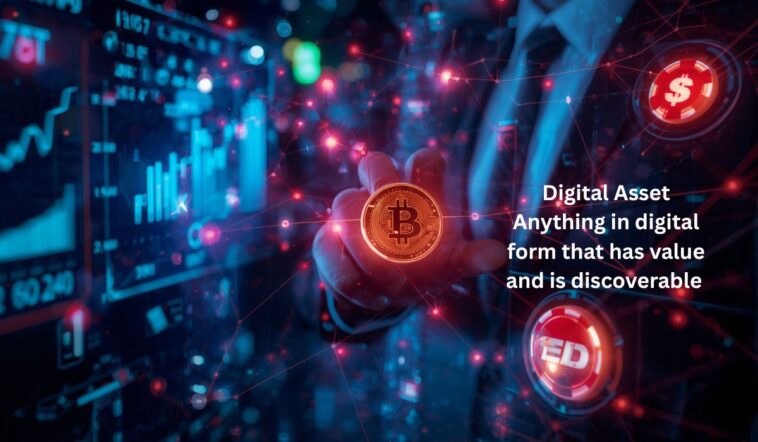
Digital assets are digital items with identifiable value that can be bought, sold, or traded. It enables new forms of business, investment, and content creation beyond physical goods and services. Its ability to facilitate global transactions in real-time, to create value and transfer ownership, and to promote economic efficiency makes it an integral part of modern economic activities.
A digital asset is anything in digital form that has value and is discoverable. It is stored digitally like photos, documents, videos, and other complex forms.
The main criteria for an asset to be considered a digital asset are that it should have the potential to create value, exist in a digital format, be identifiable, and be owned, stored, and transferred electronically. One of the main peculiarities of digital assets is disintermediation. It often reduces the need for middlemen or intermediaries to facilitate transactions, leading to lower costs, increased accessibility, and efficiency.
Along with this, its data security, privacy, and personal-control features improve the exchange of valued items. There are different types of digital assets, such as traditional digital assets and blockchain based digital assets.
1. Traditional Digital Assets
Digital files or information that have value and are stored digitally.
Examples include:
Photos, audio files, videos
Documents (PDFs, Word, Spreadsheets, etc.)
Graphics, design files, presentations
2. Blockchain-Based Digital Assets
Digital assets that are built on blockchain technology.
Types include:
Cryptocurrencies (like Bitcoin, Ethereum etc.)
Non-Fungible Tokens (NFTs) – unique digital tokens representing specific items or rights
Tokenized assets – representing real world assets or rights via tokens on a blockchain
Digital identities (identity records stored/verified via blockchain)
How To Make Money From Digital Assets
According to the value and demand of the product, money can be made from digital assets by:
1. Creating and Selling Digital Products
Creating and selling digital products such as eBooks, online courses, design templates, or any other unique digital items directly to customers. It is a step-by-step procedure:
Finding the demand and developing a product
Choose a platform to sell on, like online marketplaces or an e-commerce website
Market the digital products by promoting the product and using marketing strategies.
Determine the price of the product by considering its value and demand in the market, not just its production cost.
2. Investing and Trading Assets
Investing and trading assets, like cryptocurrencies and NFTs, for greater potential profits for short-term traders. Sometimes it involves high risk. It is done by:
Buying digital assets at a low price, hoping to sell at a high price.
By staking and yield farming to earn passive income or optimized returns.
Lending-Providing liquidity to earn interest.
Investing in funds like ETFs that hold digital assets or related companies.
3. Content Marketing and Services
Content marketing and services such as creating and distributing valuable, relevant, and consistent digital content through blogging, freelancing, the skills and services, and affiliate marketing by promoting another company’s products or services and earning a commission. Its key steps are:
Developing high-value digital products according to the skills and market demand.
Promoting and marketing the content by attracting the targeted audience through various topics.
Choose the right marketplaces and course platforms
Implement various monetization strategies to generate income.
Continuous monitoring of the performance using analytics tools
What Is Digital Asset Management?
Digital Asset Management involves everything related to digital files after they are uploaded, like storing, organizing, managing, retrieving, sharing, and publishing digital files.
Proper management of the digital files is crucial for any business or organization. It simplifies adapting and distributing assets across different countries. The importance of digital assets is increasing, which highlights the need for effective digital asset management. Each digital asset has its own lifecycle in the DAM system.
Major Processes Involved in Digital Asset Management
Digital asset management can be segregated into four major processes such as creation and planning, storage and organization, approval and governance, and archiving and disposal.
1. Creation And Planning
This process involves strategic planning by checking objectives, scope, and the current state of the existing digital assets, then connecting with stakeholders to understand their needs and requirements, and developing the concept and design for the asset, organizing, and ensuring it is easily accessible and reusable.
2. Storage And Organization
Categorizing, managing, and securing digital assets using a centralized repository (a single, main storage room for an organization’s all-important information) with tools like metadata, folder structures, and tags helps to organize and store the assets properly.
3. Approval And Governance
These processes are taken to ensure the consistency, legal compliance, efficiency, and security of the digital asset. For this purpose, specific rules, processes, roles, responsibilities, and standardized standards and policies are established.
4. Archiving And Disposal
Archiving of the digital assets includes the long-term preservation of digital assets to ensure that they remain accessible, authentic, and usable for future users. It is done when these are not actively used or become outdated, but still have a potential future value.
Are Stocks Digital Assets?

A stock is actually a financial asset that exists in records in a traditional system. So, traditional stocks are financial assets.
To consider them as a digital asset, they should be tokenized by converting the rights to an asset into digital tokens on a blockchain, thus a security token is created. It is a digital contract that represents ownership in an asset that already has value, such as real estate, a car, or company stock.
Is Bitcoin A Digital Asset?
Bitcoin is a type of decentralized digital currency that represents value and can be stored and transferred electronically. It has no central bank or authority but represents a certain digital value to the asset issued in it, with no physical form or coins, and is distributed by individuals over digital platforms, exchanges, and through peer-to-peer transactions. Since it is purely online and secured by cryptography and blockchain technology, it is possible to say that Bitcoin is a digital asset.
Bottom Line
Digital assets are valuable resources that can provide growth in value and income. It is evolving, but its exceptional characteristics are still attracting people. Digital assets are something that holds a lot of promise in the future their ease in handling that also be done in a secure way, and high potential in the economic field show the need for people to keep updated in a highly optimized way.




GIPHY App Key not set. Please check settings