
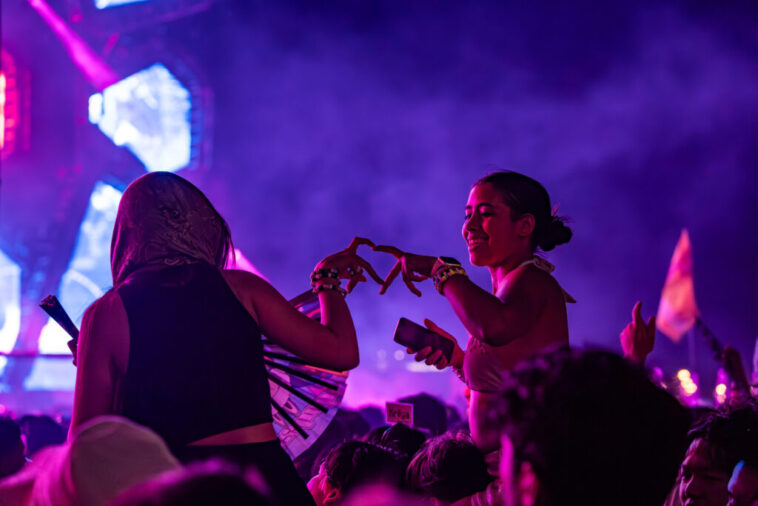
There’s a word in Portuguese, “saudade,” for the ache of missing something you may never get back. The dancefloor doesn’t have a word for it yet, but Merriam-Webster’s lexicographers should be on standby.
In 2026, we have successfully turned one of humanity’s oldest and most instinctive forms of expression into something that requires an elusive blend of safety, privacy, people, conditions and music. A Berghain regular from 2006 would look at a modern dancefloor the way a wolf looks at a golden retriever.

2019: Dancing, connection, pure energy. 2024: Phones up, vibes down. Same music, but the feeling? Totally different. You can’t record a vibe. What’s your take? Daily Afro House Music? Follow @afrohousecommunity ❤️🔥 #afrohouse #afrohousemusic #afrobeats #afrobeat #nomusic #adamport #ramp #data #housemusiclovers #livedjset #housemusicculture #raveculture
♬ original sound – Afro House Community
Contrary to what Charli xcx believes, dancefloors are not “dead.” The people on them, however, have developed a strange and deeply troubling relationship with the present moment. The dancefloor used to be one of the only places you could truly be anonymous in public, but we took that away and acted surprised when people stopped showing up the same way.
One of the worst culprits is content culture, silent but deadly like a Taco Bell fart in a car with broken window cranks. The moment a DJ drops something recognizable (looking at you, ‘No Broke Boys’), phones materialize from pockets and purses with the coordinated speed of a military drill to document it for an audience that isn’t in the room.
Here’s the thing about filming a track for your Instagram Stories, besides the fact that no one will even remember your video: it requires you to hold your arms up, keep your eyes on a screen and maintain enough physical stability to capture the shot. This is, by definition, the opposite of dancing, and you can’t do both.
Dancing is physical and unselfconscious while content creation is performative and deliberate, and the two states are neurologically incompatible. In other words, the DJ reads the room but the room is reading its notifications.
confused Europeans at #coachella
♬ original sound – VeronicaRonje
You also can’t let loose when you might go viral. Even if you somehow resist the urge to document the moment yourself, someone else’s phone or deceptive Meta eyewear is already pointed at you.
The gnawing possibility of being recorded, clipped, captioned and posted to social media by strangers before you even get home has a remarkably chilling effect on the psyche. Dancing freely has always required a suspension of self-consciousness, which is tough to do with the knowledge that your every move could turn into content that reaches employers or family members.
What makes this even harder is that the antidote to self-consciousness is practice, and practice is exactly what the pandemic stole from Gen Z. The stakes of being recorded feel highest, naturally, for the chronically online young adults who never quite got comfortable being on dancefloors.
That’s not a jab, but a structural reality. A generation that came of age on TikTok, where interaction is asynchronous and parasocial, is now arriving at venues with no real template for unscripted physical socializing. When you’re more used to crying at 15-second videos of dogs reuniting with their owners and your primary mode of connection is mediated by a screen from the padded safety of your bed, a crowded dancefloor of real people in real time is overwhelming.
We have medicalized anxiety, monetized wellness and optimized sleep, but for some reason, few have bothered to really diagnose why we’re engineering an entire generation out of their ability to dance freely. Sadly, in 2026, vigilance and dancing are mutually exclusive.
“What happens to a young person’s nervous system and sense of self when a dancefloor starts to feel like a stage is that expression can get replaced by vigilance,” said Dr. Mona Amini, a DJ and board-certified psychiatrist who founded the Scottsdale-based practice Mon’Vie Mind Wellness. “A space that historically invited release, play and embodied connection begins to register as social evaluation. When someone feels they may be filmed, posted and judged later, the body often shifts from spontaneity into self-monitoring. That can mean more contraction, less freedom and a stronger focus on impression management than actual experience.”
In this climate of perpetual visibility, Amini argues, the body learns to anticipate judgment before it can access joy. The transformation is less dramatic than it is insidious, unfolding in glances and hesitations that corrode authenticity to the point where it feels like a liability rather than a release.
“Instead of dancing as an act of unselfconscious expression, they may experience the dancefloor as a place where the self is being externally managed,” she explains. “Over time, that can weaken trust in one’s own impulses and make authenticity feel less safe than curation. I also think this changes the cultural function of dancing. If movement becomes content, it stops being purely embodied. And when the body no longer experiences those spaces as safe enough for experimentation, play, awkwardness or joy, something important is lost not just socially, but psychologically.”
Credit: Kelly Knisel for EDM.com
Then there’s the drinking conundrum. The overall percentage of people who consume alcohol in the U.S. recently hit an all-time low of 54%, according to a 2025 Gallup poll. For better or worse, alcohol has historically been the social lubricant that loosens dancefloors, and as the numbers fall, so too does their accessibility.
Since 2023, the decline in alcohol consumption has been more pronounced among women, decreasing by 11% in comparison to a 5% clip among men. This demographic shift signifies one of the most telling and timely transformations in dancefloor behavior.
Research published last year in Archives of Sexual Behaviorthe official publication of the International Academy of Sex Research, found that over 56% of women reported experiencing nightlife-related “sexual harm,” with incidents most commonly occurring on the dancefloor. Separately, 79% of women reported fearing sexual remarks, unwanted contact or other threatening behavior when going out, according to a 2017 YouGov poll.
When nearly four in five women walk onto a dancefloor already braced for something bad to happen, letting go to the music isn’t an option available to them. They aren’t absent from the dancefloor because they don’t want to dance. Many of them simply can’t afford to stop paying attention.
“The dancefloor is supposed to be a space for freedom and expression, but for many women it isn’t because of what I call ‘lurking,’” says Rach Brosman, the founder of Support Women DJs, a Brooklyn-based organization advocating for gender equity in the EDM industry. “That’s staring, standing too close, or hovering in a way that feels invasive. It makes it hard to fully let go. Women should be able to dance and dress however they want and feel safe doing it.”
Sexual harassment is just one tendon in a brass-knuckled fistful of different forces converging on the dancefloor at roughly the same time: smartphones, social media, sober curiosity, post-pandemic interpersonal atrophy and more. Any one of these would have been manageable, but together? Who knows.
Still, there’s hope. Dancefloors have survived the demolition of disco, the death of Daft Punk, penis-measuring contests between The Chainsmokers, Paris Hilton’s DJ career and the memeification of ‘Sandstorm,’ which means they are remarkably resilient. Resilience, however, is reserved for the people who want to be in the body, not the caption.
The post Why No One Is Actually Dancing on Dancefloors Anymore appeared first on EDM.




GIPHY App Key not set. Please check settings