
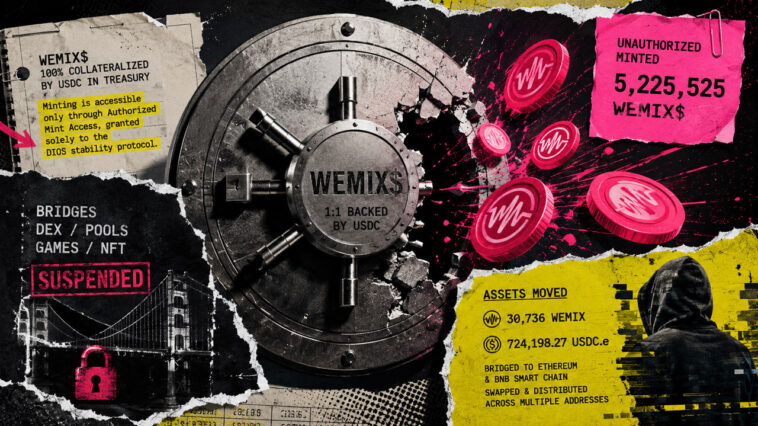
The WEMIX team said compromised ownership of a contract tied to its WEMIX$ stablecoin enabled approximately 5.23 million tokens to be minted without authorization, prompting it to suspend bridges, liquidity pools, and several services on the WEMIX3.0 network.
Contract-owner breach tested WEMIX$’s 1:1 design
The WEMIX3.0 whitepaper describes WEMIX$ as 100% collateralized by USDC held in a Treasury and says its supply should remain equal to the Treasury’s USDC volume. It also says minting is accessible only through Authorized Mint Access, which is granted solely to the DIOS stability protocol.

WEMIX’s preliminary incident update said the abnormal transactions began at 18:17 on July 26 (UTC+9), or 09:17 UTC, after ownership of a WEMIX$-related contract was compromised.
Taken together, the two documents show that owner-level control was used to produce tokens outside the whitepaper’s intended minting path. WEMIX has not disclosed the exact route by which that control was compromised, and its update does not establish that the USDC.e later moved by the attacker came directly from the Treasury.
 Related Reading
Humanity Protocol hack turns one laptop breach into an identity-token crisis
A $36 million H exploit shows how one custody failure can threaten a project built around digital identity trust.
Jun 10, 2026 · Liam ‘Akiba’ Wright
WEMIX said the 5,225,525 unauthorized WEMIX$ was converted into 30,736 units of the network’s native WEMIX token and 724,198.27 USDC.e, the bridged stablecoin used on WEMIX3.0. The company specifically said the converted USDC.e was bridged to Ethereum and BNB Smart Chain, swapped into assets including ETH and USDT, and distributed among multiple addresses. Some of those assets were later deposited at centralized exchanges.
The nominal number of tokens minted does not establish a $5.23 million loss. WEMIX has not issued a final loss estimate or identified the exchanges involved. It said some exchanges froze attacker-associated addresses after receiving cooperation requests, but did not quantify the frozen amounts or state whether individual user balances suffered losses.
 Related Reading
Polkadot Hyperbridge April Fools’ joke comes true as over 1 Billion fake DOT tokens were minted on Ethereum
A proof replay bug let the attacker mint over $1 billion DOT tokens on Ethereum, yet shallow DOT pools capped the cashout near $240,000.
Apr 13, 2026 · Olupapelumi Adejumo
Containment reached bridges, trading, games and NFTs
WEMIX’s July 26 response listed every bridge connected to and from WEMIX3.0 as suspended, including its Chainlink CCIP route and PLAY Bridge. The announcement did not attribute the compromise to Chainlink or report a CCIP failure.
CryptoSlate Daily Brief
Daily signals, zero noise.
5-minute digest 100k+ readers
Whoops, looks like there was a problem. Please try again.
You’re subscribed. Welcome aboard.
 Related Reading
Crypto users told to pull funds after Ethereum L2 bridge failure exposes rollup exit risk
The incident forced users to confront the part of rollup security that usually stays invisible: whether they can still withdraw when the bridge layer breaks.
Jun 23, 2026 · Liam ‘Akiba’ Wright
The update also listed trading in the WEMIX-USDC.e, WEMIX-WEMIX$, CROW-WEMIX$, TIPO-WEMIX$ and PLAY-WEMIX$ pools as halted. The WEMIX$ Module and PNIX DEX were paused, blockchain-linked features in some games were restricted, and NFT marketplace trading and bidding were disabled.
The disruption followed WEMIX’s September 2025 announcement that it would phase WEMIX$ out in favor of USDC.e while continuing conversions through the WEMIX$ Module. That module was among the services listed as suspended in the July 26 incident update.
WEMIX had not provided a reopening timetable in that update. The unresolved cause, final impact, frozen amounts and potential user losses leave the scope of the incident dependent on the company’s next findings.




GIPHY App Key not set. Please check settings