
Sydnie L. Mosley is a choreographer and the founder of SLMDances. Roxi Victorian is a choreographer, scholar, and dance educator. They became collaborators through Mosley’s The Window Sex Project, which uses dance-theater performance and community workshops to address gender-based sexual harassment.
Justice is not always loud. Sometimes it looks like two Black women—choreographers, educators, and community builders—laughing over the phone, refining choreography between rehearsals, or reflecting with students in a circle. Sometimes it looks like rage softened into rhythm, grief metabolized through sweat, or joy held deliberately in the middle of exhaustion.

For us, justice is practiced in the body—through African diasporic movement structures that allow us to gather, respond, refuse, and survive together. The circle. Call-and-response. Improvisation. Rhythm as grounding. Practices rooted in African diasporic traditions that continue to shape contemporary dance communities. These are not just stylistic elements; they are structures of care. These practices invite bodies often excluded from classical aesthetics—different shapes, histories, and movement vocabularies—to take up space and author their own stories. The curriculum of our engagements—how we gather, structure the circle, move, reflect, and iterate—becomes essential to the sharing itself. The process is not separate from the performance; it too is the performance.
As artists shaped by lineage and community, we have come to understand that dance is not separate from the world’s crises—it is how we move through them. What follows is a conversation about how that practice lives in each of our bodies in recent years.
Roxi: We laugh a lot when we talk. Sometimes about the work, sometimes about the absurdity of timing, sometimes because laughter feels like relief. We’ve known each other since 2020, when our paths first crossed through research and storytelling, yet we’ve never met in person. What began as an interview for my research on Black women choreographers grew into an ongoing conversation—rooted in recognition, familiarity, and a shared way of listening to the body.
It’s a connection carried through screens, voice notes, missed flights, canceled plans, and care for bodies that need rest. Still, the work keeps moving. Through shared understanding, we learned that community doesn’t require proximity, and embodiment doesn’t disappear when bodies are apart—it simply finds another way to travel.
As I prepare for us to finally meet, bringing Sydnie as an artist in residence to work through The Window Sex Project with my students in our new dance minor program at Southern University and A&M College, we find ourselves again sharing plans via phone and shared documents.
I remember leaving our first interview wondering if I had accomplished the task of gathering “data.” It felt too sisterly. Too cozy. Like couch tea and knowing glances—affirmative head nods and “Giiiiirrrl, yes”es. New to academic liberal arts research, finishing my master’s and entering my PhD studies, I wondered: How are Black women doing this? How are they researching, creating, expressing, teaching, and sharing methods with others?
But that was the data: the way our bodies recognized each other through breath, repetition, and defiance; the way laughter punctuated hard truths; the way questions deepened into a felt understanding that language couldn’t quite capture.
Sydnie: The Window Sex Project grew from that embodied questioning. I was negotiating rage and looking for care in community. I was searching for concrete solutions to sexual harassment in public spaces, but what I could feel—even before I could articulate it—was that dancing together was a way to metabolize that rage. To parse through a complicated web of body image, gaze, gender, and surveillance.
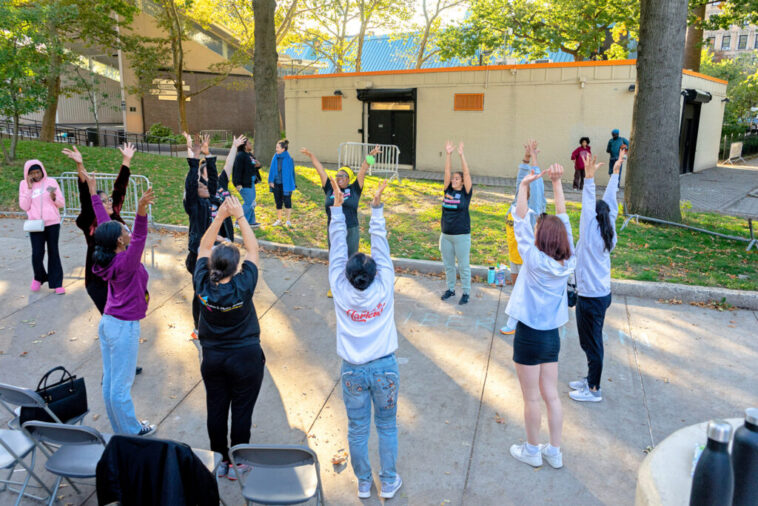
The circle became a container. We could see each other. Touch each other. Contribute—no fourth wall. No hierarchy. Just bodies practicing being present and taking up space.
Sydnie L. Mosley (center) leading a community workshop as part of The Window Sex Project. Photo by Jesus Calixto, Courtesy Mosley.
Roxi: I was in the middle of making the dance piece Mama’s Gun when we met. The work emerged from mothering while Black—the vigilance, tenderness, fear, hope, memory, and exhaustion that live in the body at once. It began in anger. The first movements spilled out aggressively—classical lines interrupted by guttural breaks. A schism between the outward presentation of a “safe” Black dance artist and the interior truth of a Black woman navigating protection and protest.
Over time, my anger shifted. It quieted, not disappeared but refined. The quiet work of tending to the bodies and spirits directly in front of you is powerful resistance. I began turning inward, focusing more intentionally on the work done with those communities: my children, the students I teach, the dancers and collaborators I create with, and the Black girls and young women whose embodied expressions shape both my scholarship and my artistic practice. Their experiences ground my work in the realities unfolding directly around me and guide my attention more than the noise beyond the room. Resistance becomes agency—activation, collective fellowship, and storytelling that ignites. These are the things I work toward in my work.
Sydnie: That resonates deeply. This past year, my body has been on a crash course through the medical system. As a freelance, self-employed artist with inconsistent health-care protections, I’ve had to confront questions about survival that feel painfully practical. What is a hospital’s actual function? How do we prepare marginalized folks to enter those spaces? How do we manage lost wages while healing?
In that context, joy feels urgent. Not frivolous—urgent. Holding space for softness and warmth feels like protest. Dancing in circles, gathering in the round, laughing in the middle of grief—these are not aesthetic choices. They are survival strategies.
Roxi: Yes, diasporic practices have always offered that in community, encouraging us to stay in our bodies and with each other, to hold memory in movement and the ritual of fellowship. In my studio classrooms—and increasingly in the curriculum I develop with my students—I move dancers out of rows and into circles, intentionally challenging rigid notions of power. The circle shifts how knowledge moves through the room. Rather than positioning the instructor as the sole authority at the front, it invites observation, call-and-response, and shared authorship. My teaching draws from African diasporic movement practices and Black social dance traditions, where rhythm, improvisation, and relational awareness guide the work. Students are encouraged to respond to each other, to notice how energy travels through the group, and to consider how movement carries memory, identity, and cultural lineage. In this way, choreography, discussion, and reflection become intertwined, and the classroom becomes not just a site of technique training but a space where students learn to move with responsibility to community. The goal is not uniformity—everybody looking the same—but collective function. What is the dance doing? What is the body offering?
The texture and fullness of the bodies dancing layer stories with resonant truths. Movement metabolizes grief. It amplifies pleasure. It transmits legacy.
Sydnie: And that’s where practice becomes justice—not performing justice, but practicing it. Iteration is a diasporic process. Each gathering refines the next. Each engagement carries memory forward. The work touches a community multiple times—through rehearsal, reflection, and sharing. It weeds out rigid power dynamics because the structure itself refuses them.
Justice, for us, is not a slogan. It is a structure. A circle drawn on a studio floor. Bodies responding to rhythm. Gatherings that redistribute power and reimagine possibility—rage refined into care. Joy cultivated as survival.
And we keep rehearsing it.
The post Collaborators Sydnie L. Mosley and Roxi Victorian Discuss Why and How Dance Can Become a Practice of Embodied Care and Justice appeared first on Dance Magazine.




GIPHY App Key not set. Please check settings