

tadamichi

Historical data shows that the vast, vast majority of investments perform poorly.
This is true for bonds, stocks, and real estate as asset classes. Nearly all of it makes for a bad investment for outside passive investors.
And what I’ll show in this piece is that this is both normal and unavoidable. And unintuitively, I’ll also show that it doesn’t mean that most of those investments shouldn’t have happened. But it does inform us a lot about how we should try to invest as allocators of capital.
A History of Duds
Whether we look at bonds, stocks, or real estate, the returns for most investments are bad. The top outliers account for most of the returns.
We can go through them one-by-one to quantify how bad they are:
Historical Bond Returns
The U.S. dollar was the second-best performing currency over the past century, second only to the Swiss franc. The United States was the largest economy in the world throughout this period, and the dollar rose to become the world reserve currency during this time. And yet, holding U.S. government bonds during their time of ascent and dominance underperformed simply holding gold.
Professor Aswath Damodaran maintains records of the performance of various assets classes going back to 1928. If you had invested $100 in T-bills (BIL) starting in 1928 and compounded them through 2023, you would have $2,249 by the end of 2023. If you had taken more volatility risk and instead invested in longer duration T-bonds (IEF), you would have turned $100 into $7,278.
That seems great at first, except for the fact that this is entirely due to dollar debasement along the way. If you had simply put $100 into gold (GLD), you would have turned $100 into $10,042. The number of dollars in the U.S. broad money supply increased by more than 400x from 1928 through 2023.
And gold holders were gradually diluted too. That’s why they only had a 100x nominal gain rather than a 400x nominal gain which would be in line with the money supply growth. Every year, the global supply of refined gold increases by an estimated 1% to 2%, which gradually impacts a gold holder’s purchasing power. If the supply of refined gold grows by an average of 1.5% per year, then after 95 years the amount of refined gold on the market will have increased by about 4x.
And the math checks out; each unit of gold increased in dollar price by about 100x, and there’s about 4x as much of it, and so the market capitalization of gold increased by about 400x which is in line with the money supply growth.
As a result of this gradual dilution, over the long arc of time a gold holder’s ability to purchase things like a barrel of oil has been pretty much flat, even as our ability to get oil out of the ground becomes better due to improving technology. Here’s the chart of the price of barrels of oil denominated in ounces of gold:
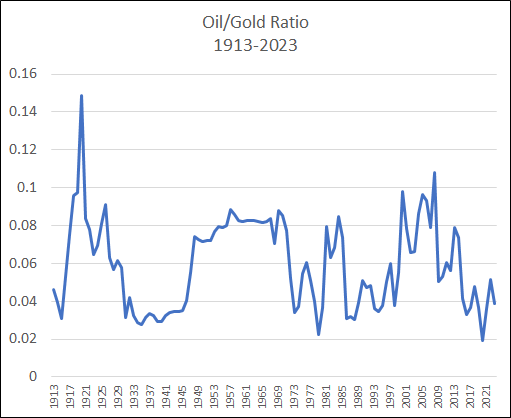
Lyn Alden, oil price data from EIA
A gold holder’s purchasing power gradually increases for things that we get exponentially better at making. A gold coin can buy more agricultural products today than it could a century ago, and more electronics, and more shoes.
But it’s not because gold appreciated, and indeed gold was gradually diluted. It’s just that gold was diluted at a slightly slower rate than human technology/productivity increased in aggregate, and so a gold holder maintained or gradually increased her purchasing power over time in practice. And she beat government bonds denominated in the world reserve currency, let alone every other currency.
Historical Stock Returns
Multiple studies over the years have shown that a tiny percentage of equities make up virtually all returns in equity markets.
Professor Hendrik Bessembinder compiled some of the most comprehensive datasets on this phenomenon.
For his U.S. study, he found that among 26,000 identified stocks between 1926 and 2019, more than half failed to outperform T-bills. But the reality is even worse than that. Just 4% of all stocks accounted for basically all stock market returns in excess of T-bills; the other 96% of stocks collectively matched T-bills as a group. And just 86 stocks accounted for half of all excess returns.
In other words, the majority of U.S. stocks historically underperformed T-bills, and then another big minority of stocks generated only minor excess returns over T-bills, and then a very small sliver of massive outperformers represented nearly all stock market excess returns over T-bills. And as the previous section showed, T-bills underperformed gold. And so, the vast majority of stocks failed to outperform the purchasing power of a piece of yellow metal.
And that’s for the United States, which had the best-performing stocks of the past century. For non-U.S. equities, the numbers are even worse. For his global study, Bessembinder studied 64,000 stocks from across the world over a three-decade period and found an incredible concentration of returns:
We study long-run shareholder outcomes for over 64,000 global common stocks during the January 1990 to December 2020 period. We document that the majority, 55.2% of U.S. stocks and 57.4% of non-U.S. stocks, underperform one-month U.S. Treasury bills in terms of compound returns over the full sample. Focusing on aggregate shareholder outcomes, we find that the top-performing 2.4% of firms account for all of the $US 75.7 trillion in net global stock market wealth creation from 1990 to December 2020. Outside the US, 1.41% of firms account for the $US 30.7 trillion in net wealth creation.
U.S. stocks as a group were among the best possible investments. Investing in the top 500 U.S. companies (SPY), and rotating them as necessary to maintain those top 500 as they join and leave that group over time, would have turned $100 in 1928 to over $787,000 through 2023 according to Professor Damodaran’s data. But as previously shown, that’s because a tiny percentage of them created enormous value while the majority failed to keep up with gold.
The international results were less stellar. And if Bessembinder had been able to run his international numbers for the longer 1926-2019 period then they would have been even worse. A large number of stock markets were completely nullified in their entirety at one point or another, due to the outbreak of war or a shift toward communism. Even the stock markets that made it through the past century intact generally underperformed the U.S. stock market.
Historical Real Estate Returns
Real estate has long been known as a good long-term investment. But is it?
Professor Aswath Damodaran’s records show that $100 invested into U.S. real estate in 1928 would have turned into $5,360 by 2023. That’s better than T-bills, but worse than T-bonds and worse than gold. If an investor levered it up they would have done much better, but we’ll get to that topic later.
To double-check this data, we can check Professor Robert Shiller’s dataset on real estate that goes back to 1890. His data shows that the nominal home price index increased by 88x from 1890 to the present. Meanwhile, the price of a unit of gold increased by 123x during that period. If the homeowner/landowner paid a small maintenance rate each year, as well as a recurring property tax each year, then the gap between those two numbers would have been even wider.
Of course, some real estate has performed very well. If someone bought Manhattan land at the turn of the 20th century, or land in Silicon Valley at the start of the venture era, those bets really paid off. Those were top percentile real estate performances.
But in contrast, significant amounts of real estate goes to zero if the city they are near decreases in population and economic activity. For example, there are abandoned properties all around Detroit. These are large once-expensive homes that are now rotting on parcels of land that nobody wants. And real estate can’t be moved if the economic situation or political situation in a region becomes untenable.
Most real estate falls somewhere between those extremes. It performs decently, especially when considering that it can replace the owner’s rental income or be rented out for cashflows, but after maintenance and taxes are considered, its unlevered total return from price appreciation and cashflow generation net of maintenance leaves something to be desired relative to gold.
And this mediocre performance in unlevered real estate occurred despite the massive population increase that occurred during the 19th and 20th centuries.

Our World in Data
Although rural and suburban residential land is rather abundant, if someone bought land in a good neighborhood near a city that grew substantially, their investment likely did well. But as population growth cools off, so do real estate prices. In Japan, there are millions of abandoned countryside homes that are nearly free. Many of them are in beautiful and safe rural areas, and yet there is insufficient demand for them. They have varying states of quality, but in aggregate they are now deteriorating due to abandonment.
Putting this all together, literally all government bonds have underperformed gold over the long run, and most unlevered real estate has underperformed gold as well. Stocks as an asset class greatly outperform gold, but only because the top 4% of them in the best-performing market do all the heavy lifting while the other 96% as a group don’t generate any excess returns.
Owner-Operators are the Winners
The numbers shown in the prior section are rather disastrous at face value; the vast majority of investments underperform gold. Does that mean they shouldn’t have been made in the first place?
The answer, especially for stocks and real estate, is that a lot of those investments actually made sense to do. But not necessarily for outside passive investors.
A big expense for companies consists of salaries for workers. This includes salaries for the founders and executives as well. And a young company is often owned by the founder/president.
If a reasonably successful company goes through its entire lifecycle from birth to death and fails to outperform T-bills or gold, it doesn’t usually mean that the company shouldn’t have existed at all. Along the way, it sustained salaries and work for many people, including the founders and executives and salaried employees. It provided products and/or services to customers, which improved overall human productivity and quality of life.
These businesses were often great for owner-operators and employees, and for customers, but not for outside passive investors.
Being an owner-operator of a business, or a worker at a business, makes a lot of sense. However, the vast majority of businesses are not strong enough to provide good returns for outside passive investors after all expenses (including salaries) are considered.
Good returns for outside passive investors are reserved for only the best types of companies; companies that are so dominant and high-margin that even after paying all of their executives and workers, they have plenty of excess profits for outside passive investors. Although stocks from any sector can have these characteristics, Bessembinder’s research found that major outperformers were disproportionally concentrated in the technology, telecommunications, energy, and healthcare/pharmaceutical sectors. They are on the right side of an emerging tech trend, they have network effects, they have economies of scale, they have protected intangible property such as patents, or they are part of an oligopoly, and so forth.
Real estate generally rewards owner-operators as well. As a real estate investor that owns cashflow-producing properties, the more work that you outsource, especially if the property is unlevered, the less likely there is to be excess profits for you above the rate of just holding gold. Unlevered cap rates of cashflow-producing properties tend to be quite low. However, someone who takes time to study different property markets, invest into select properties using leverage, build them or fix them up and selectively hire or contract people to help him, and then re-sell the homes or rent them out, can earn a good living from that activity. It’s his time and attention that is adding value and generating returns.
So the first answer to the question of why most businesses or real estate investments provide weak returns and yet still make sense to exist, is that you have to look at them from the perspective of owner-operators and workers (i.e. the inside active participants), not for outside passive investors. And the second answer has to do with leverage.
Turning Mediocrity into Wealth via Leverage
Historically, a key way to turn mediocre investments into good investments has been to apply leverage. That’s not a recommendation; that’s a historical analysis, and it comes with survivorship bias.
When leverage is used outside of certain contexts, it usually turns out disastrously. A lot of famous investors have well-known quotes about how leverage isn’t needed, and yet when you look at how they operate and what they buy, they typically do use leverage. In many cases, leverage is built into an investment itself, or held through multiple layers.
When you use leverage to own an investment (such as a business or some real estate), you’re borrowing (i.e. shorting) the abundant fiat currency and using it to buy things that have some degree of scarcity to them relative to that currency (such as decent businesses and properties).
When leverage improves a mediocre investment for outside passive investors, what’s really happening is that their fiat currency short is a good investment. And since leverage is dangerous, there are only a handful of ways to deploy large amounts of leverage safely. The mediocre investment in this context mainly serves as a decent platform for investors to attach a fiat currency short to, and then arbitrage a profit out of that difference.
Debt and Bonds
Large amounts of bonds are bought by banks or other levered entities. They borrow from depositors at a low interest rate for their liability side, while their asset side consists of higher-yielding and longer-duration loans and securities, including government bonds in many cases. Banks have historically often been levered around 10-to-1 or more.
This allows them to earn a high return on their capital. They profit greatly from the spread between the rate they borrow from depositors at and the rate they lend at or the rate they own securities at.
Other financial institutions engage in similar leveraging, where they use government bonds as collateral for loans, or other similar arrangements.
Debt and Real Estate
Real estate is the most leverageable asset for most investors. Within the context of the fiat currency system, it has been both quantifiably workable and socially acceptable to own real estate with 5-to-1 or even 10-to-1 leverage. People who are not professional investors will routinely put 20% down and borrow 80% of the value of a home, with various options to increase that to 10/90 in some cases, because we set up our financial system around this being a normal thing to do.
This occurs for a couple reasons. One is that real estate on average is less volatile than equities. A second is that it is much less liquid; a house gets appraised less frequently than a stock does, and there are significant costs of both time and money to buy or sell a house and to move from one house to another. As a result of these two things, real estate debt is generally not call-able, meaning that as long as she is making payments on time, a mortgage borrower doesn’t get liquidated and become forced to sell her house if the house price dips below the borrowed amount, which would be the case for most other types of leveraged collateral.
After maintenance and recurring taxes, the majority of unlevered real estate, even when rented out for cashflows, doesn’t outperform gold. But unlike gold, 5-to-1 leverage makes real estate actually pretty good in many contexts, and historically allows it to outperform gold. Real estate’s reputation as building wealth has been well-deserved in practice due to this fact. And of course, the true winning combination has been to own the top-decile performing properties and lever them.
Debt and Stocks
Large corporations do the same thing as real estate investors, but at lower rates of leverage.
If a company is successful enough to become one of the largest thousand companies around, they tend to have excellent access to corporate bond markets. They can borrow large amounts of money for decades at low interest rates, and use that capital to organically expand their business, buy smaller companies, or buy back their own shares. Either way, they are borrowing abundant fiat currency at low rates and using that capital to build or buy business equity, and they are arbitraging that spread for shareholders.
Consider Procter & Gamble (PG) for example. The company was founded in 1837, and has been profitable virtually every year for decades straight. And yet they have over $24 billion in long-term debt. Why? Because they’re using that debt for the purpose of financial arbitrage. It’s how they improve equity returns. They issue bonds with durations of ten or twenty years in many cases, and historically at very low interest rates that are nearly as low as government borrowing rates. And they use those proceeds to make acquisitions or buy back their own shares. As their debt matures, they refinance it into more debt. They voluntarily keep tens of billions of debt on their books on a permanent basis because it’s a permanent fiat currency short.
Many of Procter & Gamble’s bonds were issued when rates were below 1% or 2%. Those are long-term fiat currency shorts, and they were some of the best investments that the company ever made:
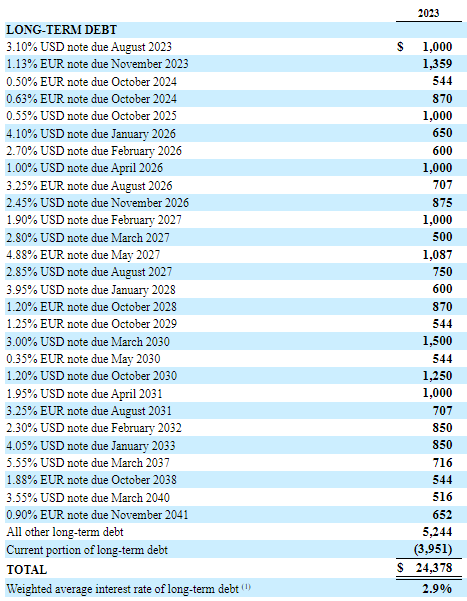
Procter and Gamble 2023 10k
You can think of it in the following terms. In developed markets, the broad money supply historically grows by 6-9% per year on average. In the United States that figure has been around 7% per year on average over the long term. If a real estate investor or a corporation can borrow at 1% or 3% or 5% rates in that context, then their borrowing rate is less than the money supply growth rate. The buyer of those bonds gets diluted over time relative to the growth of the money supply, while the seller of those bonds has effectively shorted them, and can deploy the capital into scarcer things like equity and property.
A lot of blue-chip companies do this. They have among the lowest cost access to debt in the world, and so they use it. Starting in 2013, Apple (AAPL) began taking out $108 billion in low-interest debt and using it to buy back their own shares. They’re the most successful company in modern financial history, and yet like everyone else, they began using debt as a strategic part of their capital structure because they benefit from arbitraging the spread between 1) shorting abundant fiat currency and 2) buying scarcer things including their own equity.
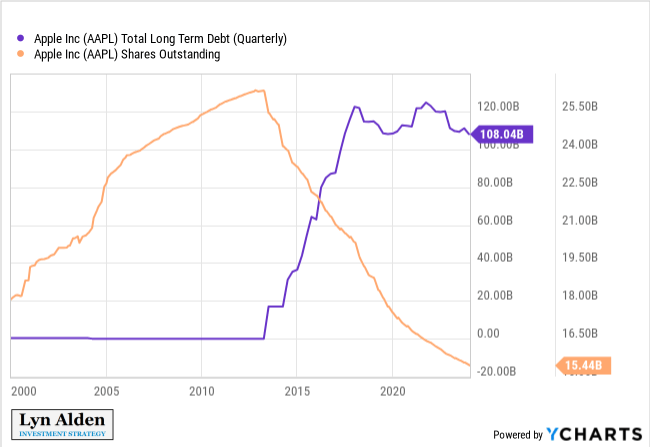
YCharts
Warren Buffett and his company Berkshire Hathaway (BRK.B) have taken this a step further, by arbitraging an insurance float.
Insurance companies take in customer premiums, and pay out customer claims. In between those two activities, they hold capital as a “float” and they typically invest that float into bonds. An insurance company is leveraged in this way, and its borrowing is basically in the form of a zero-rate loan from its customer premiums. In many cases, an insurance company will break even in terms of paying out as many claim dollars as it takes in dollars from premiums, but it makes a net profit anyway due to holding interest-bearing bonds with that zero-rate float.
Berkshire Hathaway is one of the biggest insurance companies in the world. But Warren Buffett deploys a sizable percentage of that float into stocks rather than bonds. And the stocks he buys often use leverage as previously described. He owns or has owned big stakes of companies like Apple, Procter & Gamble, Coca-Cola (KO), Chevron (CVX), Kraft Heinz (KHC), and many others. These are blue chip companies that purposely use a lot of low-rate corporate debt despite being persistently profitable companies. He also has historically invested in a lot of banks, which make use of leverage even more. And then Berkshire as a corporation also issues long-term low-rate bonds, in addition to having leverage from its insurance float.
So Berkshire Hathaway is a big leveraged insurance company that borrows a lot of money at low rates and deploys that capital into companies who are also leveraged at low rates. For the full stack, there are multiple layers of low interest rate borrowings built on top of one another, and that capital is redeployed into scarcer business equity and property. That spread, across all those layers, creates tremendous wealth for people using this strategy relative to those who are long currencies and bonds. Buffett makes sure to focus on low-volatility long-term compounding stocks with economic moats to deploy this strategy on, which keeps the risk in check.
Berkshire has also made a habit out of buying small and medium sized private businesses in full. Many of these smaller companies would have higher borrowing costs if they were independent. But Berkshire can buy a lot of them, and then issue corporate debt at the parent company level at much lower interest rates than any of them could issue on their own. So he can buy a lot of unlevered cashflow-producing small or medium-sized businesses, and turn them into a portfolio of businesses that are levered with Berkshire’s very low cost of capital.
This has been incredibly effective, because the larger it has become, the lower the cost of capital has become. Buffett understood this well from the start, and reached critical mass with this strategy.
A lot of Berkshire’s wholly-owned businesses and stock positions would be somewhat unremarkable if they were unlevered. But decent business operations, if their cashflows are stable enough, make excellent platforms to attach fiat currency shorts to. And a mediocre but reliable business with a long-term low-cost fiat currency short attached to it, has been an excellent investment.
Even within the past few years, Berkshire borrowed a lot of yen at ultra-low rates, and used it to buy the Sogo shosha Japanese stocks, which have a lot of hard assets and positive cashflows (and which have their own yen-denominated corporate debt as well). It was an excellent move; Buffett’s company benefited both from decent operations by the Sogo shosha stocks themselves, as well as the spread between them and the rapidly devaluing yen short that was used to buy them.
A Game of Financial Blackjack
In the card game of Blackjack, the goal is to get as close to 21 as possible with your cards, but without going over 21. If you go over, you automatically lose.
Over the past four decades in particular, the global financial system has rewarded players of financial Blackjack. Entities that borrow money and use it to buy scarce assets, but in a prudent enough way that they are not among the first wave to blow up in a recession, have been the winners. You want leverage, but you don’t want to “go over”.
This has been a key contributor to growing wealth divide among individuals, and a key contributor to the performance gap between large and small companies. Larger and wealthier entities, as they grow larger and wealthier, get even better access to low cost capital, which gives them even more of an advantage. It’s a virtuous cycle for a while. Larger entities have access to lower costs of capital on a hard money system to some extent, but ever-devaluing fiat currency is a supercharger for this trend because the arbitrage from having good access to credit is way bigger than it is with a hard money system.
Within the current financial system, those who do not use leverage generally lose. Those who leverage too much or too unskillfully and “go over” also lose. But those who leverage moderately and skillfully have been the winners. They enjoy a multi-trillion-dollar annual arbitrage by shorting abundant fiat currency for long durations at low interest rates and using it to buy scarcer business equity or properties.
If you don’t play the game as an investor, you usually lose because leverage drives up the valuations for your potential investments. A key reason why cap rates on real estate are so low, is that so many people buy them with leverage. If there was no significant leverage available for them, then unlevered cap rates would need to be higher to incentivize the investment, but with the existence of many people using leverage for them, it drives down the cap rates and makes them into typically low-returning investments for anyone desiring to own cashflow-producing properties unlevered.
And because it’s a global game, the players have a huge gameboard to use this strategy on. If one currency becomes too hard for this strategy to work, they can make use of jurisdictional arbitrage and deploy their capital somewhere else. There are approximately 160 fiat currencies out there. Dozens of them have decent liquidity and capital markets. Investment firms can borrow (go short) the yen and buy (go long) Brazilian assets. They can borrow (go short) the euro and buy (go long) American assets. The permutations of this strategy have been very abundant for decades.
I say “they” but of course I include myself here as well. I borrow American dollars or Egyptian pounds for multi-year durations at low rates and deploy it into scarcer property. I own equities that borrow for long durations at low rates and deploy it into scarcer business equity. I benefit, both directly and indirectly, from the spread between shorting abundant fiat currency and longing scarcer property and business equity. This has been the winning strategy.
The Changing Game Rules
The properties of the fiat currency system have incentivized debt accumulation and the playing of this global game of financial Blackjack.
Four decades of falling interest rates have been a huge tailwind for this strategy, since debts could continually be refinanced at ever-lower rates, and increasingly at rates that are very low relative to the rate of money supply growth. Additionally, large numbers of open capital markets in an increasingly connected world have made it possible to arbitrage between jurisdictions as well.
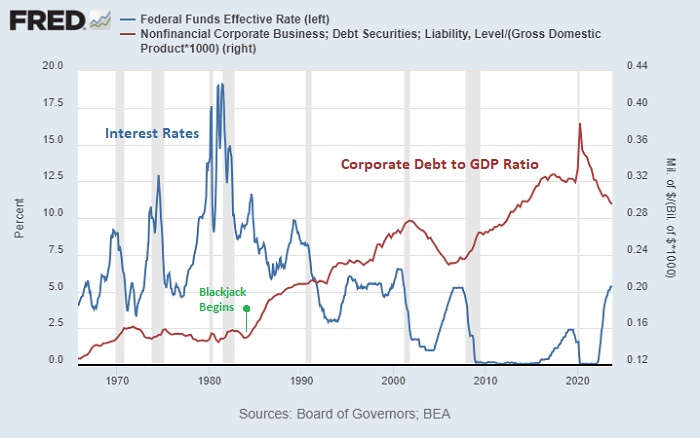
St. Louis Fed
Now, after interest rates bounced off zero in developed markets and may start going structurally sideways instead of structurally down, the effectiveness of that strategy is likely to diminish.
And as governments around the world increasingly have high debt at their sovereign level, they become increasingly incapable of sustaining high positive real yields for long periods of time, which makes it harder for them to convincingly fight inflation. Countries that face acute fiscal issues often turn to capital controls, which impairs the game of global financial Blackjack. It happened all the time in developed countries from the 1930s into the 1970s, and still happens all the time more recently in various emerging markets.
High public debt often produces the drama of default and restructuring. But debt is also reduced through financial repression, a tax on bondholders and savers via negative or below-market real interest rates. After WWII, capital controls and regulatory restrictions created a captive audience for government debt, limiting tax-base erosion. Financial repression is most successful in liquidating debt when accompanied by inflation. For the advanced economies, real interest rates were negative ½ of the time during 1945–1980. Average annual interest expense savings for a 12—country sample range from about 1 to 5 percent of GDP for the full 1945–1980 period. We suggest that, once again, financial repression may be part of the toolkit deployed to cope with the most recent surge in public debt in advanced economies.
–The Liquidation of Government Debt, IMF Working Paper 2015/007
Geopolitical conflicts are likely to further add barriers between the free movement of capital. Whether it’s kinetic wars or trade wars or financial wars, as large groups of countries increasingly have tensions between each other in terms of strategic interests and run into their own fiscal dominance issues, the frictions on global capital movement have a high likelihood of increasing.
So, the effectiveness of this global financial Blackjack strategy is likely going to diminish, although entities that already locked their debt in for long durations are potentially in a position to ride the momentum for quite a while longer.
The types of investments that worked well during the past four decades are less likely to work quite as well over the next four decades. The virtuous cycle of ever-lower interest rates, ever-higher private debt levels, and ever-higher equity valuations, is likely getting past its prime, and is at risk of rolling over into a vicious cycle in the other direction.
And in that shifting environment, it’s important to remember that most investments are bad. The majority of unlevered businesses are not strong enough to produce returns for passive investors that outperform T-bills or gold. The majority of unlevered real estate properties, after maintenance and operation and taxes are considered, also fail to outperform basic assets like gold.
So in that environment, from the perspective of a passive outside investor looking to deploy capital, it’s important to either seek out the businesses that have durable competitive advantages (network effects, powerful brands, intangible property, economies of scale, oligopoly participation, and so forth), or to be very sensitive to valuations when buying mediocre companies.
The prior four decades are unlikely to be a good dataset for back-testing and forming strategies that will work for next four decades, because the conditions will likely be quite different.
For equity and real estate investors, the key takeaways from this piece are 1) do not extrapolate the prior decades for a given investment and instead assess it with this context in mind, 2) try to emphasize the sectors that Bessembinder identified as ones that disproportionally generate excess returns, and 3) look for companies that have locked in or are otherwise still able to play this arbitrage game going forward in a more difficult environment for it.
Additionally, hard monies become a serious alternative once again in this context, and are worth serious consideration for a portfolio slice, because the hurdle rate for stocks to outperform them is high when there are not a lot of tailwinds at the backs of stocks.




GIPHY App Key not set. Please check settings