
Dance Theatre of Harlem’s Firebird—with choreography by John Taras, costumes and scenery by Geoffrey Holder, and a cast of more than 40 dancers—caused a sensation when it premiered in January 1982. New York Times critic Anna Kisselgoff declared the fantastical production, which relocated the Russian folktale to an enchanted forest somewhere in the Caribbean, an “instant hit” that sent audiences “into a whooping spell of delirium.” Firebird became a popular feature of the DTH repertoire. But it disappeared in 2004, when financial constraints forced the country’s first long-standing Black ballet company to go on hiatus. Even when a scaled-down DTH returned in 2008, Firebird, with its large cast and elaborate costumes and scenery, remained on the shelf.
Now, after more than 20 years, this jewel of a ballet has been painstakingly reimagined and remounted, thanks in part to a partnership between DTH and the University of North Carolina School of the Arts. The ballet’s February performances at Paris’ Palais des Congrès once again had audiences in raptures.

“DTH is back to the company its founder Arthur Mitchell loved so dearly, both in scale and artistry,” says current artistic director Robert Garland, discussing Firebird and the remarkable efforts that made its revival possible. His excitement—and the credit for the recent production’s success—is shared by an extended family of DTH dancers, alumni, and supporters. Many of them contributed their embodied knowledge and memories of working on previous iterations of the ballet. Ahead of the refreshed work’s run at New York City Center this April, several of these artists spoke about their roles in Firebird’s momentous reconstruction.
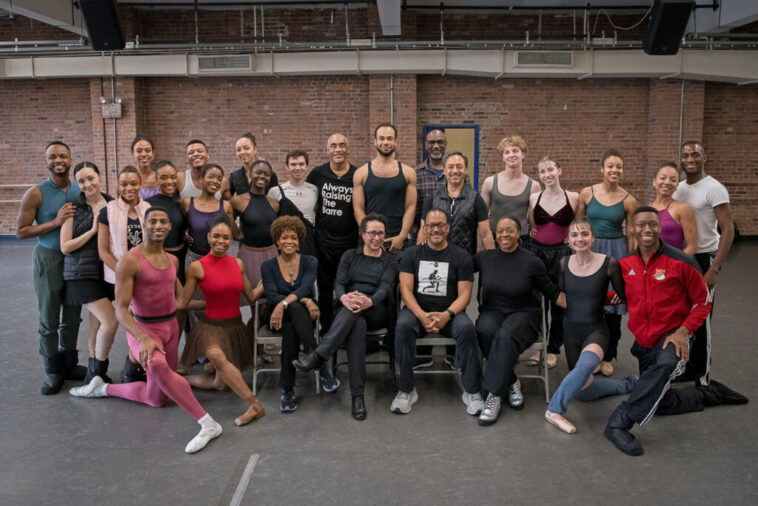
Dancers and leaders from DTH and University of North Carolina School of the Arts during Firebird rehearsals. Photo by Cherylynn Tsushima, Courtsey UNCSA.
On the Inspiration for Remounting Firebird
Endalyn T. Outlaw, DTH alum and dean of the School of Dance at UNCSA: About four years ago, a colleague from the UNCSA School of Music came to me and said, “We want to do a Stravinsky piece for our symphony orchestra, something that we can play live. Is there a ballet that you have that we can play?” I said “The Firebird would be perfect. The Firebird that I feel is truly the most magical, Dance Theatre of Harlem’s Firebird.” I wanted to respect the authenticity of what Firebird meant to me, the signature work that it was for DTH.
Robert Garland, DTH artistic director: Thanks to Endalyn’s inspiration, the school’s orchestral program recorded Stravinsky’s Firebird suite, and the school’s dancers performed some of the ancillary roles of Firebird maidens and monsters. (UNCSA students are now supplementing the principal cast in the full DTH production.)
 Members of the Firebird revival creative team. Photo by Rachel Papo, Courtesy UNCSA.
On Passing Firebird to a New Generation
Garland: I have wistful memories of the lovely Stephanie Dabney as the original Firebird, and Lorraine Graves as the original Princess of Unreal Beauty. (Both Dabney and Graves passed away recently.) I’m one generation after the original DTH members who danced Firebird. For the remount, I knew I needed to engage dancers from that last company that worked with Mr. Mitchell before the 2004 hiatus. So, Iyun Harrison and Naimah (Kisoki, formerly Willoughby) helped with the Firebird monsters and maidens. Of course, we also engaged Donald Williams, the original Young Man, and Charmaine Hunter, a second Firebird after Stephanie. So, there was an overarching alumni support system engaged for the entire process.
Charmaine Hunter, DTH alum: I danced with DTH from 1977–2002 and became ballet mistress after 2002. I was asked to restage Firebird because I danced every role. I always hung out in the studio when John Taras was staging the ballet on Stephanie. Mr. Mitchell was very careful to select pieces he knew we could dance. With Firebird, John Taras created a ballet for the bodies in front of him. I remember the notes he gave Stephanie: “A little bit more flutter, dear,” or “Get to fifth before you soutenu.” He would coach her and describe the movement quality he wanted. I shared those notes with Alexandra Hutchinson.
Alexandra Hutchinson, current DTH dancer: Charmaine is such a positive force. It’s a technically challenging role, so she helped push me and encouraged me to take it to new heights. I think a big part of the role is that it was created on Stephanie Dabney, and her body was so bendable—she really embodied the bird energy. Charmaine said that going into the role as a dancer, she found moments to pay homage to Stephanie, but also to add her own flavor to it.
Hunter: Alexandra added artistic layers and technical layers with every single rehearsal. She had all the nuances—the little flurries, the fast footwork, the head, the strong back, the arms that just didn’t seem like they had bones, the energy went all the way to her fingertips while the toes were reaching to the other side of the room.
Iyun Ashani Harrison, DTH alum: I first joined DTH in 2001, and I was one of the monsters in Firebird. What we reconstructed is partially from body memory, and partially from videos from four different decades. It was frustrating, and fun—a community effort across multiple generations. To Robert’s credit, he chose two corps de ballet members, me and Naimah (Kisoki), to stage the corps section. Typically, the principal dancers are asked to do all of this work, but they don’t perform the corps roles.
 Top row: Original Firebird Stephanie Dabney. Bottom left and center: Bethania Gomes in an early production of Firebird. Bottom right: One of Geoffrey Holder’s costume sketches for Firebird. Clockwise from top left: Photo by Martha Swope, Courtesy DTH (3); Photo by Metcalf Collection, Courtesy DTH; Photo by Eduardo Patino, Courtesy DTH (2).
On Learning Firebird in Arthur Mitchell’s DTH
Donald Williams, DTH alum: At first, I was second cast with Elena Carter-Wyatt. Mel Tomlinson was first cast with Stephanie. Then Mel got injured. It was kind of my breakout season. John Taras was meticulous about making the steps clean and telling the story. Mr. Mitchell made sure we put our DTH stamp on how we portrayed roles. He called it “bringing the magic.” There were moments he would ask us to bring the “ZAH!” and John Taras would be like, “Ahhh! That’s what it needed.” They were on the same page with Firebird. That’s why it was so successful.
Hunter: (John Taras emphasized that) the feet have to be as pristine and clean as possible. How do you do that when you have to be otherworldly on top? It’s a matter of putting the two aspects together to create this magical bird. When the Prince comes in, there’s that flutter. You don’t want him to touch you, but he’s calming you so that you can have a conversation during the pas de deux. The key is how you use your head. When she looks at him, it’s not a slow look, it’s a sharp, deliberate look. And during the pas de deux when she leans her head on his face, it’s to show trust.
 From left: Current DTH artists Kamala Saara and Brockington in Firebird. Photo by Rachel Papo, Courtesy DTH.
On Geoffrey Holder’s Distinctive Designs
Williams: Geoffrey Holder’s costumes, as soon as I put on those shorts and the crown and the outfit, I had to carry my body a certain way. The costume made me feel like I’m presenting this elegant, exotic, noble prince in the tropics. Immediately, I felt the character I was supposed to be. It transformed me into someone else.
Hunter: Geoffrey Holder was just brilliant. He created a look that had a hint of nudity on these dancers of color, while also bringing in a certain level of the mystical, the magical, the otherworldly. He just transformed the stage into a realm of color, movement, and wonder.
Leo Holder, son of Geoffrey Holder and fellow dance icon Carmen de Lavallade: I have this saying: If you graduate from Carmen and Geoffrey University, you’re going to have a flair for the dramatic, and you’re going to know, more or less, what works. With this (new) production, I also wanted to hear second opinions. So we brought in Vernon Ross, (a costume expert) who danced with DTH (when Firebird premiered).
Stephanie Dabney is no longer with us. Donald is no longer the Prince. These are new dancers, and we had to make it theirs. So with the costumes, we went for 2.0—we went for what it was supposed to be today. One dancer may be a slightly different shade from the other, and how does the costume play off of that? We had to have the Firebird’s costume tweaked. We had to take this down and reshape that.
 From left: Current DTH artists Derek Brockington and Jhaelin McQuay in Firebird. Photo by Rachel Papo, Courtesy DTH.
On the Impact of Firebird on the Dancers
Theara Ward, DTH alum: Think about the title of the “Princess of Unreal Beauty.” When I heard that I was like, What? They’re telling Black women to be unreal and beautiful! I had to shed some things to see myself as beautiful back in the 1980s. I was told I was too tall, too big, too fat. I was a teenager. But Mr. Mitchell said, “Theara, learn Unreal Beauty.” He and Mr. Taras wanted us to be beautiful, and that meant something at that time.
Naimah Kisoki, DTH alum: I first saw Firebird at New York City Center—I might have been 10 years old. I was a little ballerina in training in a company where there were no people who looked like me. So coming to DTH in 1999 was phenomenal. Mr. Mitchell groomed us to perform for something larger than ourselves. I stayed until 2004, when the company abruptly closed.
When I came back for this project, I didn’t know what to feel. But then I peered into Studio 3, and I started to cry. All of the 40 dancers participating in Firebird were in the studio. There were so many bodies that you couldn’t find space at the barre. It was like, “Yes, I’m back here, and this is what I’m meant to be doing right now—passing the torch.”
The post The Mystical, Magical Return of Dance Theatre of Harlem’s Firebird appeared first on Dance Magazine.




GIPHY App Key not set. Please check settings