
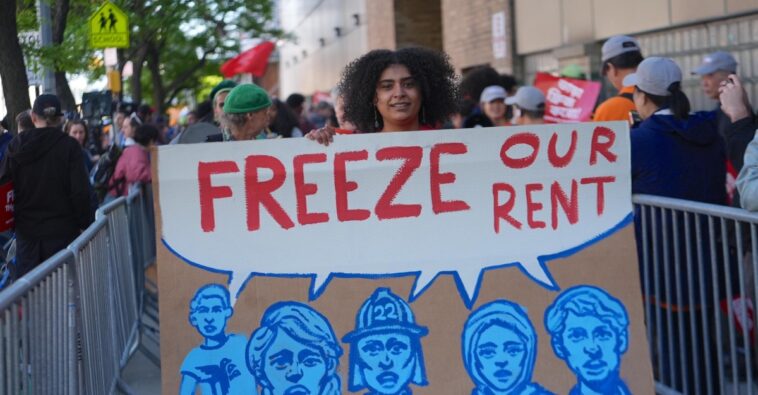
As America’s housing crisis deepens, policymakers are increasingly turning to an old idea for improving affordability: making large rent increases illegal.
In recent years. Oregon, Washington, and California have enacted statewide rent controls. In 2024, the Biden administration floated a nationwide cap on rent increases for large buildings. And last month, New York’s Rent Guidelines Board approved a two-year rent freeze on the city’s roughly 1 million stabilized units, fulfilling one of Mayor Zohran Mamdani’s signature campaign promises.

• Rent control measures tend to be enacted in cities where housing construction is already constrained by other factors.
• It’s not clear that rent regulations discourage homebuilding, when new construction is exempted.
• If poorly designed, rent control can negatively impact the quality and supply of rental housing.
While rent control has long had some appeal to voters, it has historically provoked consternation among economists. In one 2012 survey, just 2 percent of economists agreed with the statement that local rent regulations “had a positive impact over the past three decades on the amount and quality of broadly affordable rental housing.”
The reasoning behind such skepticism is simple: When you make it less profitable to provide rental housing, people produce less of it. As a result, rent control reduces the supply of housing — and thus tends to make cities less affordable in the long run.
But this orthodoxy may soon be overturned – or so argues J.W. Mason, chair of the economics department at New York’s John Jay College of Criminal Justice and a senior fellow at Groundwork Collaborative, a progressive think tank.
In Mason’s view, the evidence that rent regulations discourage construction has been widely overstated: When designed well — and paired with zoning reforms — rent controls can protect tenants from displacement without reducing the long-term supply of housing.
We spoke this week about the case for (and against) rent control in general and New York City’s policies in particular. Our conversation has been edited for clarity and concision.
Among mainstream economists, conventional wisdom holds that rent control measures are misguided, partly on the grounds that they reduce the long-term supply of housing. In your view, what does that analysis get wrong?
When we talk about rent regulation, we’re typically talking about markets where there are already very substantial constraints on housing supply. Nobody is trying to pass rent regulation in exurban Texas or the Atlanta suburbs, where you have a lot of new housing construction.
Where it’s relatively easy to build housing, rents are going to be closely tied to the cost of building and operating new housing because, if you charge a lot more than that, then you create an opportunity for competitors.
The markets where you have rent regulation are markets like New York City, San Francisco, and a lot of European cities — places where there’s already really hard constraints on the capacity to build new housing. And in cases like that, where supply is already constrained by land use rules or just by an absolute scarcity of buildable land or by other factors, you’re not going to get any additional limitation on supply from rent regulation.
In that context, owners of existing housing collect rents in the broad, economic sense — income that doesn’t derive from any contribution they’ve made to production, but merely from others’ inability to build. Under those conditions, the only thing rent regulation does is redistribute some of that economic rent from property owners to tenants.
Most critics of rent control oppose restrictive zoning too. So, I think they might say that we should focus on ending the conditions that allow landlords to extract economic rents in the first place, rather than on redistributing them.
There’s an argument that, if we could achieve deep supply-side improvements in housing, we wouldn’t need rent regulation to the extent that we currently do. And I think that’s a perfectly reasonable argument. But it does not do any good for tenants who are facing displacement today. The fact that you have a different long-term goal does not remove the need for dealing with the short-term problem.
And there are good reasons to think that rent regulation is desirable, even if we think the real problem is on the supply side. For one, I think the politics of dealing with supply issues are much easier if you also have rent regulation. A lot of opposition to addressing supply-side problems is a perception that if you get new development, then that’s going to lead to displacement of people in the areas where development is taking place.
We can debate how true that is. But it’s a very deeply held perception. So, to the extent that you can offer real security to existing tenants, you remove one of the big sources of public opposition to supply-side measures: You don’t need to oppose removing restrictions on new housing because you are locked in. You are safe. Your landlord cannot kick you out to get somebody higher-paying in.
And honestly, I think that politics is very clear here in New York. I think that you would not have gotten the City of Yes land-use reforms, or the zoning reforms that passed on the ballot initiatives this past year, or a progressive like Zohran Mamdani coming out in favor of supply-side measures to increase housing production, if we had not strengthened the rent laws back in 2019.
Putting the politics to one side, do you think there is any tension between restricting rents and increasing construction? Say a city rolls back some of its restrictions on homebuilding, and new construction stops being effectively capped by zoning rules. If that city adopts rent controls, will that reduce the supply of housing at the margin? Or is that supposed tradeoff entirely illusory, in your view?
There’s no deterrent effect to many rent regulations, including those in New York City. Obviously, you can hypothetically imagine a much more rigorous form of rent control that could discourage new construction. I’m not going to say that it is impossible for that to happen. I think that we’re just very far from that point.
This is largely because new construction is typically exempt from rent control. In New York City, you are only required to comply with rent regulations if your building is more than 50 years old. And developers aren’t deciding whether to build based on how much rent a project will yield 50 years in the future.
The longevity of housing just makes it different from other goods. People often say, “If you impose a hard cap on milk prices, people will find it less worthwhile to produce milk. And we’re going to have shortages of milk in the stores.” We can debate whether that’s always true. But it’s a reasonable argument, since milk is consumed shortly after it’s produced. So your decision to produce more milk really is based on the price that you can get for that milk today.
But housing is at the opposite extreme. The median building in New York is 80 years old. When that housing was first produced, the price it’s going for today was not a factor.
Now, I should add that in New York City, the buildings with the highest rates of rent regulation are actually newer buildings. But that’s because developers voluntarily opt into the rent regulation system, as a condition of getting tax subsidies. At that point, clearly you’re not having a negative effect on supply when this is a voluntary decision.
Is that necessarily true? In theory, the tax subsidies are supposed to encourage housing investment. And developers weigh the benefit of those subsidies against their costs: If you accept them, you need to provide some units at below-market rates. So, if New York City makes providing rent-stabilized units less profitable — by freezing rents — then don’t the subsidies become less valuable? And wouldn’t that theoretically make investors slightly less inclined to fund new housing, all else equal?
Well, we’re seeing more new housing constructed in New York City right now than we’ve seen in many decades. So clearly something is working. And maybe what’s working is just that incomes are rising, that demand for housing in the city is rising.
But in my opinion, the tax abatements are badly structured. I really would not support housing development that way. But a huge fraction of new housing that gets built in the city uses these tax credits. So I think clearly they’re attractive to developers. Clearly, it’s a worthwhile trade-off.
For critics of rent control, one study looms especially large: In 2018, a team of Stanford economists examined the impact of San Francisco’s rent control expansion in the 1990s. And they found that the policy led to a 15 percent reduction in the rental housing supply, which pushed up rents in the city by 5.1 percent. But in my understanding, you think the implications of that research are widely misinterpreted.
Yeah. I think that’s really a study about poor regulatory design. What it shows is: If you impose strict rent regulations — but you don’t restrict people’s ability to convert rental properties to other uses — that may encourage landlords to convert rental housing into condos.
In the study, rental housing supply did not fall because of a decline in new construction. It fell because of condo conversions. And that distinction is important. If you have rental housing that’s converted to condos, that’s not reducing the overall supply of housing, but only that of rental housing. And it’s not necessarily increasing the cost of housing: It may be increasing market rents in the unregulated sector, but decreasing the cost of condos for condo buyers.
In any case, a well-designed rent regulation, like New York City’s 2019 reforms, can simply disallow people from moving housing out of the rental market in that way.
Many have argued that rent stabilization in general and New York City’s 2019 reforms in particular have negatively impacted the quality of the housing stock. Specifically, the argument is that landlords respond to rent restrictions by cutting back on maintenance. Is that a serious risk?
Of all of the concerns that you’ve raised, that is the most legitimate. I don’t think that we’re really seeing that yet. If anything, we’re seeing a reduction in a number of units that seem to have severe maintenance problems in New York. But you know, some people think we should not just have a rent freeze here, but a rent rollback. So, you roll back rents by five, 10, 15, 20, 25 percent, you’ll eventually reach a point at which you have real problems with building owners not doing basic maintenance and buildings falling into disrepair.
I’m not sure what the number is. But clearly there’s a number where that happens. But I think we’re a very long way away from that. The vast majority of buildings are renting for much more than their operating and maintenance costs. The Rent Guidelines Board does studies. They suggest that the median margin is on the order of 40 or 50 percent.
As you’ve written, there is a minority of stabilized buildings in which maintenance and operating costs already exceed their total rents. But you attribute that primarily to the poverty of such buildings’ tenants, rather than to excessive restrictions on market rents?
I think that’s generally the case. There’s a sector of nonprofit-owned buildings, which tend to be the ones with the lowest rents and the lowest-income tenants. And in many cases, those buildings do face real problems with maintenance and upkeep. But they’re often not increasing rents even by the regulated amount, since tenants in these places simply can’t afford to pay more. In those cases, I think at some point you need either targeted subsidies or a change in ownership. But this is a very small fringe of buildings.
To name one last criticism of rent control: Some economists argue that it promotes an inefficient allocation of housing. The argument being: If you let people pay a below-market rent — on the condition that they don’t move — then you’re encouraging them to stay in place. And this leads to things like, for example, empty-nesters continuing to occupy three-bedroom apartments, which would have more utility for younger families.
I think we should recognize that there is a legitimate social interest in saying: Somebody who’s lived in an apartment for 15 years has a right to remain there, even if their landlord decides they could get a higher income by renting to somebody else. I think that’s a perfectly reasonable social goal.
And I think doing that actually makes the housing market more flexible and efficient. Why? Because it means that there’s less pressure to become a homeowner in order to get that security. Right now, in most markets, if you want security of tenure, the only way to get it is through ownership.
And ownership really locks you in. The transaction costs from buying and selling a house are very large. And obviously, in many cases, you get a financial risk, since a house is your main form of savings. If you sell at the wrong time, you lose a lot of money. So we get people who are locked into houses. They don’t have the same degree of geographic mobility. They can’t move to where the job opportunities are better. They stay in a big house even after their children are grown, which would really be better used by a younger family. If we give more security of tenure to renters, more people will choose to rent, and we’ll have actually, I think, a more flexible and efficient housing market.




GIPHY App Key not set. Please check settings